The suburban mystique
Let the Right One InThe suburban mystique names Blackeberg’s defining paradox: a place that seems to have no riddles because it appears to have no past. Its modernity offers freedom from inherited mysteries and terror, yet that same confidence helps leave its residents unprepared for what arrives there.
A Place Without a Past
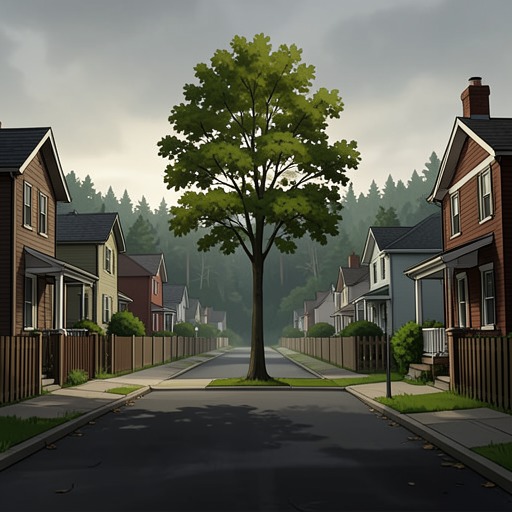
Blackeberg’s residents call it a good place to live, but the account identifies one thing missing: a past. At school, children cannot undertake special projects on the area’s history because there is scarcely any history connected to their present. An old mill, a tobacco king, and unusual buildings by the water remain as scattered traces, but they belong to a distant time and seem unrelated to the new neighborhood.
The three-story apartment buildings stand where there had once been only forest. Even a church is absent from a community of nine thousand inhabitants. These details make the lack of history concrete: Blackeberg is not simply a place whose past is forgotten, but one whose new built environment appears to have displaced it.
Modernity and Unpreparedness
The absence of historical inheritance is presented as evidence of Blackeberg’s modernity and rationality. Its residents seem beyond the reach of history’s ghosts and terror, as though the old sources of fear have no purchase in this orderly, newly built place. But this apparent insulation has a cost. The narrative says that it partly explains why the community is so unprepared when danger enters its everyday life.
The concept therefore turns on a reversal: freedom from old mysteries does not guarantee safety or understanding. Blackeberg’s confidence in a world without ghosts becomes a vulnerability precisely because the inhabitants have little framework for recognizing what threatens them.
The Aphorism
On Saturday, 24 October, the sentence “The suburban mystique is the absence of riddles” appears under Johan’s name. Its compact formulation recasts the neighborhood’s lack of history as a kind of mystique: not an abundance of secrets, but the impression that there are no secrets to solve.
Set against the account of Blackeberg’s historical blankness and consequent unpreparedness, the aphorism carries an irony. The absence of riddles describes the community’s self-image, not a guarantee that nothing inexplicable or frightening can happen there. The gap between that reassuring image and the danger the residents fail to anticipate gives the concept its force.