Tommy fights Hakan in the safe room
Let the Right One InTommy’s fight with Hakan in the safe room turns on a brutal reversal: the light that gives Tommy a weapon and a momentary advantage also reveals that his first blow has not ended the danger. The scene moves from terrified misrecognition to purposeful violence, then shows that even repeated violence cannot restore the person Tommy was before the fight.
Discovery and First Resistance
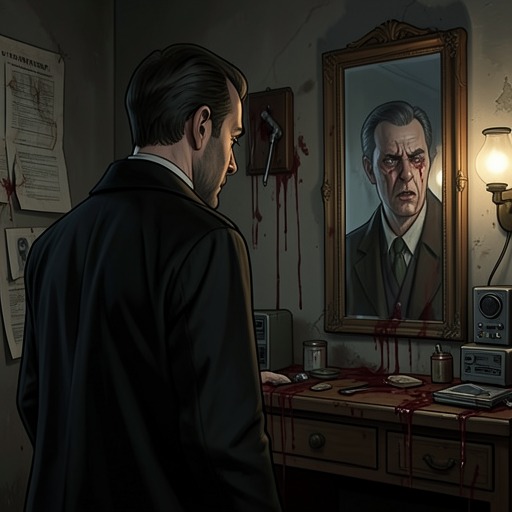
Tommy initially finds the corpse by lighting his lighter. His eyes, adjusted to the dark, are briefly blinded; when they recover, he sees a body stretched on the floor beside his feet. He recognizes the face as his father’s, and the fact that his father had been cremated does not register. In the lighter’s unsteady flame, the corpse seems to fit his expectation of someone long buried. His response is intimate and bewildered: he pats and strokes the cold foot, then feels muscles tense and move beneath the skin as he screams.
His fingers encounter Staffan’s pistol-shooting trophy statuette nestled between the corpse’s thighs. Grabbing it by the chest interrupts his panic with a practical thought: it can serve as a club. When the creature raises its upper body, a cold limb nudges his hand, and Tommy clutches the statuette. Later, a brief blue-white flash reveals the fallen boxes, the uneven walls, the passage into the storage rooms, and—one meter from his right hand—the lighter. Darkness returns, but he has fixed the lighter’s location in his mind; he pulls his foot free, retrieves it, and gets to his feet.
The First Blow and Its Reversal
With the lighter in hand, Tommy faces the approaching creature and raises Staffan’s pistol-shooting trophy statuette as a club. He waits until it is half a meter away, then swings. The blow lands at the sharp stone corner against the creature’s temple; the force travels up Tommy’s arm, its skull crumples, and cold liquid splashes across his face as it crashes to the ground. For an instant, Tommy feels triumph: the practical weapon he found in the dark has seemingly ended the threat.
The body’s posture makes the victory grotesquely uncertain. Tommy stands panting over it, and notices that it has an erection. He keeps the lighter lit rather than risk returning to darkness. Then the creature lifts its head and begins to rise. In that instant, something Tommy needs in order to remain himself seems to leave him: the first decisive blow has not restored safety, but opened onto a more frightening change in his own response.
Tommy strikes again, and then again. The narration figures his collapse into violence as an elephant falling through a tiny spiderweb: the fragile thread breaks, and with it something that had held him back. After a while, Tommy begins to think the beating is fun. The fight thus turns twice over. Hakan’s apparent defeat becomes renewed danger, while Tommy’s terrified self-defense becomes a pleasure he does not recognize as his own.
Staffan's Discovery
When Staffan opens the door with his baton angled away from his body, the fight has become a scene of devastation. Tommy kneels beside remains so badly crushed that they are scarcely recognizable as human: an arm is partly severed, and the chest, stomach, and face have been reduced to flesh, guts, and broken bone. Tommy drives a square stone down into the body as he sings, thrusting it through the remains until it strikes the floor, then lifting it to strike again. Blood and tissue cover him so thoroughly that Staffan cannot be sure it is Tommy.
Staffan recoils with nausea and lowers his eyes, but they catch on the pistol-shooting trophy statuette lying by the threshold, its pistol pointed straight upward. He recognizes it and notices that its base is missing, asking where it is. The question fixes the scene’s violence to an ordinary household object: the trophy has passed from keepsake to weapon, while Tommy’s repeated blows have carried him far beyond the immediate act of self-defense. Staffan’s horrified, uncertain recognition of the boy makes the fight’s consequence visible from outside Tommy’s experience.
The Broken Thread and the Witness
The elephant-and-spiderweb image gives the fight a measure of Tommy’s inward collapse: what breaks is not merely a fragile restraint but something he needs in order to remain himself. Its return as he drives the square stone into the body carries that private rupture into Staffan’s view. The movement from a boy fighting in darkness to a blood-covered figure striking while he sings makes the aftermath more than a question of whether Hakan can be stopped. Staffan’s inability to recognize Tommy at first exposes the distance the violence has opened between Tommy and the person he had been; the familiar trophy at the threshold is the only object he can immediately identify.