Vällingby ritual murder
Let the Right One InThe Vällingby ritual murder is the killing of a schoolboy on his way to handball practice, carried out by Hakan and discovered in circumstances that make the crime seem staged. Its significance lies not only in the boy’s death but in the way the event is encountered in fragments: as Hakan’s hurried, interrupted assault, as a newspaper account that unsettles Oskar, and as a story Tommy tells to explain what makes the murder seem different from an ordinary killing.
The Approach and Ambush
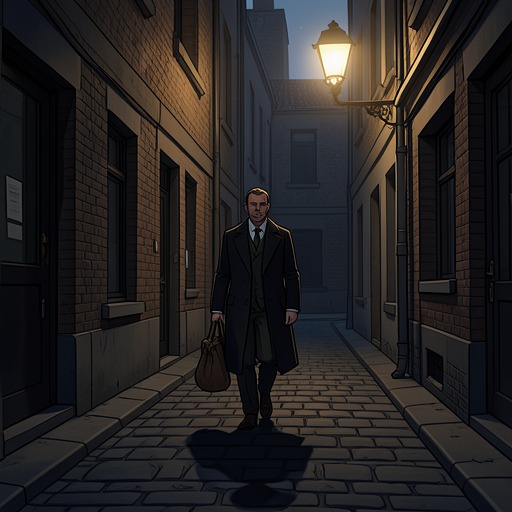
Hakan has set himself a time limit, and when a lone boy appears on the path with only ten minutes remaining, he recognizes him as a suitable target. The boy seems to be thirteen or fourteen. Hakan had intended to approach from the far end of the path, but his own immobility disrupts the plan: he watches the boy come closer and feels that every passing second reduces his chances. The hesitation gives the encounter its precarious rhythm. Hakan has decided what he means to do, yet he cannot immediately make himself move.
The boy carries a sports bag like the one Hakan has hidden in a hollow in the woods. Hakan gestures toward it and asks whether the boy is going to work out. When the boy looks down at his bag, Hakan takes his opportunity. He grabs the back of the boy’s head, presses the mouthpiece of a gas canister to his mouth, and releases the gas. The boy resists, but Hakan keeps hold of him as they fall onto the wood shavings on the trail. After the boy takes several breaths, he begins to relax. Hakan checks that the mouthpiece is still in place and looks around. He sees no witnesses.
Preparation at the Scene
The narration briefly opens an alternative possibility: Hakan imagines a world in which he walks away and leaves the boy to wake up without knowing what happened. That possibility is immediately set against the course he actually chooses. He goes to his bag, pulls on a raincoat, and lays out a knife, rope, large funnel, and five-liter plastic jug beside the boy. The equipment and Hakan’s haste establish that the encounter is not simply an impulsive assault; he has arrived prepared to continue after subduing his victim.
The account then leaves Hakan’s immediate actions without giving a full, direct description of the killing. Later information about the body supplies part of what is missing. This difference between the scene’s limited access and the subsequent reports matters: the reader knows Hakan attacked the boy and set to work, but the event’s precise course is reconstructed piecemeal rather than presented as a complete, publicly witnessed sequence.
Discovery and Reported Details
Oskar reads all the newspaper articles about the murder. One includes a photograph of a policeman who had visited the school to speak about drugs; another reports that technical experts from the National Laboratory of Forensic Science have been called to secure evidence. The investigation is underway, but the article offers no resolution, and Oskar is left waiting for further information. A school-yearbook photograph shows the murdered boy, whom Oskar has never seen. He thinks the boy looks like a Jonny or a Micke, names that connect the news to the children and conflicts in his own world without establishing that the victim was personally known to him.
The report gives Oskar a specific route and schedule to consider. The boy had been going to handball practice at the Vällingby gym and never returned home. Practice began at five-thirty, so he had probably left home at about five. Oskar realizes that the timing matches the period in which he fears he himself could have been involved. The murder’s published timetable therefore becomes more than background information: it prompts him to question his own relation to the crime. His uncertainty is not proof of involvement, and the account leaves his alarm distinct from the investigation’s still-unanswered findings.
The Body and the Story’s Afterlife
Tommy later recounts the discovery to Lasse and Robban. He stresses that the victim had been found hanging upside down from a tree, suspended by his feet rather than by his neck. Tommy explains that the boy’s neck had been cut, a detail he illustrates with a gesture across his own neck. The account makes clear that the hanging position was not, by itself, what killed the victim; it was an arrangement of the body after, or alongside, the lethal violence.
Tommy also emphasizes the discrepancy between the injury and the scene beneath the tree: there was almost no blood on the ground, only a few drops, although the killing would have involved the loss of several liters. Robban proposes that the boy was killed elsewhere and brought to the tree. Tommy accepts that as a possibility but points out the question it does not settle: if the killer had already killed him, why go to the trouble of hanging the body there? The explanation remains unresolved in this conversation. The unusual placement and missing blood turn the murder into a puzzle retold among boys, while Oskar’s newspaper reading presents it as an active investigation. Together, these partial accounts establish the crime’s reach: Hakan’s private violence becomes a public case, a subject of speculation, and a source of fearful self-questioning.