Virginia
Let the Right One InVirginia’s transformation from an ordinary woman trying to hold together a difficult relationship into a newly infected vampire makes the cost of vampirism painfully intimate. Her story is shaped by two intertwined losses: the failing bond with Lacke, the man she loves but cannot live with, and the gradual loss of control over her own body. Her eventual death in sunlight leaves Lacke with a memory he cannot escape and a new understanding of the danger he had dismissed.
Identity and Background
Virginia works at a local ICA grocery store on Arvid Mornes Road above China Park. Her life is marked by practical obligations as well as emotional strain: after her daughter moved away, Lacke moved in with her, but their relationship did not become a lasting shared life. Eight years later, Virginia still loves him, yet recognizes that she cannot live with him. The contradiction is central to her characterization: affection persists even when a relationship has repeatedly failed to provide stability.
The novel shows her in the company of Lacke and their circle at the Chinese restaurant on a snowy Friday evening. In a quieter domestic scene, she prepares beef stew while Lacke showers, then goes to check on him when he has been in the bathroom for a long time. Her care is habitual and concrete, expressed through food and attention rather than grand declarations. When she tries to support him on a snowy path, he pulls away and insists that he can walk by himself. She watches him go, aware that love has not made their life together possible.
Rupture with Lacke and the Attack
Virginia’s relationship with Lacke breaks open during his grief over Jocke. She approaches him as he speaks about the emptiness left by his friend, trying to draw his attention back to her. Instead, Lacke turns his pain against her, accusing her of being cold and attacking her personal life. Virginia slaps him and runs out of the apartment. The separation is not a clean rejection of him: she leaves in tears, walking through the park and trying to contain her sobs as she makes her way home alone.
On that walk, a creature attacks her from behind. For a moment, Virginia interprets the sudden weight as the physical form of the sorrow she has been imagining. She then feels the attack at her throat and struggles to shake the creature off before a hand covers her mouth. The attack follows immediately upon the rupture with Lacke, turning an emotionally exposed walk into the beginning of a bodily and existential crisis.
Her injuries are not life-threatening. After treatment at the hospital, she is discharged with stitches and bandages. Lacke offers to stay with her or live with her until she recovers, but she refuses. She intends to return to work the next morning because she cannot afford to remain home. The decision establishes how little room she has to treat illness as an interruption: even after an assault, the prospect of missing work weighs on her plans. That night, memories of the attack return as she tries to sleep. When she gets up hungry, the ordinary food she takes from the refrigerator holds no appeal.
Hunger and the Discovery of the Infection
At work, Virginia tries to keep going by packing frozen shrimp in the grocery store’s storage room. Lacke had told her that the attacker was not human, describing a childlike creature with fangs and claws, but she had dismissed his account as a drunken hallucination. While weighing the shrimp, she recalls that the attacker had seemed extraordinarily light. She can entertain the possibility that it was a very small child, but she has not yet accepted Lacke’s explanation.
A cut on her finger changes that. When she instinctively sucks the blood, its taste brings a powerful, pleasurable relief. Virginia keeps sucking before she realizes what she is doing, then pulls away and looks at the blood on her finger. The moment is both revelation and alarm: the hunger that made ordinary food seem unappetizing now has an unmistakable focus. She becomes dizzy and collapses at work, unable to continue her shift.
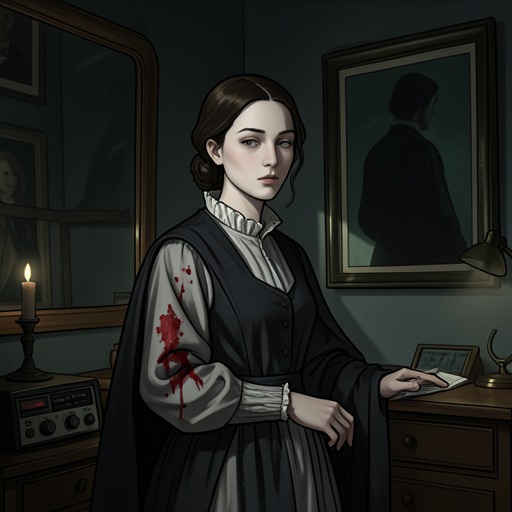
After returning home, Virginia’s condition worsens. She closes the door against Lacke’s pleading, locks it, and adds the chain because she does not want him—or anyone—to see her. She has seen small blisters on her face and hands after being out in daylight, and her hunger has changed into an unbearable restlessness. She walks around the apartment, scratches herself, and takes a cold shower, but none of it eases the agitation. The infection is no longer a theory about the attacker; it is a force reorganizing her appetite, her body, and her ability to endure ordinary contact.
The Infection’s Independence and Virginia’s Ending
By dawn, even brief exposure to pale daylight is painful, and Virginia wants to die. During the night she has repeatedly injured herself in an attempt to drink blood, leaving blood around the apartment. At one point, as she sits in the kitchen and feeds from a cut, she becomes aware of the infection not merely as an illness within her but as something with a life and force of its own. She understands that it can continue after her death and take control of the body. Suicide, she realizes, would not end the danger.
This recognition makes her predicament more than a struggle against hunger. The infected body is no longer simply an extension of Virginia’s will: the force inside it has its own claim on survival. Her later choice to end her life in sunlight follows from that grim understanding, though the decision cannot erase the consequences of the infection. Her death becomes one of the defining losses in Lacke’s story.
Lacke’s Grief and Narrative Significance
After Virginia’s death, Lacke remembers that she would have believed him when others dismiss the idea of vampire killers. He had not believed her when belief might have mattered, and that failure becomes inseparable from his grief. He recalls her final suffering in the hospital, but the memory offers no comfort or resolution. Instead, it makes his loss more immediate and deepens his conviction that he should have understood what was happening sooner.
Virginia’s story also changes the meaning of Lacke’s later confrontation with the creature. When he finds a wounded, childlike body, he cannot easily reconcile its apparent helplessness with the violence he associates with the attack on Virginia and Jocke. The conflict between seeing a vulnerable child and recognizing a continuing threat echoes the central conflict of her arc: the infection presents itself through a human body, but it does not obey ordinary human needs or limits. Virginia’s fate gives that conflict its personal cost, while her realization about the infection’s independent life gives it stakes beyond her own survival.