Virginia awakens as a vampire
Let the Right One InVirginia awakens as a vampire after eleven hours of near-total stillness, an episode in which apparent death gives way to consciousness and she identifies the cause of her altered body. The scene makes transformation both a physical process and a moment of recognition: Virginia recalls being bitten, understands her new needs and sensitivities, and names what she has become.
The transformation during stillness
Virginia has been lying motionless, wrapped in duvets and blankets, for eleven hours. Her body temperature has fallen to twenty-seven degrees, and her heart is beating only four times a minute. These measurements place her in a state close to bodily shutdown, while the duration of her stillness makes waking seem like a return from an interval in which ordinary signs of life have almost disappeared.
The account also describes changes that have taken place before Virginia regains consciousness. Her stomach and lungs have adapted to a different existence, and a growth in the sinoatrial node—the part of the heart that controls its contractions—has doubled in size. It is not ordinary tissue: the growth consists of brain cells. The narration presents it as a separate, developing brain that has become self-sufficient, no longer dependent on Virginia’s larger brain and capable of continuing even if her body dies. Her transformation is therefore not only a change in appetite or sensation; it has begun to alter the organization of her body at its center.
Consciousness and bodily evidence
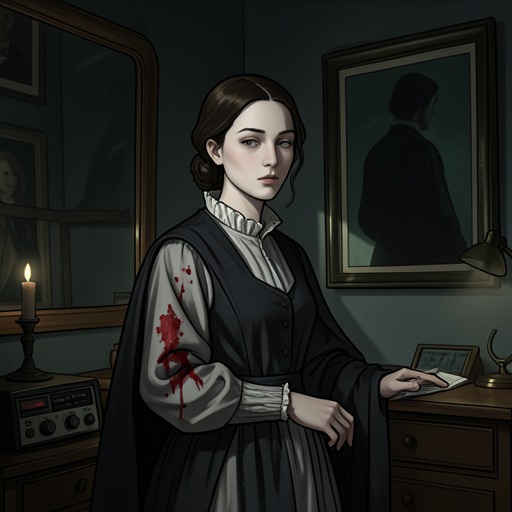
Virginia opens her eyes and knows that she is awake, although opening them does not make the room any less dark. The distinction matters: her consciousness has returned, but ordinary sight has not simply resumed in its former form. The account describes the impression of something withdrawing as she comes to, leaving her with an awareness of a presence that had occupied her body during her absence. This makes awakening feel less like an uncomplicated recovery than an uneasy recognition that her body has changed without her consent or awareness.
Her breathing provides the first clear evidence of renewed bodily function. Before falling asleep, she had determined that she was not breathing; now she draws air again. Her air passages have dried during the long interval, and her throat needs clearing. She remembers what happened, notices dried blood on her arms, and finds no visible cuts or scars where she recalls having hurt herself. The injuries have healed. When she checks the time, it is a quarter past six in the evening, and it is dark. The changed body is thus disclosed through a sequence of practical checks—breath, skin, memory, time, and the conditions of the room—rather than through an explanation supplied by another person.
Reconstructing the attack
In the bathroom, Virginia recognizes the smell of urine as belonging to Lacke and Morgan. Morgan has not come to mind as a visitor, but the evidence of his presence prompts her to recall the evening when they helped her home. She remembers that Morgan had used the bathroom while she lay on the couch after being attacked and bitten. This recollection connects the apparent recovery of her wounds to the earlier assault: the episode she had treated as an unexplained illness now has a cause in the encounter that preceded her collapse.
That reconstruction brings together the signs she has already noticed. She can see in the dark, is sensitive to light, needs blood, and has healed with extraordinary speed. Virginia considers the possibility of an illness that could be treated in a hospital or psychiatric ward, but those explanations do not account for the pattern she has assembled. She concludes that she is a vampire. The spoken recognition is a decisive turn in the event: what had been a frightening collection of bodily anomalies becomes, in her understanding, a coherent condition with an explanation.
Relief and immediate aftermath
The recognition changes Virginia’s response to what has happened. She had been distressed by the fantasies and actions of the night and had understood them as evidence of personal responsibility. Once she identifies her condition, she feels the pressure ease and the burden lift; she no longer regards those experiences as simply her own deliberate wrongdoing. The scene does not make the consequences disappear, but it changes how she assigns their cause, shifting her understanding from personal blame toward a transformation imposed by the vampire state.
Virginia gets up partway and runs a bath. When the telephone rings, she registers it only as a mechanical sound and does not try to speak to anyone; she feels that communication is no longer possible. The call therefore marks the distance between her awakened consciousness and ordinary human contact. The event ends not with help arriving or the transformation being reversed, but with Virginia alone with the knowledge she has reached: she has survived the interval, yet the body and needs to which she has awakened are no longer those she had before.