Virginia chooses to end her life in sunlight
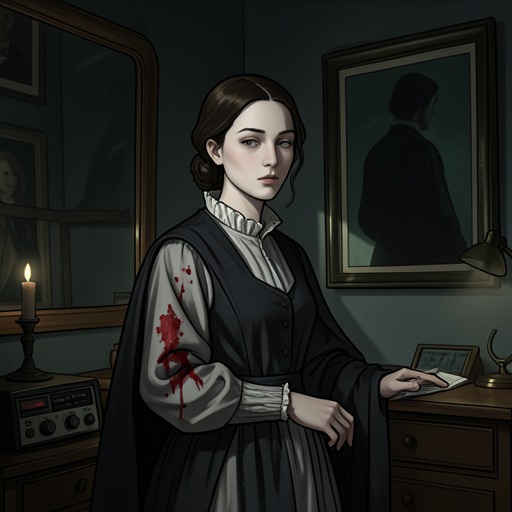
Let the Right One InVirginia chooses to end her life in sunlight while confined to a hospital bed, turning the opening of the blinds into the decisive action of the scene. Her death is first experienced from within, through a failed attempt to let go and a sudden rush of memories; afterward, Lacke names what happened, and Morgan sees the physical trace that confirms it.
The decision and its conditions
The nurse approaches Virginia cautiously. She has apparently been told about Virginia’s actions during the night, and her eyes go straight to the bindings holding Virginia’s arms. Reassured by them, she returns to the bed and speaks to Virginia as though she were mentally weak. The scene thus places Virginia under watch and restraint even as the nurse presents her purpose as helping Virginia get better. Her request to open the blinds arises within this controlled setting, but it is not a request for treatment: she means to expose herself to the light.
Virginia closes her eyes, sighs, and gives up resisting the nurse. Then she asks, politely, for the blinds to be opened. The calm courtesy of the request disguises its finality. The nurse nods and goes to the window, taking Virginia’s words as an ordinary instruction rather than recognizing what Virginia intends. The small, practical movement toward the window becomes the hinge of the event: Virginia has chosen the means, but another person’s routine action makes that choice possible.
The opening of the blinds
As the nurse crosses to the window, Virginia kicks off the blanket, exposing her body. She holds her breath and keeps her eyes tightly shut. These deliberate physical details make the decision visible without requiring an explanation: she prepares herself for what the light will do, while shutting out the moment of its arrival. The restraints and the nurse’s presence remain part of the scene, but Virginia’s bodily action gives her final choice a force of its own.
She had resisted all morning what she now consciously tries to release. Yet she cannot simply turn off. Instead, her experience breaks into a rapid succession of memories, like a film strip running at speed. The fragments move across a life rather than arranging themselves into a final account: a bird in a cardboard box; the smell of mangled sheets in a laundry room; her mother leaning over cinnamon-bun crumbs; her father and the smoke from his pipe; Per; the cottage; Len and the large mushroom they found one summer; Ted with mashed blueberries on his cheek; and Lacke, seen from behind and then recalled again. The ordinary specificity of these images contrasts with the extremity of the present. The scene does not explain every memory or tie each one to a fuller story; instead, their abrupt return makes a private life flash past in fragments as Virginia faces death.
The sound of the blinds clattering marks the end of that inward sequence. Virginia is then drawn into what she experiences as a sea of fire. The transition is swift: the room’s mechanical noise is followed by the bodily consequence of the exposed light. The attempt to choose death does not grant her the quiet disappearance she had tried to bring about. Consciousness persists long enough for the memories and the burning to be experienced.
Death recognized and witnessed
Later, Lacke’s eyes clear as he looks toward the foggy, dreamlike room. When asked what has happened, he answers that she burned; when Virginia’s name is spoken, he confirms that she went up in flames. His brief statements replace Virginia’s inward experience with an account that another person can give. The room still appears dreamlike to him, but his words make the outcome plain: Virginia has died in the fire caused by the opened blinds.
Morgan steps toward the room and is challenged by an older man who says it is not a public exhibition. Morgan insists that he is retrieving Lacke’s clothes, pointing out that Lacke is sitting naked. Once allowed inside, he takes the clothes from a chair beside the unmade bed and glances at the other bed. There he sees a charred hand with outstretched fingers protruding from beneath a sheet. The hand is unrecognizable, but the gold ring with a blue stone on its middle finger is unmistakably Virginia’s. A leather strap is fastened across the wrist. The ring preserves an identity that the burning has obscured, while the strap remains as a material reminder of the restraint present earlier in the scene.
The event’s significance
The sequence turns on the difference between Virginia’s deliberate request and the nurse’s apparent understanding of it. The nurse believes she is carrying out a small step toward helping Virginia recover; Virginia uses that step to expose herself to sunlight. What begins as a controlled bedside exchange becomes irreversible because the practical action of raising the blinds has a consequence neither the nurse’s manner nor her stated purpose can contain.
The scene also gives Virginia’s death two distinct forms of evidence. From within, it is an effort to let go interrupted by the rush of remembered life and completed in fire. From outside, it is a brief report from Lacke and the sight of a charred hand whose ring remains recognizable. The memories do not resolve into a neatly explained biography, and the body cannot be recognized by appearance; only the ring identifies Virginia in the aftermath. The event’s final movement is therefore from a private, fragmentary experience to the sparse signs by which the living confirm what has happened.