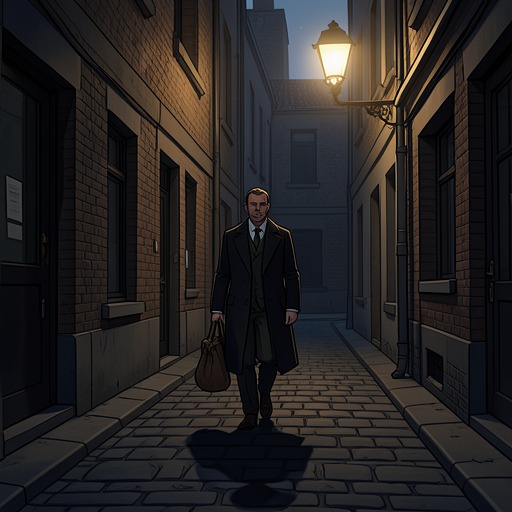
Yörk Bengtsson's murder and concealment of his body
Let the Right One InJocke Bengtsson’s murder begins with an act of misplaced trust: when Eli appears to need help, he carries her toward the restaurant, imagining that he is beginning a new life. Eli attacks him, and he dies. Hakan later finds Jocke’s body and conceals it, turning a private killing into a disappearance that leaves those who knew Jocke without an explanation.
The Encounter and Attack
Jocke asks what has happened and, after Eli thanks him, decides to help her. He lifts her in his arms, supposing that her slight weight may point to neglect or trouble at home. As he carries her toward the restaurant, he is absorbed in thoughts of a fresh start. Then pain in his throat interrupts that imagined future. He lets go of Eli reflexively, and she attacks him. His attempts to resist fail; the encounter ends with Jocke dead among the leaves. The scene turns his ordinary impulse to help into the opening through which Eli’s concealed predatory nature becomes lethal.
Hakan's Concealment
Hakan finds Jocke beneath the arched ceiling of an underpass, with Eli's thin pink sweater lying on him. When Hakan notices the injury that caused Jocke's death, the sweater becomes more than a discarded possession: it links Eli to the scene. Hakan's response is not to seek help or report what he has found. He gathers the sweater and the body, choosing instead to hide the evidence.
He carries Jocke along a path through the forest toward the shore. There, Hakan ties two large stones around the corpse's feet with rope and lowers it into the water. The work strains him, but when the bubbles stop rising, the body is hidden from view. Jocke's killing has now become a disappearance: Hakan has concealed the physical evidence, leaving those who knew Jocke without a public account of what happened.
A Death Known to Few
The concealment leaves Jocke’s death suspended between private knowledge and public absence. Lacke insists that something must be done: he knew Jocke, recognizes that he is dead, and understands that no one else knows what happened because they did not witness what he saw. His appeal to the person beside him—asking whether they saw it too—makes the aftermath hinge on shared testimony. The killing has not erased Jocke from the memory of his friend, but hiding the body has made that knowledge difficult to establish beyond the small circle of witnesses.
Knowledge, Evidence, and Disappearance
The event’s aftermath is organized around a gap between what is known and what can be demonstrated. Hakan’s concealment removes Jocke’s body from sight, but it cannot erase the knowledge held by those who encountered the death. Lacke’s insistence that he knew Jocke and knows he is dead gives the disappearance a witness’s counterweight: the body is absent, while grief and testimony remain. The scene thus turns concealment into more than a practical obstacle; it makes the question of who saw what—and whether that knowledge can be shared—part of the event’s continuing consequence.