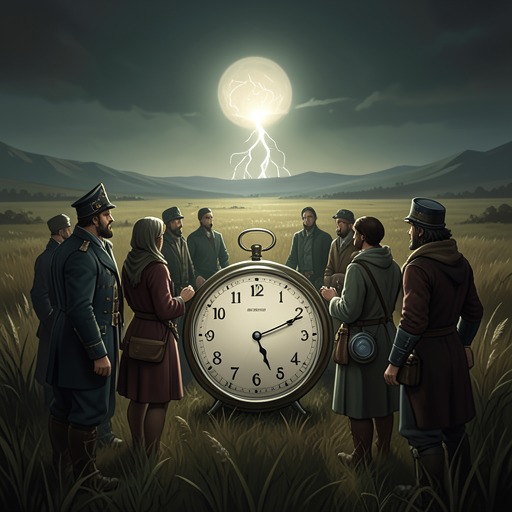
Altered time in near-death experiences
Life After LifeAltered time in near-death experiences is the reported disruption of ordinary duration and temporal sequence during an apparent encounter with death. The accounts range from a paradisiacal scene in which a minute and ten thousand years seem equivalent to a Life review experienced as lengthy while the physical action around it appears suspended. Together, they make altered time one of the book’s recurring features of near-death experience, while leaving unexplained how such reports relate to physical time.
Reported forms of altered duration
The book describes altered time as very commonly reported, not as an exceptional detail confined to one person’s account. Its examples do not establish a single, uniform experience: one report concerns a duration that cannot be meaningfully measured, while another gives an extended review of a life and a striking contrast between that inner sequence and the apparently motionless scene around it. The difference matters. Altered time can mean that ordinary measures of duration lose their relevance, or that events seem to proceed at a pace sharply at odds with the action perceived in the physical surroundings.
The first example comes from a woman who, during an apparent clinical death, seemed to find herself in paradisiacal surroundings. Asked how long the experience seemed to last, she replied, “You could say a minute or you could say ten thousand years. It doesn’t make any difference.” Her answer does not offer an estimate that can be converted into clock time. Instead, it describes a condition in which the alternatives of a brief interval and an immense span have lost their practical distinction. The account conveys not simply that time felt fast or slow, but that duration itself no longer seemed to provide a meaningful measure.
The Life review and suspended action
A man trapped in an explosion and fire describes a different configuration. He seemed to float above his body and see people running to rescue him. Then his physical surroundings seemed to disappear, and a review of his entire life came before him as he “discussed” it in the presence of Jesus Christ. Asked about the duration, he said that, if required to express it in temporal terms, the review had taken at least an hour. The account thus assigns the experience a substantial subjective span without establishing an equivalent clock measurement.
The return to the physical scene sharpens the contrast. When the man was told that he must return, the review disappeared and his surroundings came back into view. The people he had seen attempting to rescue him seemed frozen in the same positions they had occupied when the review began. As he seemed to return to his body, their action sped up again. The episode therefore connects altered duration to altered sequence: the review seems to occupy an extended interval, yet the rescuers’ movement does not appear to have advanced in step with it. The account presents this discrepancy as part of the experience, not as a solved explanation of what happened physically.
Comparison with mystical visions
The book places these accounts alongside a broader observation that near-death experiences can involve an altered sense of time and space. It also notes a resemblance between this temporal feature and mystical visions. One reported formulation captures the contrast in plain terms: “Time there isn’t like time here”. In this framing, the accounts do not merely describe a long or short episode; they challenge the assumption that duration is experienced in the same way in every state of consciousness.
That comparison remains a comparison, not a claim that the experiences are identical. The book distinguishes the temporal reports from other features of near-death accounts, including the panoramic review of a person’s life. In the fire-and-explosion account, the Life review is central to the experience of duration, but the evidence does not make every instance of altered time a life review, or every Life review an account of suspended surroundings. The examples retain their particular forms even as the author draws attention to a recurring resemblance.
What the reports establish—and do not
The book sets the testimony against the contemporary Western view described there: time is an intimate feature of the physical universe and flows in a linear fashion. People who return from near-death experiences, by contrast, may assert that “time stood still.” The tension between these accounts and the ordinary model is presented as an anomaly, not resolved by the author. The examples establish what some people report about their experience; they do not, by themselves, determine how long an event objectively lasted or supply a physical account of the apparent suspension.
This distinction is important to the book’s treatment of near-death testimony more generally. Its proposed theoretical model is a constructed account embodying common elements, while the collected reports vary in what they contain and how they describe it. The author cautions against assuming that someone who has been “dead,” in the sense used in these discussions, must know everything about what happens after death. Returning subjects do not describe themselves as infallible or omniscient; many remain baffled by what they experienced. Altered time therefore functions both as a recurrent feature worth investigating and as a boundary on easy interpretation: it invites attention to the reports without turning their strangeness into proof of a complete explanation.