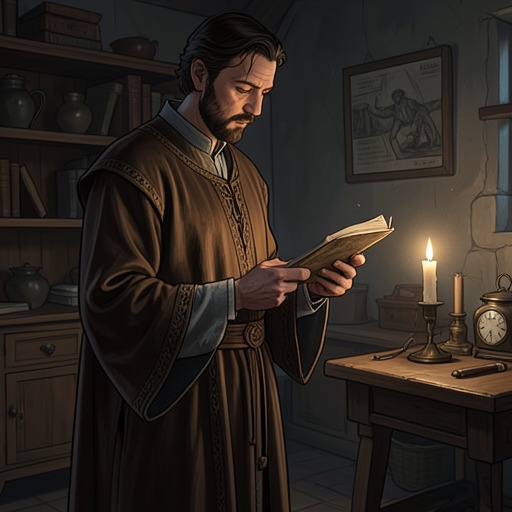
Saint Bede
Life After LifeSaint Bede is an English monk and historian whose chronicle, as presented in the book, preserves an early account of a man returning to life after death. The episode gives his historical writing a central role in the book’s comparison of near-death narratives: it records a guided passage through darkness into brilliant light, a return imposed on a reluctant traveler, and a lasting change in the man’s conduct. Bede’s account is not merely an inventory of wonders; it makes the reported experience a summons to live differently and to take spiritual questions seriously.
Identity and Historical Role
Saint Bede lived from 673 to 735 A.D. and completed A History of the English Church and People in 731. The book introduces him as an English monk and identifies the return-from-death narrative as one of the wonders he relates. That chronology places the account in an eighth-century historical and religious work, rather than in the contemporary interviews around which the book’s broader inquiry is organized.
The narrator situates Bede among writers whose accounts help establish that near-death stories have a long history. He first describes finding a wealth of earlier material across cultures and periods, while cautioning that the examples assembled are only a fraction of what may exist. Bede’s story is one of the substantial cases in that survey: its guided journey, luminous destination, message about returning, and subsequent change in the traveler’s life allow the narrator to compare its motifs with those found in modern reports.
The Return from Death in Bede’s Account
Bede locates the story in Britain, in the country of the Northumbrians, where a devout head of a household falls ill and grows steadily worse. He dies in the early hours of the night. At daybreak, as mourners remain around his body, he suddenly sits up alive. Their shock is so great that they flee; only his wife stays beside him, despite her fear, because of her love for him. The returned man reassures her that he has been released from death and says he must no longer live as before, but adopt a very different way of life.
The man’s account begins with a guide: a handsome figure wearing a shining robe. The two travel silently in what seems to be a northeasterly direction, until they reach a vast, deep valley extending without end. The guide leads him out of darkness into clear light. Ahead stands an immense wall, apparently without a gate, window, or other entrance. The traveler wonders how they will pass it; when they reach it, they are suddenly on top. Beyond lies a broad, pleasant meadow, flooded with light that seems brighter than daylight or the sun at noon.
The guide eventually tells the man that he must return to his body and live among people again. His prospects after death, the guide explains, will depend on weighing his actions more carefully and keeping his words and conduct virtuous and simple. The guide says he had left the man temporarily to discover what his future would be. The traveler is reluctant to return, captivated by the beauty of the place and the company of the spirits there, but does not challenge the guide. His return is abrupt and unexplained: he suddenly finds himself alive among people again.
A Changed Life and a Selective Audience
The return has consequences beyond the man’s survival. Not long afterward, he abandons his worldly responsibilities and enters the monastery of Melrose, which Bede describes as almost entirely enclosed by a bend in the river Tweed. In Bede’s presentation, the change fulfils the man’s initial declaration that he cannot resume his former way of life. The experience becomes a turning point, translating an encounter with the next world into a concrete reorientation of life in this one.
Bede also describes limits on how the man shares what he has seen. He will not discuss the experience with people who are apathetic or careless in their lives. Instead, he speaks to those troubled by fear of punishment or encouraged by hope of eternal joys, and who are willing to take his account to heart and grow in holiness. The story thus gives the returned man a purpose as a witness, but not an indiscriminate one: he reserves his testimony for listeners whom he believes may respond to its moral demand.
Bede’s Place in the Book’s Comparison
The book’s narrator draws attention to three features of Bede’s account: how strikingly the man’s outlook and life change, the presence of a spirit who guides him through the transition, and his reluctance to speak to people who will not listen with sympathy and an open mind. These observations frame the story as both a record of a return and a narrative about what a return is for. The guide’s direction, the promised future among the spirits, and the man’s choice of audience all connect the extraordinary journey to conduct and belief.
The comparison is made cautiously. The narrator notes that Bede’s account comes from an earlier culture and allows for differences in cultural idiom when comparing it with contemporary experiences. The parallel is therefore presented through recurring narrative elements, not as proof that every account describes the same event or uses an identical religious framework. As a historical witness within the book’s argument, Saint Bede matters both for preserving the story and for the form in which it survives: a journey beyond death whose return ends not in ordinary life resumed, but in changed commitments and a message directed to those prepared to hear it.