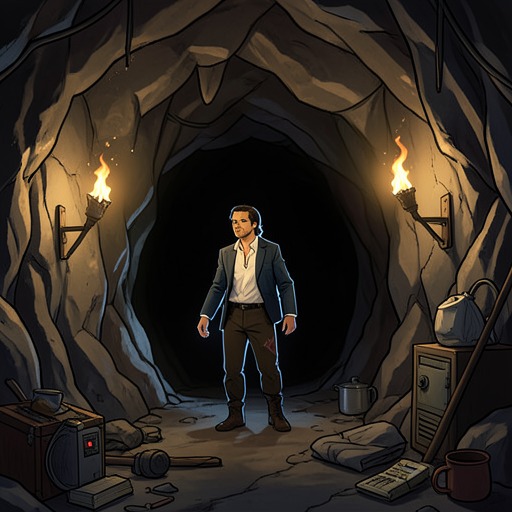
Socrates
Life After LifeIn Plato’s Allegory of the Cave, Socrates turns a dialogue with Glaucon into a sustained examination of mistaken certainty, education, and the cost of returning to a community still confined by its assumptions. Rather than appearing in a narrated personal adventure, he guides the argument through a hypothetical society of prisoners: their world is made of shadows, while liberation brings painful disorientation before a wider reality can be understood.
Identity and Place in the Dialogue
The epilogue identifies Socrates as Plato’s old teacher and presents the allegory as a dialogue between Socrates and Glaucon in Book VII of the Republic. Socrates is not merely named as the speaker: his questions determine how the imagined scene unfolds and what it asks the reader to notice. Glaucon responds to each stage, while Socrates builds the case by asking him to consider what the prisoners could see, what they would believe, and how they might react to a change in their circumstances.
The episode gives no account of Socrates’s life beyond this relationship and role. Its attention stays on the reasoning enacted in the dialogue. Socrates introduces the cave as an image of human beings generally, then tests that comparison against concrete details: chains that prevent the prisoners from turning, a fire behind them, objects carried past a low wall, and shadows cast on the wall they face. His method makes the allegory less a detached declaration than an argument Glaucon is led to confirm step by step.
The Prisoners’ World
Socrates begins with people held in one place from childhood, their legs and necks fettered so that they can look only forward. They see neither themselves nor one another directly, but only the shadows produced by the fire. Beyond them, bearers carry implements and images above a partition. The prisoners therefore take the passing shadows for the objects themselves; if they speak about what they see, they suppose their names refer to those passing objects.
Socrates extends the limitation from sight to sound. An echo from the opposite wall would make a passer-by’s voice seem to belong to the shadow. The prisoners’ error is thus supported by the whole arrangement of their environment: what they see, hear, name, and recognize all appears to confirm the same restricted account of reality. When Glaucon agrees that they would regard the shadows as real, the dialogue establishes the premise on which the later stages depend. The prisoners are not simply missing information; their habitual standards of recognition make the appearance seem sufficient.
Release and Gradual Recognition
Socrates describes release as both an escape from bondage and a painful disruption. A prisoner is made to stand, turn, walk, and look toward the fire. The objects whose shadows had seemed familiar are initially difficult to discern, and the released person may judge the former shadows more real than the things now presented. Even turning toward the fire can cause pain and prompt retreat to whatever remains easier to see. In Socrates’s account, exposure to a clearer source does not immediately produce understanding; it first unsettles the prisoner’s confidence.
The ascent out of the cave intensifies that difficulty. Socrates imagines the prisoner being drawn up a rough, steep path and brought into sunlight, where the brightness initially prevents him from seeing the things called real. Recognition develops by degrees: first shadows, then reflections in water, then the things themselves. Only after this habituation can the former prisoner contemplate the heavens and, more readily at night, the stars and moon; the sun and its light are last. From observing the sun, he can infer its relation to the seasons, the courses of the year, and the visible region. Socrates makes learning a gradual reordering of perception rather than a single moment of revelation.
Return and the Allegory’s Conflict
Having described the ascent, Socrates asks Glaucon to consider what the liberated person would think of the old dwelling and its prisoners. The answer is a contrast: the person would count himself fortunate in the change and feel pity for those still confined. The cave’s prizes would also lose their attraction. Its inhabitants honor whoever most quickly identifies the shadows, remembers their usual order and conjunctions, and guesses what will appear next. The person who has seen beyond the cave would have little reason to envy those honors, because the skill they reward belongs to the prisoners’ limited world.
Socrates then reverses the journey. On going down again, the returning person’s eyes would need time to adjust to the darkness. If required to compete at judging shadows before that adjustment, he would appear inept and invite laughter. The prisoners could conclude that the ascent had damaged his sight and was not worth attempting themselves. Socrates carries the consequence further: if they could seize and kill anyone trying to release them and lead them upward, they might do so. This is a conditional ending within the allegory, not a narrated event in Socrates’s life. It makes resistance part of the problem: a person’s changed understanding does not automatically persuade those whose shared habits and rewards depend on the old account.
Narrative and Thematic Function
Socrates’s questions give the allegory its accumulating force. Each agreement from Glaucon—from the prisoners’ dependence on shadows to their likely hostility toward a liberator—connects one circumstance to the next. The movement from chains, to release, to ascent, and back down makes the abstract contrast between appearance and understanding legible through changing conditions of sight and social standing.
His role also keeps the argument open as an exchange. Socrates does not simply announce that the prisoners are mistaken; he asks Glaucon to follow what their restricted position would make them believe, and then to imagine the discomfort and risk of changing that position. The final threat against the would-be liberator gives the ascent a social cost: clearer vision may bring pity for those left behind, but return offers no guarantee of welcome. Within the epilogue, Socrates is therefore the voice through which the cave becomes both an account of how recognition changes and a warning about how firmly a community can defend its familiar shadows.