Animal Social Hierarchy and Dominance
Life of PiAnimal Social Hierarchy and Dominance is the account of how territory, social rank, and signals of authority organize animal behavior—and how a human can use that knowledge to reduce danger. It links the everyday work of zookeeping to the precarious arrangement aboard a lifeboat: survival depends not on overpowering Richard Parker, but on reading his responses and making the boundaries between them legible.
Territory and the Management of Distance
Territory begins with distance. The account describes each animal as having a flight distance, the minimum separation it wants to keep from a perceived enemy. The distance varies by species and by the way an animal senses danger: cats look, deer listen, and bears smell. A flamingo may remain untroubled by a person more than three hundred yards away, but become tense when that boundary is crossed. Giraffes may tolerate an approach to within thirty yards from a motor car, yet run when a person on foot is still 150 yards away. Fiddler crabs, howler monkeys, and African buffaloes are also given distinct thresholds: ten, twenty, and seventy-five yards respectively. These examples make territory a behavioral relation, not simply a marked patch of ground: proximity and the manner of approach can change what an animal perceives as a threat.
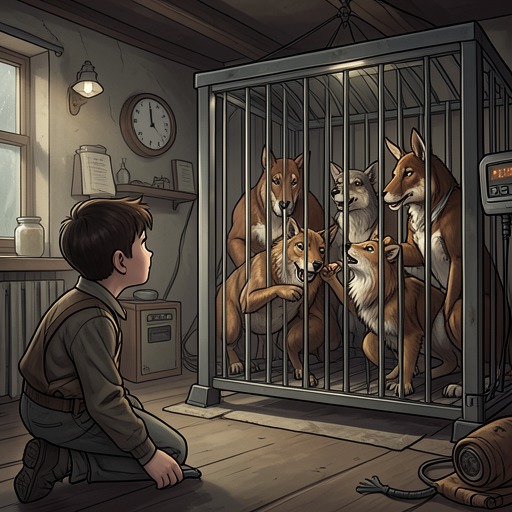
Zookeeping seeks to diminish that flight distance through knowledge, food, shelter, and protection. When these provisions work, the wild animal can remain in the zoo without continuing distress; it eats, behaves, socializes, and reproduces. Pi’s father is presented as particularly gifted at this work. Though he lacks formal training, he watches closely and intuitively guesses what an animal may be thinking. His success illustrates that human authority in this context is not merely force: it depends on attentive care and on learning how the animal responds to its surroundings.
Rank, Signals, and Submission
Territory also structures encounters between animals and people. The lion-pit example explains an attack as a response to an invasion of territory rather than hunger, since zoo animals are amply fed. A circus trainer therefore enters the ring first and in full view, establishing it as his territory. Shouting, stamping, and snapping a whip reinforce the claim. The round ring leaves the lions without corners in which to hide, and their movement along its edges is read as submission to a dominant presence.
Rank matters beyond the immediate encounter. It determines whom an animal associates with and how, as well as where and when it eats, rests, and drinks. Uncertainty about position produces nervousness and danger; a stable rank, by contrast, makes conduct more predictable. The trainer must maintain his position, because a slip from super-alpha to beta can bring serious consequences. Yet rank need not be decided by brute strength. The account cites zoo director Hediger’s observation that intimidation can establish social superiority without a fight. The trainer’s erect posture, calm manner, steady gaze, fearless step, and unfamiliar sound—such as a whistle—can create doubt in the animal and prompt it to back down. Authority is thus presented as a performance assembled from posture, setting, and signals.
The Omega Animal and Human Care
The animal most receptive to circus training may be the omega, the lowest-ranking member of a pride. Such an animal has more to gain from closeness to the trainer: not only extra treats but also protection from other members of the pride. The compliant animal can become the star of the show, while more cantankerous beta and gamma animals remain at the ring’s edge. The same pattern is reported in zoos, where socially inferior animals may work hardest to approach keepers, remain faithful to them, and be less likely to challenge them. The observation is associated not only with big cats but also with bison, deer, wild sheep, and monkeys.
This pattern gives the account’s language of dominance a complication. The relationship is not only a contest in which one party imposes a will on another. An animal’s position within its group can make companionship with a keeper valuable, while the keeper’s food and protection help sustain that bond. The omega’s cooperation can therefore be read both as submission within a hierarchy and as an adaptation to the security offered by a human relationship.
Applying the Principle to Richard Parker
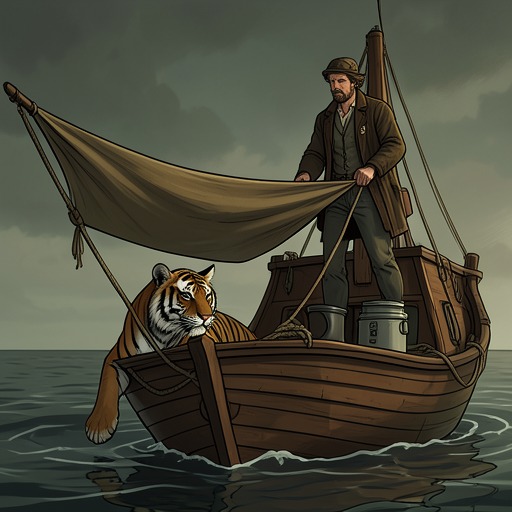
At sea, Pi recognizes that he and Richard Parker share the same confined setting and will live or die together. Richard Parker’s quiet prusten—a puff through the nose associated with friendliness and harmless intentions—briefly changes the tenor of their encounter. Pi’s fear eases, but the sound does not make the tiger safe. Instead, it helps Pi recognize that he must attempt to tame him. Pi sees the lifeboat’s round horizon as a possible circus ring, the sea as a source of rewards, and The whistle as a means of signaling. His zookeeping knowledge becomes a survival plan: establish a workable relation rather than wait for the tiger to disappear.
That plan is put into practice through territorial provocation. Pi advises choosing regular but manageable waves, streaming the sea anchor to stabilize the lifeboat, and preparing a safe haven. He stamps at the edge of the tarpaulin and blows the whistle to make a consistent signal of aggression, while remaining outside the animal’s territory. The aim is to provoke a response without provoking an attack. By retreating slowly and maintaining eye contact, he tries to draw the animal toward a boundary crossing; once it advances into his territory or the neutral zone, he can respond as though the boundary has been violated. The method turns a dangerous encounter into a sequence of cues, limits, and consequences. It also depends on restraint: Pi’s instructions warn against entering the animal’s territory or provoking it beyond control.
Repetition as a Means of Establishing Order
The later training on the island shows that dominance alone does not produce learned behavior. Pi describes animals as operating chiefly through instinct or rote, with limited ability to form new associations through intelligence. Teaching an artificial connection between an action and a treat therefore requires repeated practice, and is especially difficult with an adult tiger. Pi blows the whistle, pounds his chest, repeats the command Hep, and tosses Meerkat morsels as rewards. The training is laborious rather than effortless; Richard Parker’s youth and pliability, and his status as an omega animal, contribute to Pi’s success.
Pi teaches him a four-jump routine through a hoop made of thin branches. Each jump earns part of a Meerkat. Pi changes the hoop’s position, then turns his back and commands Richard Parker to return and jump again. Although he remains afraid the tiger may attack instead, Richard Parker completes the jumps. In this sequence, hierarchy, territorial control, and reward-based repetition meet: Pi’s signals establish a human-led routine, while food reinforces each completed action. The concept’s narrative significance lies in that practical conversion of observation into conduct. Knowledge of rank cannot eliminate danger, but it gives Pi a way to shape the terms of coexistence with an animal whose strength he cannot match.