Animal territoriality
Life of PiAnimal territoriality is the account’s central explanation for why animals occupy, defend, and sometimes return to particular spaces. It also becomes a practical survival principle for Pi Patel: on the lifeboat, he must recognize Richard Parker’s boundaries and establish boundaries of his own. The concept makes territory more than a location. It is a familiar arrangement of shelter, food, water, and safety, and the uncertain border between two occupants can determine whether they coexist or come into conflict.
Territory and the Work of a Zoo
An animal’s regular position and posture matter because departures from routine may register a change in its surroundings. The disturbance could be minor—a hose, a puddle, a ladder’s shadow—or a sign that demands investigation. Such attention to routine follows from the claim that animals are territorial: familiar space helps them avoid enemies and find food and water. An animal’s settled place is therefore not an arbitrary point on a map but part of how it manages the basic conditions of life.
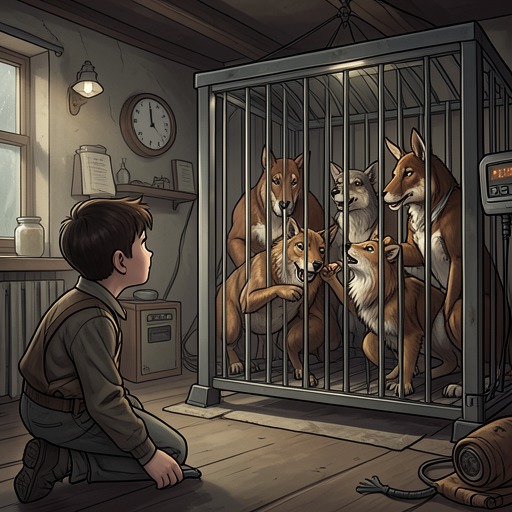
A sound zoo enclosure condenses the scattered resources of a wild territory into a smaller area. It can provide places to rest, eat, drink, bathe, groom, and watch from, while food appears regularly and protective barriers keep threats away. Once an animal has explored and marked that space in the ordinary ways of its species, it may occupy it as a landholder rather than experience it as a prison. The enclosure’s size differs from a wild range, but the account treats its adequacy in terms of whether the animal’s needs can be met there.
The arrangement is a reciprocal boundary: an animal marks its space, perhaps with urine or another secretion, while human barriers limit where it can go. On this account, a well-designed enclosure can function as a stable territory, neither inherently better nor worse than a wild one. The narrator entertains the possibility that an animal able to make an informed choice might prefer dependable food and protection from parasites and enemies, but qualifies the thought: animals cannot make that kind of human comparison and instead adapt within the limits of their nature.
Familiarity, Disturbance, and Flight Distance
Zookeeping is described as the work of making human presence less threatening. Its practical aim is to diminish flight distance—the minimum separation an animal wants to maintain from a perceived enemy. The measure varies by species and by the way an animal detects an approach. A flamingo may tolerate a person more than three hundred yards away but flee if that distance is crossed; a giraffe may allow a closer approach from a car than from a person on foot. Cats rely on sight, deer on hearing, and bears on smell. These examples show that a boundary is not simply a fixed line: it is perceived through an animal’s particular senses and circumstances.
Knowledge of the animal, along with food, shelter, and protection, can make a human presence less alarming. The desired result is an animal that remains healthy, eats without fuss, behaves and socializes naturally, and reproduces. Pi Patel presents his father as naturally gifted at this work: without formal training, he watched animals closely and seemed able to judge what was on their minds. His success is reflected in the animals’ multiplying, in some cases excessively.
Territorial dependence also explains why escape does not always mean a lasting departure. The account describes a chimpanzee that repeatedly shut an unlocked cage door, apparently distressed by its open state; roe-deer that fled from visitors into a nearby forest but returned to their corral; and a bear that got out of its enclosure and later climbed back in. These examples complicate the idea that freedom simply means leaving a confined space. A familiar territory can remain the safer or more legible place, even when an exit is available.
Territory, Rank, and Animal Training
Territorial boundaries intersect with social rank. An animal entering a lion’s space may provoke an attack not because the lions are hungry, but because the intrusion challenges their position in the territory. A circus trainer therefore enters the ring first, visibly asserting control through posture and movement. The lions are made to understand where they stand in relation to the trainer before the performance begins. The account emphasizes that this ordering cannot be allowed to lapse: if the trainer loses dominance, the consequences may be dangerous.
Rank shapes access to company, food, resting places, and water. Until an animal knows its position, social life can become unstable and provoke nervous or aggressive behavior. Establishing rank need not require a fight; intimidation and the signals surrounding an encounter may be enough to make one animal yield. The trainer’s erect posture, steady gaze, calm advance, and sharp sounds work as elements of a psychological display. The broader point is that behavior depends not only on physical force but on an animal’s reading of the social situation and the certainty of its place within it.
The Lifeboat as a Contested Territory
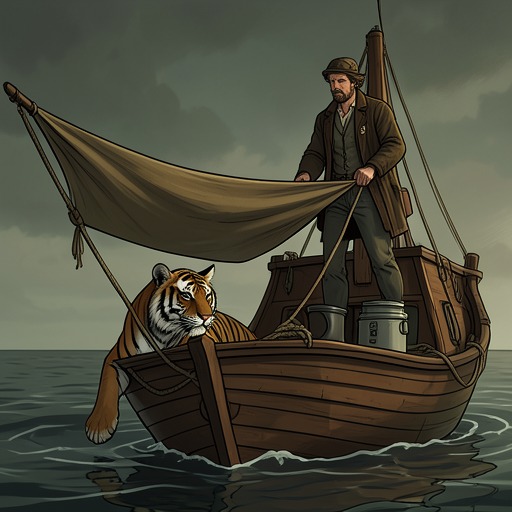
On the lifeboat, this framework becomes Pi Patel’s means of staying alive alongside Richard Parker. When Richard Parker makes a quiet prusten, a puff through the nose associated with friendliness and harmless intentions, Pi Patel’s panic briefly eases. The sound does not make the tiger safe, but it gives Pi Patel a moment to recover his senses and recognize that the two are literally sharing one boat. He concludes that he must tame Richard Parker, both because the tiger could outlast him and because the tiger’s presence keeps him from being left alone with despair. The lifeboat is at once their shared refuge and a space whose division must be continually managed.
Pi Patel’s training strategy turns the boat’s boundaries into tools. He treats the sea as a source of rewards, uses a whistle to signal and assert control, and regards the lifeboat’s round outline as a kind of circus ring. Later, he describes a deliberate exercise for asserting his own territory: stabilize the lifeboat with a sea anchor, remain at the edge of his area, make a consistent noise, and retreat while keeping Richard Parker in view. The aim is to provoke a limited advance across the boundary, not an outright attack; once the tiger intrudes, Pi Patel responds forcefully with the whistle and the sea anchor. The method depends on controlling the encounter’s threshold rather than entering the tiger’s space.
The principle returns on the floating island. When Richard Parker ranges farther afield, marks tree trunks, and roars, Pi Patel worries that the tiger is becoming comfortable enough to seek a mate and might no longer tolerate another male in his night territory. A sudden close encounter in the forest confirms that the island has changed their arrangement: Richard Parker repeatedly rears and threatens, then moves away when Pi Patel remains still. Pi Patel follows with the whistle, and that night decides to resume training. He repeats commands, uses food rewards, and teaches Richard Parker a sequence of jumps through a hoop. The exercise is laborious, but it rebuilds a structured relationship in a setting where abundance and space might otherwise loosen Pi Patel’s influence.
Significance
Animal territoriality connects ordinary zoo routines with the perilous negotiations of the sea. In both settings, familiar space supports survival, boundaries communicate claims, and disruption can produce fear or aggression. The lifeboat makes the principle especially consequential: Pi Patel cannot remove the tiger or abolish their shared dependence, so he tries to create an intelligible order within it. The concept does not erase the danger between them; it explains how attention to space, routine, and rank can make a precarious coexistence possible.