Animals’ Territorial Instincts and the Idea of Freedom
Life of PiAnimals’ Territorial Instincts and the Idea of Freedom challenges the easy equation of wilderness with freedom and captivity with misery. Its central claim is that animals depend on familiar territories and established patterns: a suitable enclosure can function as a secure home, while an animal’s attempt to flee may signal that something within its territory has become frightening or intolerable. This account makes animal behavior legible through needs, boundaries, and social relations rather than through an abstract human ideal of liberty.
Freedom and the Limits of the Analogy
The concept begins by questioning a sentimental picture of wild life as a simple, dignified existence in open space. In that picture, a large predator roams at will, eats without constraint, and watches over its family; captivity abruptly destroys this supposed happiness. The counterargument is that life in the wild is shaped by necessity: food is scarce, danger is persistent, territory must be defended, and parasites must be endured. Animals are constrained by those conditions even when no human-made barrier is present. The question is therefore not merely how much space an animal can cross, but what choices and security its surroundings actually allow.
To clarify the distinction, the narration compares an animal’s hypothetical freedom to a person abandoning family, friends, society, and possessions to wander alone. Physical departure is possible, but that possibility alone does not show that departure is likely or desirable. Animals, the account argues, are conservative in their habits: small changes can unsettle them, and familiar routines matter. The comparison shifts attention from the visible openness of a landscape to the ties and patterns that make a place livable.
The same argument challenges the idea that movement is random. An animal’s use of space is patterned, whether it follows familiar paths in the wild or occupies an expected place in a zoo. A change in its usual position may have a modest cause, such as an alteration in the surroundings, or may signal a problem requiring attention. The animal’s location is not, in this account, proof of unconstrained choice; it belongs to a pattern that can be disturbed and interpreted.
Territory as Home and Necessity
Territoriality is presented as a basic organizing principle of animal life. A familiar territory helps an animal avoid enemies and obtain food and water, the persistent requirements around which its movements are arranged. The account compares an animal’s claim to its space with human attachment to home: forcing people out of a familiar residence and calling them free would ignore what makes that place secure and usable. By analogy, removing an animal from its territory does not automatically improve its condition simply because the new space is larger.
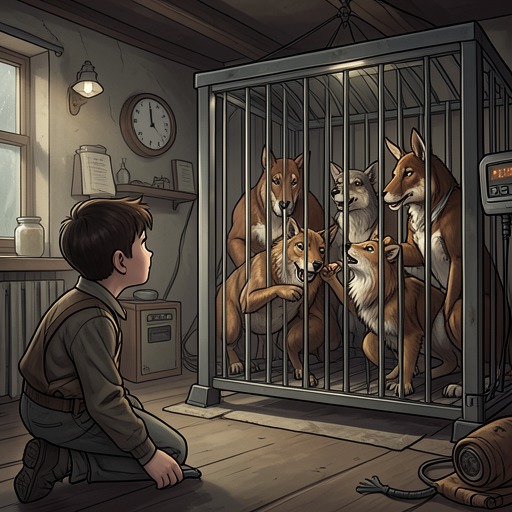
A well-designed zoo enclosure is described as a compact territory, not merely a replica of wilderness. Its value depends on whether it brings the necessary functions of a habitat within reach: places to rest, eat, drink, bathe, groom, and keep watch. In the wild, those resources may be spread across a large area and accompanied by threats; in an enclosure, they can be concentrated and protected. The comparison with a human house emphasizes this compression of basic needs into a bounded space, rather than the superficial resemblance of a zoo to a natural landscape.
Once an animal has explored and marked out an enclosure in ways characteristic of its species, the narration suggests, it can take possession of the space rather than experience itself as a temporary, anxious occupant. It may defend that territory if another enters it. Under this account, a constructed boundary and an animal’s own territorial claim can coexist: the barrier keeps the animal within, while the animal’s markings communicate that others should stay out. The argument does not claim that every enclosure is adequate, or that a zoo is inherently preferable. It presents a suitable territory as a condition whose value depends on whether the animal’s needs are met.
Escape, Disturbance, and Social Order
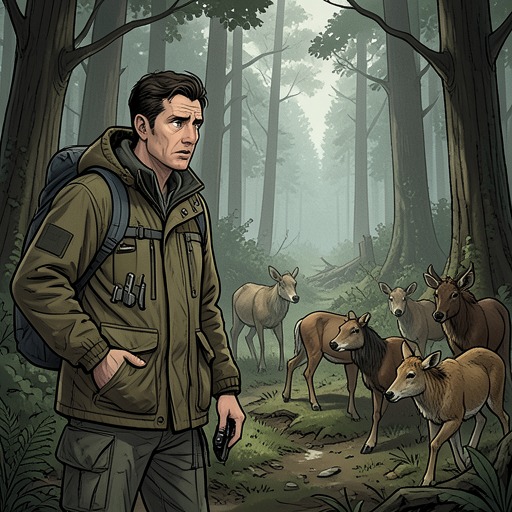
The explanation of escape follows from this emphasis on territory. Animals may try to flee because an enclosure fails to meet their habitat needs, because a mature animal cannot adapt readily to a changed environment, or because a sudden disturbance triggers a flight response. A startling noise, an enemy, or pressure from a dominant animal can turn a familiar space into a source of alarm. Escape, in this account, is often movement away from a perceived threat, not a considered journey toward an imagined better destination. The unfamiliar space beyond the boundary may itself be frightening, and an escaped animal may seek the first nearby place that feels secure.
The discussion of flight distance gives this account a practical dimension. Different species respond to a perceived enemy at different distances and through different senses: cats watch, deer listen, and bears smell. A flamingo may tolerate a person at a distance of more than three hundred yards but become tense as that distance closes. A giraffe’s response also depends on context: it may allow a closer approach from a motor car than from a person on foot. These examples show that human proximity is not a uniform stimulus; an animal’s response depends on how it detects a possible threat and how far away that threat is.
Social rank also shapes access to space and resources. The account of a circus trainer entering a lion’s ring first presents the ring as a contested territory: the trainer establishes his presence through posture and behavior, and the lions respond within a hierarchy. Rank influences where an animal can rest, eat, and drink, and with whom it can associate. The trainer’s position has to remain clear; if his dominance is uncertain, the animals’ uncertainty can make them nervous and potentially dangerous. The example connects territorial boundaries to social order: behavior in a space depends not only on its physical limits but also on who is understood to control it.
The Idea Put to Use at Sea
The concept becomes a survival strategy in Pi Patel’s dealings with Richard Parker. After Richard Parker makes a friendly-sounding prusten call, Pi Patel recognizes that the two are bound to the same immediate space and cannot rely on the tiger’s death to solve the danger. He begins to understand their survival as interdependent: Richard Parker threatens him, but also keeps him from surrendering to despair. Taming the tiger becomes both a practical necessity and a way to preserve a reason to continue living.
Pi Patel adapts territorial and dominance principles to the Lifeboat. His later instructions describe using a stable sea, preparing a safe retreat, and cautiously provoking the animal from the edge of his own territory. He uses the Orange Whistle to make a consistent signal, taking care not to enter Richard Parker’s space or provoke an outright attack. The aim is to induce a controlled crossing of a boundary, then assert his own claim to his territory. The procedure makes physical space, distance, and signaling into tools for managing danger rather than relying on strength.
On the floating island, the same principles remain relevant even as conditions change. Richard Parker ranges farther afield and behaves as though the island could support a settled life; his marks and calls make Pi Patel worry that the tiger may regard the area as territory and cease tolerating another male there. A sudden encounter in the forest produces a sequence of threat displays: Richard Parker rears, withdraws, and repeats the gesture before moving off. Pi Patel then runs after him and uses the whistle, resuming the training relationship rather than assuming their earlier arrangement will persist automatically.
The training itself illustrates the slow work of creating new associations. Pi Patel repeats a command, uses rewards, and teaches Richard Parker to jump through a hoop made from thin branches. He does not treat the performance as evidence that the tiger has become harmless: fear remains, and the training depends on repetition, Richard Parker’s particular disposition, and the tension Pi Patel senses in him. The episode brings the concept’s claims about habit, territory, and adaptation into the survival plot. Boundaries can be negotiated, and behavior can be shaped, but neither becomes secure through a single gesture; the fragile order must be maintained through observation and repeated action.