Bengal tiger
Life of PiThe Bengal tiger is a powerful and dangerous animal in the novel, but its significance extends beyond the threat it poses. At the Pondicherry Zoo, Santosh Patel uses a tiger to teach his sons about the limits of human safety around wild animals. Later, after the Tsimtsum sinks, Pi Patel finds himself sharing a lifeboat with Richard Parker, a young Bengal tiger whose presence turns that childhood lesson into a daily problem of survival. The relationship that follows depends not on making the animal harmless, but on understanding its behavior, establishing boundaries, and recognizing how much Pi’s own will to live comes to depend on it.
Zoo Life and the Lesson of Danger
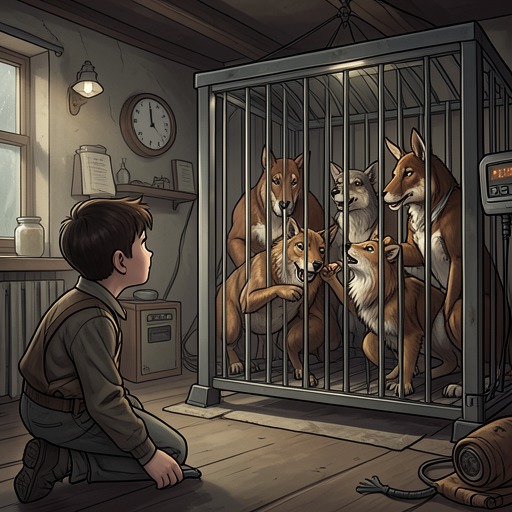
At the zoo, tigers are not presented as tame playmates but as powerful animals whose behavior must be respected. Santosh Patel takes Ravi Patel and Pi Patel into the cat house before it opens to the public. There, Mahisha, a 550-pound Bengal tiger, approaches the bars and displays an intimidating response to the people nearby. The iron bars are reassuring to the adults, but the scene makes clear that they are a necessary barrier, not an invitation to approach. Santosh tells his sons never to touch a tiger, put their hands through its cage, or even get close to it.
Santosh arranges a demonstration to make the warning unforgettable. A goat is placed in a neighboring cage, separated from Mahisha by bars and a trapdoor. The tiger’s attention shifts toward the goat; when the trapdoor opens, Mahisha moves into the adjoining space. Pi and Ravi are frightened, and Gita Patel takes the boys away. She protests that the experience may scar them. Santosh answers that the demonstration was meant to protect them: a goat, he argues, is preferable to Pi being harmed if he ever tried to touch a tiger. The lesson is therefore both concrete and parental. Affection or curiosity cannot cancel the danger posed by a wild animal.
The episode also sits beside Pi’s account of his own imaginative play. He sometimes gave animals human voices and roles, but insists that this imaginative treatment did not make him mistake their real nature. The distinction matters: the zoo can invite stories about animal personalities, yet responsible care requires attention to the animals as animals. Pi’s later understanding of Richard Parker will depend on keeping both perspectives in view—his imaginative interpretation of the tiger and the practical danger of sharing space with one.
Behavior, Territory, and Captivity
Pi explains zoo-keeping through the concept of flight distance: the distance an animal needs to maintain from a perceived threat. Different animals respond to different cues, and their reactions vary with how people approach them. Zoo-keepers try to reduce this distance by providing food, shelter, protection, and knowledgeable care. In this account, successful care does not mean erasing an animal’s wildness. It means creating conditions in which the animal can remain healthy and behave in relatively stable ways while living in captivity.
Territory and social rank are equally important to Pi’s explanation of animal behavior. An animal that does not know where it stands in a hierarchy may become nervous and dangerous. In a circus, a trainer establishes dominance through posture, steady attention, movement, and recognizable signals; the contest need not end in a fight. The tiger’s response to people, in other words, is shaped by social context as well as physical strength. Later, Pi will adapt this logic to the lifeboat, treating its different areas as territories and using repeated signals to influence Richard Parker’s movements.
The novel also situates zoo animals within an international trade. When the Pondicherry Zoo is sold, Bengal tigers are among the animals sought by overseas zoos. Their relocation requires negotiations, health and origin certificates, export and import permits, quarantine arrangements, and transportation. The transaction is a practical solution to the Patel family’s move to Canada, but it also shows how animal lives become subject to institutions and paperwork. The zoo must arrange a future for the animals even as its keepers and their family prepare to leave India.
Richard Parker’s Arrival and Name
Richard Parker’s presence on the lifeboat begins with the sinking of the Tsimtsum. From the water, Pi sees the tiger struggling to stay afloat and calls for him to reach the boat. Pi’s impulse changes when he recognizes the danger of bringing a tiger aboard. He tries to push Richard Parker away, but the tiger climbs onto the lifeboat. Pi sees the animal rise on the tarpaulin and throws himself into the sea. The scene reverses the lesson at the zoo: the danger is no longer separated from the human by iron bars, and there is no keeper’s protected position from which to observe it.
Pi later works out how Richard Parker came to be at the Pondicherry Zoo—and why he has that name. A hunter in the Khulna District had been hired after a series of attacks near the Sundarbans. The animal encountered at the site was a tigress with a cub, rather than the suspected man-eater. The hunter used an immobilizing dart, and the tigress and cub were taken to the zoo. He named the cub Thirsty after seeing it rush to drink at the river. A clerical mix-up on the shipping papers exchanged the names: the documents listed the cub as Richard Parker and the hunter as Thirsty None Given. The name on the papers stuck. Richard Parker is thus not the hunter, as the name’s history might suggest, but the tiger cub whose identity was accidentally recorded under the wrong name.
That history gives the sea-bound animal a life before Pi’s crisis. Richard Parker was raised in a zoo and accustomed to receiving food and water there. Pi later recognizes that this background affects their precarious arrangement: at sea, the tiger cannot hunt in a jungle or drink from a river, and Pi becomes the source of supplies. Their survival together is not a simple story of a wild animal becoming a pet. It is a relationship formed under constraint, with each dependent on conditions the other helps maintain.
Life Together at Sea
When Pi first understands that Richard Parker is still aboard, he is weak from going without food, water, and sleep. The tiger’s presence makes the danger seem absolute; Pi believes there is little point in hoping to outlast an animal so much stronger than he is. Yet the practical urgency of thirst redirects his attention toward finding water. This shift is crucial. Richard Parker remains a threat, but Pi has immediate tasks that can be acted on, and survival begins to require more than fear or passive waiting.
The animal’s killing of the hyena changes the balance on the boat. Pi witnesses Richard Parker emerge and kill the hyena, ending a danger that had been present alongside the tiger. The event also demonstrates that the tiger can act without the prolonged noise Pi had expected from animals fighting. Richard Parker’s strength is not merely a frightening possibility; it is an active force aboard the lifeboat. Pi must now plan around the tiger’s power rather than imagine that the other animal is the greater threat.
A small vocalization provides a different kind of evidence. Pi recognizes Richard Parker’s prusten, a quiet puff through the nose associated with friendliness and harmless intentions. The sound does not make the tiger safe, but it gives Pi a moment in which immediate attack does not seem imminent. Pi concludes that he must tame him—not because the tiger can be relied on to die first, but because the two are literally and figuratively in the same boat. Pi also admits that part of him is glad Richard Parker is there: the tiger occupies his attention, keeps him from dwelling entirely on his family and losses, and helps sustain his will to live. The presence that frightens Pi also gives him a reason to continue.
Pi’s training plan draws on his knowledge of zoo behavior. He uses the open, circular sea as a kind of circus ring, the sea as a source of rewards, and a whistle as a signal for asserting authority. His first plan becomes Plan Number Seven: Keep Him Alive. The wording captures a change in objective. Pi cannot simply remove the danger; he must keep the tiger alive while managing the conditions that make their coexistence possible.
The training depends on territory and repetition. Pi describes provoking an animal from the edge of his own space without entering its territory, using a consistent sound, then responding to a boundary crossing with the whistle and the sea anchor. On an island, he returns to the problem when Richard Parker becomes more settled in the abundant space and Pi fears the tiger may no longer be responsive to him. He repeats the whistle and command, offers food as a reward, and teaches a sequence of jumps through a hoop made from branches. The training is tiring and frightening; its success comes through repeated practice, not through a sudden transformation in the tiger’s nature.
Contest, Dependence, and Meaning
The relationship’s precariousness becomes especially clear when Pi catches a large dorado. Richard Parker turns his attention from the flying fish to the fish Pi is holding and begins to crouch. With no effective weapon and little time to retreat, Pi stares directly at the tiger. Pi believes that a cat will not attack while its prey maintains a direct stare, but knowing the rule does not make the moment safe. After several seconds, Richard Parker turns away. Pi then gives him a portion of the fish. Pi treats the encounter as a turning point: he begins spending more time on the lifeboat, first at the bow and later on the tarpaulin, though his caution remains.
Pi also understands his survival through the supplies he provides. Richard Parker had been accustomed to a zoo, where food arrived without his having to hunt for it. At sea, Pi brings him food and fresh water. Pi interprets this dependence as a source of power: he remains alive, including while sleeping on the tarpaulin, because the tiger does not attack him. The explanation is not that the Bengal tiger has ceased to be dangerous. Rather, Pi has found a workable arrangement in which the animal’s reliance on him, his control of food and signals, and his own careful attention to territory help keep the danger in check.
In the later account Pi gives of the shipwreck, the tiger also belongs to a second, human story. Pi identifies the Taiwanese sailor with the zebra, his mother with the orangutan, and the cook with the hyena; in this version, the tiger corresponds to Pi himself. He says that the tiger killed the hyena and the blind Frenchman, just as he killed the cook. This correspondence complicates the distinction between human and animal without simply cancelling it. The Bengal tiger remains a creature with its own behavior and needs, while also serving as the form through which Pi’s account represents violence and survival. Its decisive significance lies in that double role: Richard Parker is both an animal Pi must manage and the companion whose presence helps him endure the sea.