Canada
Life of PiCanada is the distant destination that reshapes Pi Patel’s family life: first an abstraction beyond familiar geography, then the intended home that drives the sale of the family zoo and their departure from India, and finally the country Pi Patel chooses after surviving the shipwreck. Its meaning shifts from strangeness to possibility and, in the adult narrator’s account, to a home he loves even while he misses the country he left.
A distant idea becomes a destination
When Pi Patel’s parents announce that the family will move, Canada means almost nothing to Pi Patel and Ravi Patel. Places much closer to Pondicherry already seem alien to the boys, so Canada registers as somewhere impossibly far away. That distance is emotional as well as geographic: it is a country they cannot yet connect to their own lives, and one Pi Patel associates with fierce winds and fantastically cold winters. He and Ravi Patel do not want to go.
The decision follows mounting political anxiety in India. Pi Patel’s father reads the news with deepening worry as the Indian Emergency suspends the Constitution and the central government brings down the Tamil Nadu government in February 1976. The takeover strengthens his fear that political instability threatens the family’s future and the zoo’s prospects. For him, the zoo is an educational and scientific institution, not a reliable source of profit; its survival depends on the freedoms and stable government he believes the country is losing. The family is not wealthy, despite owning many animals, and Pi Patel’s father worries that hard work may not secure a future for his children. Canada becomes the answer to that uncertainty: a chance to begin again elsewhere.
Moving a zoo before moving a family
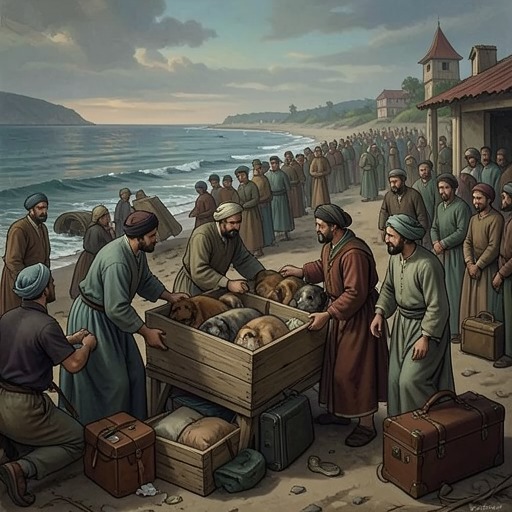
The family’s plan involves more than choosing a destination. They sell the Pondicherry Zoo, both to provide money for immigration and to arrange a future for its animals. The Convention on International Trade in Endangered Species has recently taken effect, changing the conditions under which captured wild animals can be traded. American zoos offer higher prices than Indian zoos, and most animals go to institutions in the United States. Two, however, are destined for the Canada Zoo, giving Canada a place in the family’s preparations before it becomes Pi Patel’s home.
The transfer takes well over a year and requires extensive negotiation and paperwork: health certificates, export and import permits, quarantine arrangements, transport, and agreements with receiving zoos. American representatives examine the animals, testing and inspecting them before approving their transfer. Pi Patel describes the animals as receiving working papers, an image that makes the zoo’s relocation resemble the family’s own preparation for a new national life. The move is not simply a matter of packing and leaving; animals, like people, must pass through systems of classification and authorization before crossing borders.
Departure from India
On June 21, 1977, the family leaves Madras aboard the Japanese cargo ship Tsimtsum. Canada has taken more than a year to become imaginable in practical terms, but departure makes the separation from India immediate. On the last day in Pondicherry, Pi Patel’s mother lingers over the familiar country she is leaving: its heat and monsoons, rice fields, river, coastlines, temples, friends, and known shopkeepers. Pi Patel and the other men of the family are eager to go; she is less ready to relinquish the life they know. Her question about buying cigarettes before departure gives the impending journey an ordinary, intimate pause, while Pi Patel’s father points out that tobacco is available in Canada.
The family’s voyage is meant to carry all of them toward a fresh start, but the shipwreck breaks that plan. At sea, when an approaching ship resembles an oil tanker, Pi Patel imagines that his father, mother, and Ravi Patel may still be alive. The Tsimtsum had several lifeboats, he reasons, and perhaps his family has already reached Canada and is waiting for news of him. Canada, previously a feared and unfamiliar prospect, briefly becomes part of his hope that his family’s life has continued beyond the disaster.
Arrival, return, and belonging
After Pi Patel reaches the Mexican coast, local people take him to their village, where he receives food and care; the next day, police bring him to a hospital. His recovery begins in Mexico, not Canada. The later journey toward his new life is made possible by the generosity of people who provide clothes and food and by Mexican and Canadian officials who help him move from the beach to his foster mother’s home and eventually to the classrooms of the University of Toronto. In his telling, this passage forms one continuous corridor of assistance between rescue and a place in Canadian life.
As an adult, Pi Patel speaks of Canada with affection. He misses the heat, food, and everyday sights and sounds of India, but insists that he loves Canada. His account of university life makes that attachment concrete: he excels at St. Michael’s College and wins the available student awards in zoology, while continuing his religious studies. Canada is not presented as a cure for every loss. Pi Patel still dreams of Richard Parker and grieves the tiger’s abrupt departure; his memories of India remain vivid. Yet when investigators ask whether he will return to India, he says that he will go to Canada because there is nothing for him in India now except sad memories. The country once defined by distance and cold has become the destination he chooses after catastrophe, even as the story preserves the homesickness and bereavement that accompany that choice.