Faith as a Pillar of Survival
Life of PiFaith as a Pillar of Survival describes how Pi Patel’s religious life gives shape and continuity to experience, especially when he is isolated at sea. It is neither a simple escape from suffering nor an unbroken state of consolation: prayer and ritual sometimes steady him, while hunger, exhaustion, and despair remain. Faith matters because it gives him ways to recognize a larger order, to act within the limits of his circumstances, and to return to devotion after moments when belief feels difficult.
An embodied religious inheritance
Pi Patel’s religious sensibility begins in childhood as an inheritance of physical and sensory experience. When he was a baby, an aunt took him to a Hindu temple in Madurai. He remembers no conscious part of the visit, but describes its impressions as a seed that continued to grow. The account associates that inheritance with colored powders, flowers, bells, drums, bare feet on stone, incense, lamps, songs, murals, and the presence of elephants. These are not incidental decorations around an abstract belief: Pi Patel presents them as the means by which religious feeling first became familiar and enduring.
That attachment extends from ritual into an understanding of the universe. Hindu thought allows him to speak of Brahman both as nirguna, beyond qualities and description, and as saguna, approached through forms such as Shiva, Krishna, Shakti, and Ganesha. At the temple, the murti in the inner sanctum makes the sacred feel near; worship, prasad, and the blessing of a flame give that nearness bodily expression. This background helps explain why, during the ordeal, faith can be practiced through objects and gestures rather than depending on a formal place of worship. Its support is rooted in habits of attention Pi Patel carries with him.
Learning devotion through other traditions
Pi Patel also encounters religious devotion beyond his Hindu upbringing. In a baker’s home and workplace, he watches a Muslim pray after the call to prayer. The baker interrupts a conversation, unfurls a carpet on the flour-covered bakery floor, performs the prayer, and then returns to the interrupted conversation. The contrast with the Christian practice Pi Patel knows prompts him to notice not only different beliefs but different bodily forms of communion. Later, in a mosque, worshippers arrange themselves shoulder to shoulder in rows, and Pi Patel finds that bringing his forehead to the ground feels deeply religious.
The baker is a Sufi who seeks fana, union with God, and describes his relationship with God as personal and loving. His teaching presents devotion as reciprocal movement: a person turns toward God and God hastens toward that person. This encounter does not replace Pi Patel’s earlier religious inheritance. Instead, it expands the forms through which he recognizes devotion. The significance becomes practical at sea, where he will pray to Allah as well as adapt Christian and Hindu practices to his isolation.
Vastness and the scale of suffering
During one night on the sea, Pi Patel looks out beneath a clear sky at the crescent moon and stars, with the water extending around and beneath him. The immensity of the setting changes how he sees his suffering: for a moment, he can regard it as finite and insignificant within a vast universe, and accept that perspective. He compares the experience to the sage Markandeya beholding the universe after falling from Vishnu’s mouth. The image gives his perception of scale a religious frame; it does not turn the night into a lasting resolution.
In daylight, Pi Patel protests that his suffering does matter and that he wants to live. That reversal is central to the role of faith in his ordeal. A moment of cosmic perspective can still him, but it does not erase the urgent claims of his particular life. He mumbles Muslim prayers and goes back to sleep, carrying both the temporary acceptance and the continuing desire to survive. Faith holds those responses together without making them identical: awareness of vastness coexists with attachment to the narrow, vulnerable view of life available to him.
Ritual adapted to survival
At sea, Pi Patel reshapes religious observance around what he can actually do. He performs solitary Masses without a priest or consecrated hosts, darshans without murtis, and pujas using turtle meat as prasad. He directs acts of devotion to Allah without knowing where Mecca lies and with imperfect Arabic. These adaptations preserve the repeated actions and devotional intentions of religious practice while acknowledging that the ordinary settings, objects, and authorities are absent. He says they bring comfort, but also records how difficult it can be to sustain trust and love amid anger, desolation, and weariness.
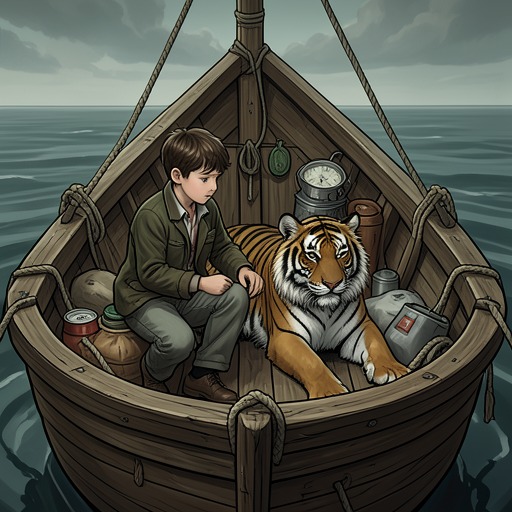
When his spirits sink, he uses the things around him to recall creation and his place in it. He names his makeshift turban as God’s hat, his pants as God’s attire, Richard Parker as God’s cat, the Lifeboat as God’s ark, the surrounding expanse as God’s wide acres, and the sky as God’s ear. The inventory makes the physical world of the ordeal available to religious attention: clothing, animal, vessel, sea, and sky all become points of connection. Yet each image is also tested by the same reality. The turban unravels, the pants fall apart, Richard Parker remains dangerous, the Lifeboat feels like a jail, the sea threatens his life, and the sky seems not to listen. The sequence does not deny material hardship; it makes the tension between devotional meaning and physical constraint explicit.
Despair nevertheless passes. A school of fish around the net, a knot that needs retying, or the thought that his family was spared the ordeal can interrupt the darkness. Pi Patel describes God as remaining a point of light in his heart, after which he can go on loving. On the day he estimates to be his mother’s birthday, he sings to her aloud. The birthday song is another small act of continuity: even alone at sea, he marks a family bond through a familiar human observance.
Faith as continuing practice
Pi Patel’s faith functions as a pillar not because it guarantees safety or keeps despair away, but because it can be renewed through attention and action. His religious life moves among inherited Hindu rites, Christian observance, and Muslim prayer, and on the Lifeboat it takes forms constrained by hunger, weather, limited supplies, and isolation. His practices make devotion possible without the usual sacred spaces or complete ritual materials.
The result is a form of support that remains vulnerable to the circumstances it addresses. The same Lifeboat can be understood as an ark and experienced as a jail; the same surroundings can suggest divine creation and threaten survival. Pi Patel’s repeated acts of prayer and naming do not settle that contradiction. They help him return to a relation with God and to continue loving and living while it remains unresolved.