Fishing gaffs
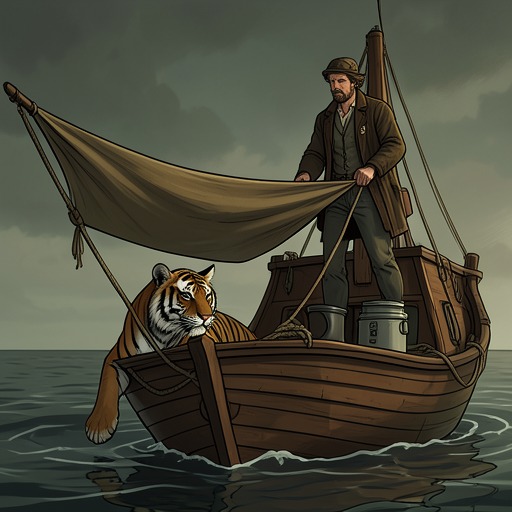
Life of PiThe Fishing gaffs are a pair of sectional, barbed hooks that turn fishing from a slow gamble into Pi Patel’s most valuable practical skill at sea. In his hands they become weapons, instruments of food gathering, and tools for signaling authority to Richard Parker: their significance lies not in one function, but in how survival makes a single piece of equipment serve several kinds of control.
Design and Equipment
Two gaffs are listed among the Lifeboat’s emergency supplies. Each can be assembled from three screw-in pieces: two tubular sections that form the shaft and a separate head. One shaft section ends in a moulded plastic handle and has a ring for securing the gaff with a rope. The head carries a hook about two inches across its curve, ending in a needle-sharp, barbed point. Assembled, a gaff is about five feet long, yet Pi finds it light and sturdy enough to wield with confidence.
The rope attachment matters because a missed strike need not cost him the tool. Pi fishes with different hooks, depths, and weights of sinker, but the gaffs ultimately prove more valuable than the other equipment. The design combines reach, a sharp point, and a means of retrieval; in practice, however, success depends as much on judgment and timing as on the implement itself.
Learning to Hunt
At first Pi fishes in open water, sinking a gaff to a depth of about four feet, sometimes with a fish already speared on it as bait. He waits for hours, body tense, then must decide in an instant when to jerk the shaft upward. Experience teaches him not to strike wildly: fish learn from repeated traps, and a premature or poorly aimed blow may let a catch escape. A large fish hit in the stomach or tail can twist free and dart away, injured and exposed to another predator.
Pi adjusts his aim to the fish’s reactions. He targets the ventral area below the gills and lateral fins, where a struck fish’s instinct is to swim up, in the direction he is pulling. Sometimes the gaff only pricks its target, and the fish bursts out of the water within reach. Pi then abandons any fastidious hesitation about touching sea life. If the hook’s hold seems uncertain, he lets go of the gaff, relying on its rope, and grabs the fish with his hands. The ensuing struggle is close and violent: he uses his fingers, hands, knees, and teeth to hold a slippery fish down until he can reach the Hatchet and chop off its head.
This practice changes both Pi’s competence and his relation to killing. He becomes bolder and more agile, developing an instinct for when and where to strike. The gaff does not make fishing effortless; it gives him a method that he can refine through failure, observation, and repeated physical effort. The fish are food for a starving boy and, when his catch exceeds what he can keep, food for Richard Parker as well.
Bait, Abundance, and Scarcity
Pi improves his results by using part of the Cargo net as a lure. Too stiff, heavy, and loosely woven to work as a fishing net, it attracts fish when trailed in the water; seaweed growing on it makes the net still more appealing. Fish that linger locally gather around it, while passing Dorado slow down to investigate. A hook hidden in the weave allows Pi to use the gaffs against fish drawn close by the net.
The arrangement sometimes produces more fish than Pi can use. He catches Dorado, Flying fish, jacks, groupers, and mackerels, but the Lifeboat has too little space for him to dry all the meat, and he cannot eat it all. He keeps what he can and gives the rest to Richard Parker. The contrast between scarcity and surplus is not a change in the sea’s generosity alone: it reflects Pi’s growing command of the tools and techniques available to him. During successful hauls, scales cling to his body until it glitters; the marks recall the tilaks Hindus wear on their foreheads, making the fisherman appear, in Pi’s imagining, like a fish god. The gaffs help make that fleeting abundance possible, but they do not remove its limits.
A Tool of Authority
The gaffs also enter Pi’s effort to maintain a hierarchy aboard the Lifeboat. When Richard Parker defecates, Pi uses a gaff to nudge the feces toward himself across the tarpaulin, a risky and deliberate task. His purpose is not simply to keep the space clean. He has observed Richard Parker trying to hide the waste, which Pi reads as deference rather than an assertion of dominance.
Pi handles the feces in a conspicuous display, sniffing them and fixing Richard Parker with his gaze while sounding the whistle in a low, menacing way. The gaff makes the first part of this encounter possible, but the act’s force comes from its staged handling and the signals around it. An implement used to seize food becomes part of a contest over territory and rank. Across these episodes, the Fishing gaffs connect practical survival to Pi’s changing conduct: they help him capture food, adapt to its violence, and sustain the fragile order he tries to impose on life beside Richard Parker.