Goats
Life of PiGoats occupy two sharply different roles in Pi’s memories of the zoo. In one, a herd becomes the unlikely social companion of an isolated Indian rhinoceros; in the other, a goat is placed in danger so that Pi’s father can make the threat posed by a tiger impossible for his children to underestimate. Together, these episodes show how the zoo’s animals can form relationships beyond expected species boundaries, while also revealing the difficult balance between animal care and human instruction.
The herd and the rhinoceroses
When Peak, a young wild male Indian rhinoceros, began eating less and showing signs of distress from isolation, Pi’s father looked for a temporary companion while he searched for a female. The arrangement was an experiment with an unequal cost: if Peak accepted the goats, the zoo might save a valuable animal; if he did not, the goats might be lost. The trial worked, and Peak and the herd became inseparable. Their association later continued even after Summit arrived, extending beyond a brief intervention for one animal.
The goats and rhinoceroses settled into a shared routine. When the rhinoceroses bathed, the goats gathered beside their muddy pool. When the goats ate in their corner, Peak and Summit stood nearby like guards. Their closeness did not erase the animals’ differences, but it gave them a recognizable pattern of mutual presence. The public found the arrangement popular, making the cross-species group not only a practical response to Peak’s isolation but also a visible feature of the zoo.
The episode complicates the idea that captivity is only a matter of keeping animals in enclosures. The animals’ companionship matters to the account because it changes how they live within those enclosures: Peak, initially suffering and eating less, becomes part of a stable group, and the goats share space with two large rhinoceroses. Pi presents the outcome as an unexpected success rather than as proof that every species can be paired safely. His father’s decision begins as a stopgap, and its value lies in the particular relationship that develops.
A lesson staged beside the tiger’s cage
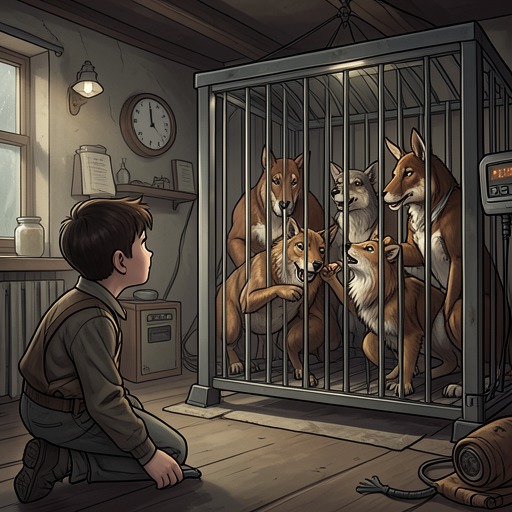
The goats’ second major appearance has a different purpose. Pi’s father gathers the children and announces that he will show them how dangerous tigers are. Babu brings a goat whose legs have been tied and places it in a cage beside Mahisha’s. Bars and a trapdoor separate the animals. The goat moves to the raised rear level of its enclosure while Mahisha tracks its movements from the other cage. Pi’s mother holds him from behind as the demonstration proceeds.
The tiger’s reaction makes the separation between the animals consequential. Mahisha becomes increasingly agitated as the trapdoor is opened; the goat tries to jump, but the smooth cement wall at the back prevents it from escaping that way. Pi’s father had arranged for Mahisha not to be fed for three days, a detail the family learned later. Once the trapdoor slides open, the tiger crosses into the goat’s cage. Pi does not claim certainty about what he saw before his mother turned him away, but the scene frightens the children. The lesson is delivered through the risk to the goat, not through an abstract description of tiger behavior.
Pi’s mother objects that the children may be scarred by what they have witnessed. His father answers that the demonstration is meant to protect them: if Pi someday reached through the bars to touch what looked like pretty orange fur, a goat would be preferable to the child. His soft, contrite response makes clear that he recognizes the distress the lesson caused, even as he defends its purpose. He then continues the lesson more gently, using accounts of dangerous encounters with other large animals rather than repeating the same demonstration.
The children remain upset. Pi and Ravi give their father the cold shoulder for a week, and their mother also ignores him. Pi imagines the rhinoceroses lowering their heads in sadness at the loss of one of their companions. That image connects the demonstration to the earlier herd: the goat is at once an individual animal exposed to danger and part of a familiar zoo community. The family’s anger does not undo the lesson, but it records its emotional cost.
Animal behavior, familiarity, and territory
Elsewhere, Pi explains that zookeeping depends in part on reducing an animal’s flight distance: the space it wants to maintain from a perceived enemy. Food, shelter, protection, and knowledge of an animal’s needs can help make its surroundings stable. The goat-and-rhinoceros association belongs to this broader account of animals adapting to life near other species and humans. It is not presented as a consequence of force or as a universal rule; it is a particular arrangement that worked for Peak and the herd.
Pi also describes zoomorphism, in which an animal takes a human or another animal to be one of its own kind. He cites the rhinoceros-and-goat group as one example among other surprising animal associations, including a mouse that lived among vipers and dogs that foster lion cubs. In his explanation, companionship and social stability can matter more than a strict classification of which species should associate. The goats therefore recur as evidence that the boundaries humans expect between animals do not always determine the relationships animals form.
A separate zoo notice, mentioned in the same discussion, explained that rhinoceroses are herbivores and do not eat goats. The need for such a sign underscores how readily visitors might misread the animals’ proximity: the goats stood beside the rhinoceroses not as food, but as companions. That public misunderstanding contrasts with the tiger demonstration, where the goat is deliberately made vulnerable to establish the danger of a predator. Across both episodes, the goats expose the difference between an animal’s actual place in a relationship and the role people assume or assign to it.
Narrative significance
The goats link care, risk, and the limits of human understanding in Pi’s recollections of the zoo. Their companionship with Peak and Summit challenges a simple predator-and-prey view of animal life; the demonstration beside Mahisha then shows why such familiarity cannot be mistaken for safety around every animal. The same zoo that makes room for an unexpected interspecies bond also uses an animal to teach a frightening lesson about boundaries.
Pi’s father appears in both accounts as a practical zookeeper, but the episodes register different consequences of his judgment. His experiment with Peak gives the rhinoceros a companion and becomes popular with the public. His demonstration for the children teaches caution, yet leaves them angry and distressed. The goats’ importance lies in that contrast: they are not merely scenery or a generic emblem of vulnerability, but animals whose companionship, exposure to danger, and place in the family’s memory give the zoo’s lessons their human and ethical weight.