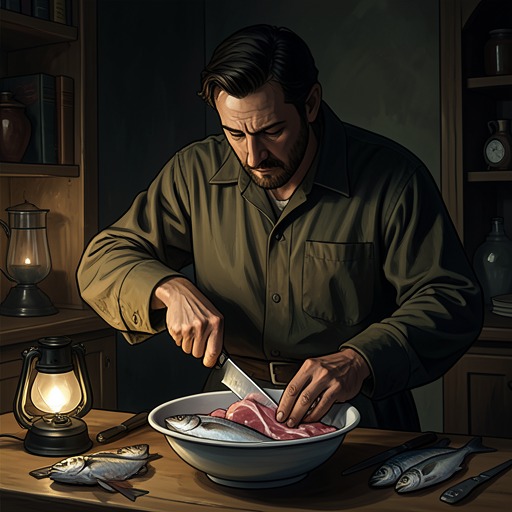
Hunting knife
Life of PiThe Hunting knife is one of the Lifeboat’s most versatile tools, important less as a weapon than as an instrument for turning scarce supplies into the means of survival. Pi uses its different edges and pointed end to modify an oar, prepare bait, and process a turtle. Across these tasks, the knife makes the difference between merely possessing emergency equipment and being able to adapt it to immediate needs, though it cannot do every job on its own.
Design and Place in the Supplies
The knife is listed among the Lifeboat’s emergency equipment as a large hunting knife with a solid handle, a pointed end, one sharp edge, and a sawtoothed edge. A long string attaches it to a ring in the locker. That tether makes the knife part of a deliberately stored supply system: it is available among the tools Pi retrieves, but secured rather than simply loose among the provisions. The inventory also lists fishing kits, gaffs, hatchets, and other equipment, placing the knife within a collection of tools whose uses overlap without being identical.
Its form matters because Pi puts both sides of its blade to work. He uses the sawtoothed edge for cutting into an oar and later for working through a turtle’s shell; the point serves a different purpose when he drills holes. The account presents this variety through practical decisions, not through a formal lesson in tool design. The knife’s significance emerges as Pi encounters a problem, considers what he has, and makes the object serve a new task.
Making the Raft More Usable
After taking water from Richard Parker’s rainwater supply, Pi turns to improving his position on the raft. He checks its knots and then repurposes the fifth oar, previously used as a footrest, as a mast. With the knife’s sawtoothed edge he cuts a notch about halfway down the oar; with its point he drills three holes through the flat section. The work is slow, but gives him a way to make the improvised mast hold its place and support the lines for a canopy and supplies.
The knife is therefore involved not only in cutting material but in reshaping the raft’s structure. Pi threads ropes through the holes and ties them to the ends of the horizontal oars, then uses the lines to support a blanket canopy. The resulting shelter is rudimentary: the mast rises only a short distance above his head, and the deck is barely large enough for him to sit cross-legged or lie down tightly. Still, it is seaworthy and helps keep him apart from Richard Parker. The knife’s work contributes to a concrete change in his circumstances, converting an oar and blanket into a more serviceable arrangement.
Fishing and the Cost of Improvisation
When Pi first tries fishing, he takes a fishing kit and the knife from the locker. Without suitable bait, he cuts his remaining shoe into pieces and hides a hook in a piece of leather. The choice makes use of what he can spare, but the attempt fails: fish take the shoe bit by bit, and Pi ultimately loses the tackle. The knife has helped prepare the bait, but it cannot make the bait effective or prevent the loss of the line and hooks.
That failure distinguishes the knife’s capacity from the larger uncertainty of survival at sea. Pi has equipment and can adapt it, yet practical skill does not guarantee a result. The episode also establishes that he has only one shoe left because the other was lost when the Tsimtsum sank. The knife cuts into an object already marked by that loss, making the attempt at fishing an instance of turning a dwindling personal possession into a possible food source. The possibility does not pay off, and the lost tackle remains a consequence of the first effort.
A Tool with Limits
The knife’s later use in preparing a turtle shows both its value and its limits. Pi consults the Survival manual and attempts to follow its advice, but the turtle’s retracted head makes the recommended method impractical. After trying another approach, he uses a hatchet as well as the knife. The knife’s sawtoothed edge proves useful for removing the tough belly shell, but the process is exhausting, and it does not replace the other tool. Pi eventually gives the turtle to Richard Parker and returns to the raft, depleted by the work.
Taken together, these uses make the Hunting knife a tool of adaptation rather than a guarantee of control. It helps Pi fashion a canopy, try to catch fish, and process food, but each task remains shaped by conditions the tool cannot master: the raft’s instability, the scarcity of bait, or the difficulty of handling an animal. Its narrative importance lies in this practical tension. In Pi’s hands, equipment becomes improvable and multifunctional, yet survival still depends on judgment, other supplies, and persistence when a useful object is not sufficient by itself.