Jesus Christ
Life of PiJesus Christ is the figure through whom Pi Patel encounters Christianity as both a demanding account of divine suffering and a source of lasting devotion. At fourteen, Pi arrives in Munnar as a contented Hindu with little knowledge of the religion. The story Father Martin tells him first provokes disbelief; its emotional force, and the questions it leaves open, draw Pi toward a faith he had expected to resist.
Identity and First Encounter
Pi’s first encounter with Christianity takes place during a family holiday in Munnar. Three local hills bear three houses of worship: a Hindu temple, a mosque, and a Christian church. On the fourth day, Pi climbs the hill with the church, but his apprehension keeps him outside. He knows little about Christianity and expects its reputation for having few gods and great violence to be borne out by what he might find within.
Instead, Pi is struck by the priest he sees in the rectory. Father Martin sits with an open, patient manner that Pi understands as an invitation to bring him a troubled heart or conscience. The clean white room, dark wooden furniture, and open doors reinforce the impression of welcome. Pi leaves, then overcomes his fear and enters the church. Its images confuse him: he tries to understand the central painting and the sculpture beside the sanctuary, but cannot reconcile the apparent scene of sacrifice with the calm kindness he has just observed in the priest.
The next day Pi returns to Father Martin. The priest serves tea and biscuits and treats him as an adult while relating the Christian account of Jesus Christ. For Pi, this is not merely an introduction to unfamiliar beliefs. It is a story whose central claim—that humanity’s wrongdoing is answered through the suffering of God’s Son—runs against his expectations of what divinity should be.
The Story and Pi’s Resistance
Pi responds first with incredulity. To test the logic of the story, he imagines an equivalent situation at the zoo: if animals had caused deaths and destruction, it would be absurd for his father to offer Pi as their substitute. His comparison makes the Christian account feel strange to him, not self-evident. He asks whether Christianity has other stories that might be more satisfying, but Father Martin explains that the earlier stories lead toward one central Story to which Christians return.
The account remains difficult because Pi’s Hindu understanding of divinity makes death seem incompatible with God. He recalls stories in which Krishna reveals the universe within his mouth and Vishnu’s Vamana incarnation expands to cosmic proportions; even Rama, in Pi’s view, can exceed the limits of human strength. Such gods display abundance and power. Jesus Christ, as Pi has heard him described, is instead hungry, thirsty, tired, sad, anxious, and subject to mockery and death. Pi cannot accept that a divine incarnation would truly undergo humiliation and mortality, but neither can he dismiss the idea as a sham without making the suffering meaningless.
Father Martin’s answer to Pi’s objections is love. The answer does not dissolve Pi’s questions. He continues to measure the Christian story against his sense that divinity should be powerful enough to rescue and overcome evil, and he finds the human vulnerability of Jesus Christ troubling. Yet the trouble itself holds his attention. During three consecutive days of tea with Father Martin, Pi returns to his questions; the more he learns, the harder it becomes for him to leave Jesus Christ behind. His resistance becomes an unexpected form of attachment.
Conversion and Continuing Devotion
On the last day of the holiday, Pi hurries back up the hill to see Father Martin. He asks to become Christian. Father Martin replies that Pi is already Christian in his heart because he has met Christ in good faith. The priest pats Pi on the head, and Pi experiences the gesture as an occasion of overwhelming joy. He enters the church without his former fear, regards it as a place that belongs to him too, and prays to Jesus Christ as alive.
Pi then runs down the hill and up the one with the Hindu temple, offering thanks to Krishna for having brought Jesus Christ into his path. This movement between the church and temple gives his conversion a distinctive shape: accepting Christianity does not require him to renounce the Hindu devotion that formed his religious imagination. His commitment to Jesus Christ begins through encounter and love, but remains part of a religious life able to hold more than one tradition.
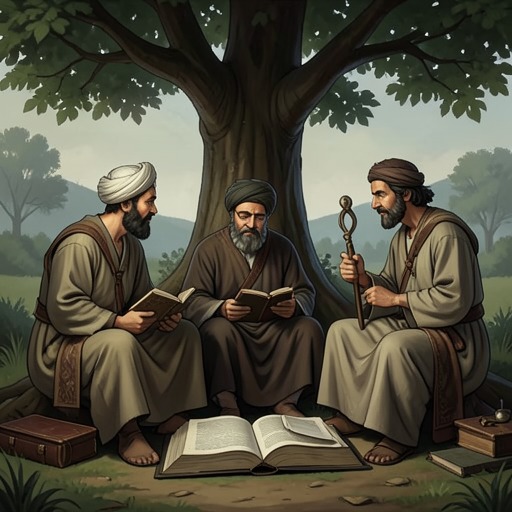
Jesus Christ also becomes a contested figure in the later dispute among Pi’s religious guides. The priest insists that salvation is found only in Jesus, while the other religious leaders challenge one another’s claims. Their argument turns Pi’s private devotion into a public question of religious allegiance. The scene shows the difference between his experience of faith and the exclusive boundaries others try to impose upon it.
Practice at Sea and Narrative Significance
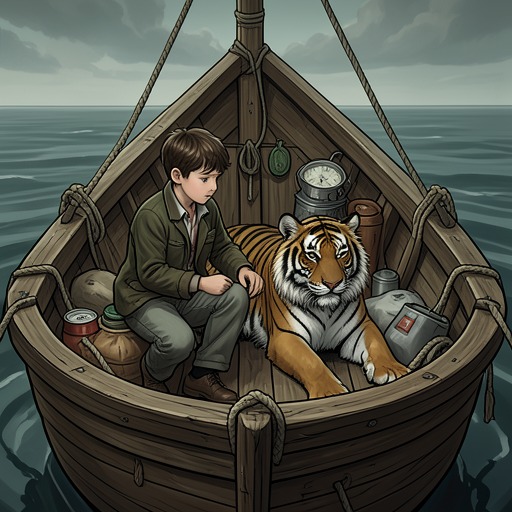
During his ordeal at sea, Pi adapts religious observances to isolation and scarcity. His practices include solitary Mass without a priest or consecrated Communion hosts, alongside Hindu darshans without murtis, pujas using turtle meat as prasad, and acts of devotion to Allah despite uncertainty about the direction of Mecca and his imperfect Arabic. He says these practices bring comfort, though trusting and loving God can at times feel painfully difficult. Christian worship remains part of a larger, improvised discipline rather than a separate or abandoned stage of his life.
When despair threatens to overwhelm him, Pi uses the objects and conditions around him to remind himself of creation and his place within it. He has made a turban from the remnants of his shirt, and he invokes God through the clothes he wears, Richard Parker, the lifeboat, the sea around him, and the sky above. These reminders do not make the ordeal safe or easy: the clothing wears out, the lifeboat feels like a prison, and the sea threatens his life. Their significance lies instead in the religious attention they help him recover. The darkness passes, and Pi continues to love God.
Jesus Christ’s role in Pi’s story is therefore neither a brief episode of youthful conversion nor a simple replacement for his Hindu background. The Christian account confronts him with a God whose vulnerability differs sharply from the divine power he expects, while Father Martin’s hospitality gives that account a human setting in which it can be approached. Pi’s subsequent prayer, his return to the church, and his Christian practice at sea show a devotion sustained through bodily actions and repeated observances. Set beside his continued gratitude to Krishna and his other forms of worship, his relationship with Jesus Christ exemplifies a faith formed through encounter and maintained without the neat boundaries demanded by the later religious argument.