Lifeboat at Sea
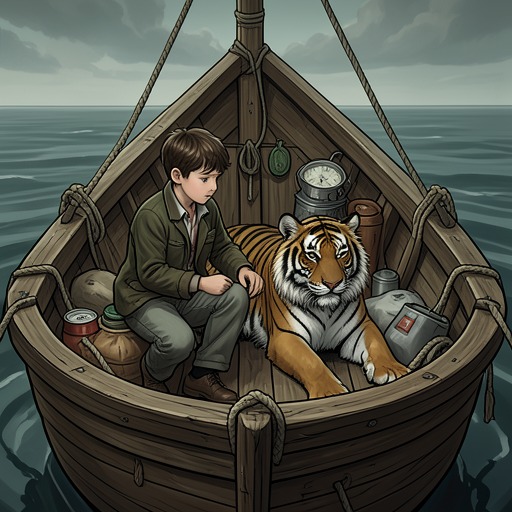
Life of PiLifeboat at Sea is the small, vulnerable vessel on which Pi Patel’s survival after the Tsimtsum sinks depends. It offers a place to escape the water, store what can be salvaged, and maintain distance from Richard Parker; yet each of those functions is insecure, negotiated against a tiger, a failing supply of fresh water, and the Pacific Ocean itself. The boat is not a stable refuge so much as a material problem Pi must repeatedly solve.
Launch and First Peril
The vessel enters Pi’s ordeal amid confusion and violence. After the ship sinks, he sees Richard Parker struggling in the water and calls him toward the boat, using the Orange Whistle to urge him on. Once the tiger reaches the boat, Pi’s impulse reverses: he tries to push him away with an oar, then attempts to row clear, but only turns the vessel and brings one end closer. Richard Parker pulls himself aboard. Confronted with the adult Bengal tiger standing on The tarpaulin, Pi recognizes the danger and throws himself overboard.
The boat’s arrival in the storm is itself precarious. Men throw Pi from the ship, and he lands on the half-unrolled The tarpaulin covering the Lifeboat at Sea, roughly forty feet below. The vessel is still suspended from its davits, swinging about twenty feet above the water. A male Zebra then leaps from the ship, misses the cover, and crashes onto the last bench, breaking it and shaking the boat before it drops into the waves. The vessel is thus shelter and hazard from its first appearance: Pi lands on it by chance, while the animal’s impact damages the place that must keep them afloat.
When Pi is in the water, sharks circle nearby and Richard Parker is somewhere inside the boat. Pi notices that the rope securing The tarpaulin is looser across the short prow than along the rest of the vessel. He wedges an oar handle into that gap, creating a crooked projection above the waves, then wraps his legs around the oar and uses a lifebuoy to secure himself. The improvised support holds him only a few feet above the water, but that small elevation separates him from the sharks. In a storm, a minor structural detail becomes the difference between remaining exposed and having a precarious perch.
Shelter, Territory, and Supplies
The Lifeboat at Sea divides Pi’s existence into spaces with unequal claims. Richard Parker occupies the covered interior and establishes a territory Pi cannot safely ignore; Pi’s own foothold depends on the boat’s edges, benches, and cover. The tarpaulin can provide a barrier, but it does not make the interior safe. Pi’s survival therefore rests partly on keeping the tiger from attacking and partly on preserving a workable separation between them. Their uneasy coexistence turns the vessel into a shared but contested habitat rather than a refuge Pi can command alone.
The boat also holds the limited resources on which that coexistence depends. Pi keeps collected rainwater and water from the Solar Water Stills in a locker, hidden from Richard Parker, inside three 50-litre Plastic Water Bags. He seals the bags with string, wraps them in blankets to protect them from rubbing against the metal hull, and moves them as little as possible. During heavy rain, he fills every available container, including buckets, beakers, empty cans, and plastic bags. The care lavished on these containers records how fragile his supply is: a leak or split could undo the work of collecting water and intensify the most constant anxiety of the journey.
Fresh water is also bound up with the relationship between Pi and the tiger. Pi adds seawater to Richard Parker’s share, adjusting the proportion according to how recently it has rained. Food is harder to ration. Richard Parker notices when Pi catches a turtle, a dorado, or a shark, and Pi has to give him a large share quickly, before the tiger’s impatience at the edge of his territory makes delay dangerous. The boat’s storage space and narrow boundaries shape both the practical distribution of supplies and the terms of their daily coexistence.
A Platform at the Mercy of the Sea
The vessel’s isolation is measured not only by distance from land but by the recurring patterns of its surroundings. From the Lifeboat at Sea, the sky and sea alter constantly in color, sound, and violence, while Pi remains at the center of an unchanging circle. The Pacific Ocean can whisper, roar, or fall silent; none of those changes brings the castaway closer to a secure destination. The boat is the fixed point in this shifting field, a tiny platform that makes the immensity around it newly visible.
When a major storm builds, Pi brings in equipment and deploys both Sea Anchors at different lengths so that they will not interfere with each other. They steady the vessel against enormous swells, but their resistance also pulls its bow downward. When one wave swamps the boat, Pi faces the choice of drowning or being exposed to Richard Parker. He jumps onto The tarpaulin and draws it toward the stern, hooking it down along both sides to close the animal inside. Working from the cramped interior, with only about twelve inches between a side bench and the gunwale, he manages to secure three of the four remaining hooks. The cover becomes an emergency boundary, but sealing the boat leaves Pi in a tight space as water crashes over it and Richard Parker remains unseen beneath it. The storm’s force makes the boat’s fittings, rather than any assurance of safety, the measure of what Pi can do.
The Lifeboat at Sea also carries the possibility of rescue without guaranteeing it. A large tanker passes close enough for its bow wave to lift the small vessel, which misses the ship by less than two feet. Pi fires a rocket flare poorly; it strikes the ship and falls into the Pacific. He blows the Orange Whistle and shouts, but the tanker’s engines and propellers overwhelm his efforts. Within twenty minutes, the ship has become a speck on the horizon. Richard Parker watches the departure, then settles back to sleep. For Pi, the boat has brought him close to salvation only to leave him behind with the same tiger and the same open water.
Messages, Landfall, and Meaning
The boat serves as a platform for reaching beyond its immediate confines, though even that effort is uncertain. When it drifts through oil and domestic and industrial waste, it bumps into a refrigerator; Pi opens it, finds rotten food and the remains of a dead animal, and watches the refrigerator sink. He then puts a message in an empty wine bottle, recording that the Tsimtsum sank on July 2, 1977, four days out of Manila, and asking that his family in Winnipeg, Canada, be informed. He seals the bottle and launches it. The vessel carries the message only as far as Pi can send it; its eventual arrival is not established.
After a prolonged passage, the Lifeboat at Sea reaches Mexico. Pi uses the remaining Sea Anchors to keep it oriented against the surf, then releases them in stages to ride a wave toward shore. The vessel nearly capsizes, but a well-timed wave carries it past the collapsing walls of water and onto the sand. There, Richard Parker leaps over Pi and runs toward the jungle without looking back. Pi struggles ashore and is left without the companion whose presence aboard had been both a mortal threat and a reason to keep going.
The Lifeboat at Sea gathers the practical and emotional contradictions of Pi’s survival into one object. It is too small to make the Pacific manageable, too exposed to guarantee protection, and too divided by territorial danger to offer uncomplicated shelter. Yet its tarpaulin, oar, hooks, containers, and anchors repeatedly give Pi something he can use. The boat does not master the sea or resolve his dependence on Richard Parker; it provides a narrow, temporary ground from which he can keep acting, endure isolation, and finally reach land.