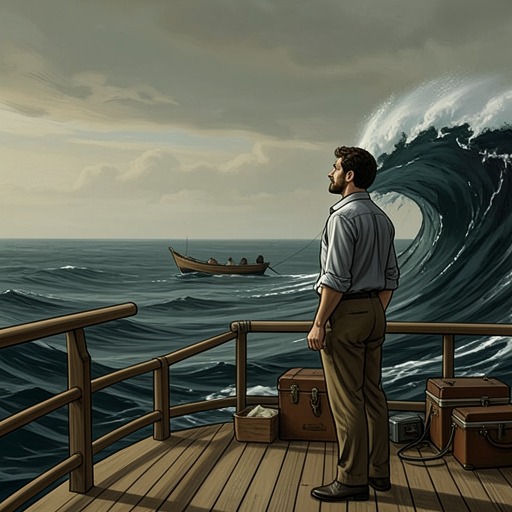
Pacific Ocean
Life of PiThe Pacific Ocean is more than the setting of Pi Patel’s ordeal: it is the force that governs its practical limits and its felt scale. After the Tsimtsum enters the ocean from Manila, the ship sinks on the fourth day out. Pi is left to survive on the water for 227 days, with the sea determining the reach of rescue, the availability of food and water, and the stark boundaries of what he can see. Its changing surfaces offer no stable landscape, yet its unchanging expanse becomes the central condition of his life.
Route and Shipwreck
Before the disaster, the Pacific is the final stretch of a family voyage. The Tsimtsum has travelled from Madras across the Bay of Bengal, through the Strait of Malacca, around Singapore, and onward to Manila. There, it takes on fresh feed and a female Congo chimpanzee, while routine engine work occupies the ship’s crew. Pi is absorbed by the animals and cargo; Ravi, who watches the work, says something is wrong with the engines. The cause of the later sinking remains unresolved: Pi thinks there may have been an explosion, but he was asleep when it happened and cannot be certain. In his account, the explanation lies beyond recovery, at the bottom of the ocean.
The ship sinks midway to Midway, on the fourth day after leaving Manila. Pi remembers the vessel’s disappearance as a collapse of the world beneath him, and the ship’s place on the map he had marked with an orange-tipped pin becomes a pinprick of absence. That private map had made the voyage legible: each morning he obtained the ship’s position from the control bridge and recorded its progress. The sinking destroys that orderly relation between location and knowledge. The last trace he sees is oil on the surface; there are no other lifeboats in sight, and he cannot find his family. The Pacific changes from a route across the map into an immense space in which even the fate of those nearest to him is inaccessible.
The Castaway’s Immediate World
At dawn, the sea appears to imitate the forms of land. Swells briefly rise into hills and valleys, but the resemblance cannot offer shelter or direction. Pi surveys the surrounding water and sky and finds neither family nor rescue craft. The weather eases after the stormy night: the wind softens, clouds brighten, and his wet shirt begins to dry. The beauty of the morning does not undo his isolation. It sharpens the contrast between a tranquil-looking ocean and the practical uncertainty of survival, as Pi shifts between attending to immediate needs and being overcome by grief.
The Pacific also dictates the small, consequential choices made aboard the lifeboat. At first Pi expects rescue within hours and watches the horizon while trying to keep distance from the spotted hyena. When he recognizes that thirst cannot wait, fear of the animals gives way to the need to search the boat for water. The ocean’s exposure makes that search urgent: there is no shore to reach and no dependable source of fresh water beyond what the lifeboat carries or what Pi can collect. In time, he learns to use the equipment and routines available to him, while fishing and gathering water become recurring work rather than temporary measures. The sea is both the barrier separating him from land and the environment from which he must extract what keeps him alive.
Duration, Weather, and Perception
The ordeal lasts 227 days, more than seven months. Pi compares it with the documented survival times of other castaways, then sets his own duration apart. The number makes the ocean’s role measurable, but daily life is not experienced as a simple count. Pi keeps busy because there is always work to do aboard the lifeboat or raft. Tasks structure the hours against a horizon that supplies no ordinary markers of progress. The sea does not simply surround the ordeal; it helps determine how time can be endured.
Its conditions continually reverse what Pi wants. Daylight can expose him to punishing heat, while night brings cold; thirst accompanies hot weather, and rain can leave him soaked and chilled. A calm sea may feel oppressively motionless, while rising waves make open water dangerous. Abundance can also be temporary and difficult to preserve: when floating bananas pass within reach, Pi fails to recognize their usefulness in time, and the water disperses them. Later, he encounters drifting refuse, including plastic, lumber, cans, bottles, cloth, and rope. He searches it for something useful, but the mass of waste also leaves oily smears on the lifeboat. The ocean carries possible resources and unwanted remnants together, without promising that either will arrive when needed.
Vastness and Isolation
Pi’s account makes the ocean’s scale a problem of perception as much as distance. At night, a clear sky and a crescent moon reveal an enormous volume of air above him and water around and below him. He sees his suffering as finite against that immensity, a perspective that briefly allows him to accept it; in daylight, his desire to live asserts itself again. The Pacific offers no settled viewpoint from which his condition can be understood once and for all. Vastness can reduce the apparent scale of his pain, but it cannot make his individual life matter less to him.
The recurring image of circles gives this condition a precise form. The castaway remains at the centre while the apparent circumference stretches beyond reach; sky, sea, and wind change, but his position within that geometry does not. The sea may whisper, roar, or fall silent, and the sky may shift from clear blue to heavy cloud and rain, yet Pi remains confined to the same exposed point. Day and night, heat and cold, hunger and plenty become opposing conditions that can alternate or coincide. The ocean’s apparent openness thus produces a peculiar enclosure: there are no walls, but the visible world repeatedly returns Pi to his own isolation.
Signals, Landfall, and Significance
Even when the ocean carries evidence of human activity, it does not provide a direct route back to people. Among the refuse, Pi finds an empty wine bottle and sends a message identifying the Tsimtsum, its sinking on July 2, 1977, its position in the Pacific four days out of Manila, and his situation in the lifeboat. He asks that his family in Winnipeg be notified and notes that he has some provisions but faces a Bengal tiger. The message is a deliberate attempt to turn his location into information someone else might receive; the evidence does not establish that the bottle reaches anyone. The surrounding water can carry the signal, but cannot guarantee an answer.
The Pacific finally gives way to land in Mexico, though arrival is not an effortless release. Pi uses what remains of the sea anchors to keep the lifeboat aligned with the surf, then times their release as waves carry it shoreward. The landing is dangerous, and he is so weak that even reaching land brings little immediate capacity for happiness. Richard Parker bounds past him onto the beach and disappears into the jungle without looking back. The ocean has kept Pi and the tiger together through the ordeal; at landfall, their shared confinement ends without a farewell or a visible conclusion to their relationship.
As a setting, the Pacific joins physical danger to the limits of knowledge. It conceals the cause of the Tsimtsum’s sinking, separates Pi from his family, and offers no assurance that his message will be found; at the same time, it supplies the conditions and materials around which his survival routines take shape. Its endless horizon is both the obstacle to rescue and the field within which survival remains possible. The change from mapped passage to drifting point, and finally to a difficult landing, gives the ocean its decisive narrative function: it measures the distance between ordinary life and the fragile possibility of return.