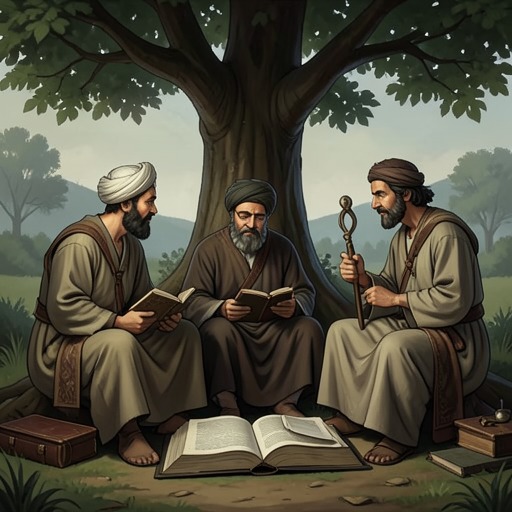
Pi Begins Practicing Islam
Life of PiPi Patel’s turn toward Islam begins not with formal instruction but with a meeting in his hometown: a Muslim baker invites him into his home, interrupts their conversation to pray, and later shares the worship that gives shape to his faith. Through repeated visits, Pi encounters Islam as both bodily practice and a personal relationship with God. The baker’s Sufi teaching becomes one strand in Pi’s religious life, and its influence endures when he must adapt devotion to the conditions of the lifeboat.
First Encounters
At fifteen, Pi explores the Muslim quarter near the zoo. He approaches Jamia Masjid but initially stays outside, carrying suspicions about Islam that he has inherited from its reputation. The mosque appears quiet and plain to him: a white, open building with green trim, straw mats, and two slender minarets. He moves on without entering, so his first meaningful encounter with the faith comes not through the mosque’s architecture but through a nearby baker.
The baker sits cross-legged beside flat, round loaves displayed outside his small shop. Pi mistakes one for old bread, picks it up, and is startled when the man offers him a taste. In his surprise, Pi drops the loaf into the street; the baker responds calmly, explaining that it can feed a cow and offering him another. They eat together, and Pi stays to learn how the bread is made. The encounter makes room for curiosity where apprehension had been: a chance meeting becomes an invitation into the baker’s home and into a practice Pi does not yet understand.
As the baker explains that the loaves cook on smooth pebbles heated in an oven, the call to prayer comes from the mosque. He pauses, goes into the next room, and returns with a rolled carpet. He unfurls it on the bakery floor, prays, then rolls it up and resumes the interrupted conversation. Pi watches the repeated sequence of standing, bowing, kneeling, and prostrating. At first he interprets it as a kind of exercise, and assumes the call has summoned the baker to the mosque. Instead, he sees prayer take place in the middle of the man’s workplace. Later, when Pi is praying in church, the memory of this encounter returns to him. The contrast helps him recognize the force of a form of worship different from the one he already knows.
Learning the Faith Through Practice
Pi returns to the baker and asks what Islam is about. The answer directs him away from an abstract account of doctrine and toward the relationship between a believer and God. On another visit, Pi attends worship at Jamia Masjid. The worshippers first sit in an unarranged group; when it is time to pray, they stand shoulder to shoulder, filling the spaces in their rows. Pi joins them and finds that bringing his forehead to the ground feels deeply religious. The bodily gesture, like the baker’s prayer in the bakery, turns belief into something enacted rather than merely observed.
The baker is Satish Kumar, a Sufi Muslim mystic who seeks fana, union with God, and understands that relationship as personal and loving. He teaches Pi through both conversation and example. His advice presents movement toward God as answered by a movement from God, making divine closeness central to the faith he practices. Pi learns with him to pray and to practise dhikr, the recitation of the ninety-nine revealed names of God. Kumar is also a hafiz, someone who knows the Qur’an by heart, and sings it in a slow, simple chant. Although Pi’s Arabic remains limited, he loves the sound of the recitation and experiences it as carrying a depth beyond his comprehension.
Kumar’s importance is sharpened by a coincidence: Pi also has a biology teacher named Satish Kumar, a Communist and devotee of science. The two men teach him different fields—Islam and biology—and together lead him toward religious studies and zoology at the University of Toronto. Pi regards both as teachers of his Indian youth. The shared name does not make their beliefs the same; instead, the two teachers stand beside one another in the account of how Pi’s intellectual and religious interests develop.
Spiritual Experience and Religious Plurality
Pi describes the baker’s modest home as a place that can feel more sacred to him than a mosque, church, or temple. After visits, he sometimes leaves with a sense of glory. Once, cycling home from town, he looks out over the sea, road, trees, and sky and experiences them as parts of a harmonious unity. He describes the moment as one in which Atman meets Allah. The account links his Muslim practice to, rather than in place of, the Hindu understanding of spiritual reality already present in his life.
This continuity matters because Pi’s religious life is formed through several traditions. His early Hindu devotion is rooted in temple rites, images, offerings, music, and other practices that make faith meaningful through the senses. His attraction to Christianity likewise grows from a personal encounter with Christ. Islam joins this religious life through the baker’s invitation, the prayer performed at work, and the shared worship at the mosque. Pi does not present the traditions as interchangeable: each has its own forms and relationships. Yet his experience of spiritual presence crosses their boundaries. Much later, in Canada, he describes a vision of the Virgin Mary. That later experience does not belong to his initiation into Islam, but it echoes the account’s broader insistence that encounters with God can arrive through more than one religious image.
Practice at Sea and Lasting Significance
During his ordeal at sea, Pi continues this pattern of adapting religious practice to the circumstances around him. Without priests, consecrated Communion hosts, or temple images, he holds solitary Masses, performs darshans without murtis, and makes pujas in which turtle meat serves as prasad. He also directs acts of devotion to Allah, although he does not know where Mecca is and gets the Arabic wrong. These are not simply memories of an earlier religious education: they are rituals he actively reshapes so that devotion remains possible in isolation.
That effort does not make faith effortless. Pi says that trust and love can become difficult amid anger, exhaustion, and despair. At such times, he reminds himself aloud that the improvised things around him belong within God’s creation: his makeshift turban, his clothing, Richard Parker, the lifeboat, the surrounding sea, and the sky. The reminders offer a counterweight to despair, even though the same objects and surroundings can feel precarious or confining. A fish appearing or a practical task demanding attention can help the darkness pass; thoughts of his family also bring relief. Pi’s account therefore presents religious practice as recurrent labor, sustained through words, gestures, and attention rather than secured once and for all by conversion.
Islam’s place in Pi’s life begins in an ordinary exchange over bread and becomes a durable practice shaped by companionship, prayer, study, and mystical experience. The baker’s example teaches him that devotion need not wait for a formal religious setting: prayer can interrupt work and resume where it left off. At sea, Pi carries that lesson into radically altered circumstances, keeping Islamic devotion among the practices through which he continues to seek God.