Pi Misses a Chance at Rescue as an Oil Tanker Passes
Life of PiThe missed tanker rescue is a sharp reversal in Pi Patel’s ordeal: a ship that seems to promise an immediate return to human life passes within reach of the Lifeboat without seeing its occupants. The encounter carries Pi from ecstatic certainty to helpless abandonment, while Richard Parker registers only the commotion. Its force lies in that gap between what the ship means to Pi and what it can recognize from the sea.
Recognition and the promise of rescue
Pi’s first response to the sight of a ship is an exclamation to Richard Parker: “Richard Parker, a ship!” The brief cry begins a rush of hope. Pi imagines the ordeal ending and addresses the tiger as if he can share the news: “We've made it! We're saved! Do you understand, Richard Parker? We're saved !” His happiness briefly displaces hurt and frustration; he describes himself as blazing with joy.
The ship appears to be coming directly toward them. Pi thanks the divine in several names, and the scene joins practical expectation to religious gratitude: rescue seems not merely possible but already granted. He gets to his feet, an effort he has not made for a long time, and imagines people, food, and a bed as the ordinary goods of life returned. The tanker’s approach turns those needs into a vivid prospect. Its bow becomes distinct, and its black metal with white trim gives the imagined salvation a visible form.
Yet the hope is already conditional. Pi wonders whether the ship might pass too far away to see the Lifeboat and considers firing a rocket flare. As the distance closes, he continues to expect recognition, while the ship’s actual course remains beyond his control. The episode’s suspense grows from that mismatch: Pi can see the approaching vessel and interpret its direction as rescue, but he cannot know whether anyone aboard has seen him.
The approach becomes a threat
The tanker does not turn aside or stop. Pi realizes with horror that it is bearing down on the Lifeboat. Its bow becomes a widening wall of metal, accompanied by a huge advancing wave. Richard Parker at last reacts, giving a powerful, tigerlike “Woof! Woof!” The sound marks the danger as physically present even to the animal, though neither castaway can alter the ship’s course.
Pi’s response becomes hurried action. He considers a flare, rejects the delay, and tries to row, calling out instructions to himself as he works at the oar. The bow wave lifts the Lifeboat; Richard Parker crouches, his hair standing up. For a moment, survival depends not on being rescued but on avoiding immediate destruction. The Lifeboat slides off the wave and misses the tanker by less than two feet. The same vessel that had embodied deliverance has become a moving hazard capable of crushing them.
Signals unanswered
As the ship passes, Pi tries to make the occupants notice him. He fires a rocket flare, but aims it poorly: instead of clearing the bulwarks and exploding where the captain might see it, the flare ricochets off the ship’s side and falls into the Pacific Ocean, where it dies with a hiss. He then blows the whistle with all his might and shouts at the top of his lungs. Neither signal changes the outcome. The passage gives the failure a precise physical sequence: a flare reaches the hull but not the people aboard, and Pi’s voice is overwhelmed by the scale and noise of the ship.
The tanker’s engines rumble and its propellers churn underwater, mechanical sounds unlike the natural sounds Pi has heard for weeks. The ship weighs three hundred thousand tons; in less than twenty minutes it has dwindled to a speck on the horizon. Its immense size offers no assurance of rescue. Instead, the black hull passes like an opaque wall, close enough for Pi to fire at and shout toward, yet apparently indifferent to the small craft in its wake.
Aftermath and meaning
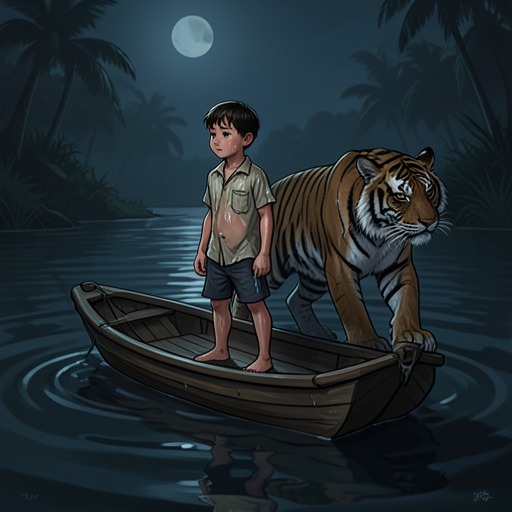
When Pi turns away, Richard Parker is still looking after the tanker. Their gazes meet briefly. Pi’s eyes hold longing, hurt, anguish, and loneliness; Richard Parker understands only that something stressful and momentous has happened, beyond his comprehension. He does not understand that salvation has nearly arrived and been lost. After the ship disappears, he settles down for another nap, offering only a cranky meow. The difference is not simply between human and animal feeling: Pi understands the consequence of the passing ship, while the tiger experiences its disturbance without grasping the rescue it represented.
Pi’s response to this failure is to address Richard Parker with an avowal of attachment: “I love you!” He says that without the tiger he does not know what he would do, and promises to get him to land. The missed rescue therefore ends not in a solution but in a renewed commitment to endure together. The scene’s value reverses from the promise of safety to the certainty that the two remain at sea, yet it also makes their dependence on one another newly explicit. The tanker vanishes; the bond Pi speaks aloud remains.