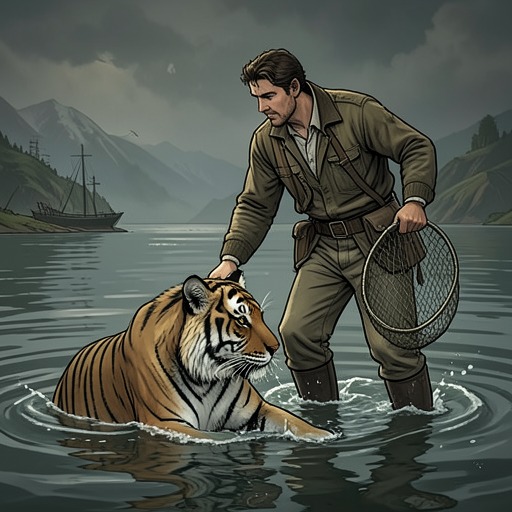
Pi builds a raft to escape Richard Parker
Life of PiPi Patel builds a raft to put distance between himself and Richard Parker, turning the Lifeboat’s emergency equipment into a fragile refuge. The construction is an act of survival under immediate threat: every knot must hold, every movement risks attracting the tiger, and the finished craft offers separation without safety. Its launch changes Pi’s position, but not his predicament; tethered to the Lifeboat, he must choose how far to remain from Richard Parker and how much danger to accept beneath him in the Pacific.
Background and Immediate Threat
After the Tsimtsum sinks, Pi is thrown overboard by crew members and lands on the Lifeboat. There, amid the animals, he is trapped with Richard Parker. When he begins building, the Spotted hyena has just been killed by the tiger. The killing happens almost silently, and Richard Parker emerges from beneath The tarpaulin. Pi is close enough to see the danger directly, while the dead hyena and the confined space make clear how little room the Lifeboat offers for an escape on foot.
Pi’s first thought is to organize his survival. An earlier arrangement using an oar at the bow no longer works: The tarpaulin has been unrolled, leaving nothing to hold that oar in place. Nor can he trust that such a perch would keep Richard Parker from reaching him. He therefore needs a separate floating platform. The choice is not between safety and danger, but between the tiger at close quarters and the open sea.
Building the Raft
Pi works from the Lifeboat’s equipment while trying not to provoke Richard Parker. Four buoyant oars form the raft’s square outline around a lifebuoy. To secure the corners, Pi draws life jackets from beside the tiger, one at a time. The Spotted hyena’s cries and Richard Parker’s rumbling growls intensify the pressure; Pi’s hand trembles as he reaches for the jackets, and he considers throwing himself into the water if necessary.
He threads the oars through the jackets’ armholes so the jackets hold the four corners together, then ties them shut. From the locker he takes buoyant rope and cuts it into sections with a Knife. At each meeting point between the oars he makes ten knots, still afraid that the framework might come apart. He adds further rope around the lifebuoy and through the jackets, weaving the components together as a second safeguard. The improvised structure resembles a square marked out by four oars, with the lifebuoy at its centre: a small, carefully reinforced construction made from whatever can float.
The last connection matters as much as the frame. Pi passes the remaining buoyant line through a hole near the Lifeboat’s stem and hitches it, intending to attach the other end to the raft. Before he can finish, Richard Parker rises and kills the Spotted hyena. Pi is momentarily frozen by the sight. When the tiger hesitates at the rolled edge of The tarpaulin, unsettled by its softness, the open space, and the Lifeboat’s movement, Pi throws him a rat. Richard Parker takes it and retreats beneath the covering to eat. That brief diversion gives Pi time to continue.
Completing and Testing the Craft
While Richard Parker eats, Pi retrieves six more life jackets and the last oar. He attaches a life jacket beneath each side of the raft, straps another across the lifebuoy’s opening to make a seat, and lashes the final oar in place as a footrest. He then hitches the long rope between raft and Lifeboat. The added components improve the craft, but the work remains exposed: the line keeps Pi connected to the tiger’s boat, and the finished raft is still only large enough to sit on.
Pi eases the raft into the sea to test whether it will float. It takes to the water, buoyed by the life jackets, and the oars and lifebuoy rise clear of the surface. The test brings a new danger into view. Fish scatter, but three or four Sharks remain; one swims directly beneath the raft. Pi lies flat and spread-eagled, expecting the craft to overturn or a Shark to bite through its supports. It sinks lower and rolls, with the oar tips dipping underwater, but it remains afloat, and the Sharks come close without touching it.
A Refuge That Cannot Become an Escape
The rope pulls taut, holding the raft about forty feet from the Lifeboat. Pi has built the raft to escape Richard Parker, yet now he wants to return: against the open water and Sharks, the Lifeboat looks like a haven. He tests the raft’s stability, finds the footrest useful, and recognizes the craft’s severe limitation. There is just enough room to sit, not enough to make it a secure home on the Pacific.
He pulls himself closer, then stops short of the Lifeboat. Richard Parker is still eating, and Pi has to weigh the known danger aboard against the Sharks that have so far not attacked him. He settles at roughly thirty feet away, a distance that balances his fear of being too close to the tiger against the risk of being too far from the Lifeboat. He loops the extra rope around the footrest so he can release slack if needed. The raft has not delivered Pi from danger; it has given him a narrow position from which to manage competing threats.
As rain begins, Pi returns toward the Lifeboat to collect supplies, including a rain catcher, a blanket, and a survival manual. The wet locker lid slips from his hand and makes a loud noise, drawing Richard Parker’s attention as the tiger eats. Pi falls back onto the raft and lets out the rope, expecting an attack that does not come. The episode extends the raft’s function beyond its construction: it is the platform from which Pi must keep working, gather necessities, and preserve distance, even when a single mistake can make that distance widen abruptly.
Significance
The raft makes Pi’s survival active and provisional. He does not simply wait for rescue or trust that the Lifeboat can be shared safely; he inventories what floats, devises a structure, reinforces it, tests it, and adjusts its position in response to the dangers he encounters. The repeated checking of knots and the careful setting of the tether turn practical improvisation into a means of controlling, however imperfectly, the space between himself and Richard Parker.
Yet the construction cannot resolve the conflict that prompted it. The raft’s small size, the Sharks below, and the rope tying it to the Lifeboat prevent a clean break. Pi gains a little room to act, not freedom from risk. The raft therefore establishes the precarious arrangement on which his next efforts depend: survival requires him to remain close enough to the Lifeboat for supplies, but far enough from the tiger to stay alive.