Pi catches and kills his first fish
Life of PiPi Patel’s first fish-catching episode is also his first deliberate killing of a living creature. A flying fish, first mistaken for a threat from Richard Parker, gives way to a school of airborne fish and then to a dorado that Pi catches for food. The sequence turns the necessities of survival into a personal threshold: Pi must kill, grieve, and continue, while learning that a successful catch can provide for both himself and the tiger sharing the Lifeboat.
The Flying Fish and the Opportunity
A flying fish, about fifteen inches long, has landed in the locker after striking Pi Patel across the face. He initially fears that Richard Parker is responsible, but discovers the fish instead; Richard Parker is still about fifteen feet away, watching it with curiosity. Pi throws the fish toward the tiger, hoping it might work as a treat and help tame him. The attempt fails when the fish swerves away from Richard Parker’s open mouth and drops into the water. Pi is left with the immediate fear that he has lost an opportunity to manage the tiger, as well as the fish.
The encounter changes abruptly when a school of flying fish breaks from the sea. Dozens leap at a time, some traveling more than a hundred yards through the air. Some fall into the boat, while others strike its side or pass over it. Their sudden arrival is explained by dorados pursuing them: the larger fish cannot follow their flight, but can overtake them with powerful leaps from the water. The chase brings a plentiful catch within reach of Pi, though it also makes the boat a place of frantic movement rather than safety. Once he has gathered fish, Pi wraps one in a blanket, takes the hatchet, and moves toward the raft with unusual care. Having lost his tackle earlier that morning, he is determined not to compound that mistake.
The First Killing
Pi tries several times to bring the hatchet down, but cannot complete the action. He has been a peaceful vegetarian, and the violence he has witnessed so far has been carried out by other animals. Although he had thrown the rat that Richard Parker killed, he distinguishes that indirect responsibility from choosing to kill with his own hands. He considers striking the fish with the blunt end of the hatchet, but cannot bring himself to do that either. Instead, he decides to break its neck under the blanket, out of sight.
Even that method is difficult for him. The fish struggles, and Pi imagines its position from the creature’s side; he stops more than once, though he knows that delaying will prolong its suffering. In tears, he eventually completes the act. He regards the dead flying fish as the first sentient being he has ever killed and feels that his former identity as a harmless, religious boy has been altered. He understands all sentient life as sacred and says that he continues to include the fish in his prayers. The fish’s death therefore has two consequences at once: it supplies food, and it leaves Pi with a moral burden he does not dismiss simply because the killing was necessary.
Learning to Fish
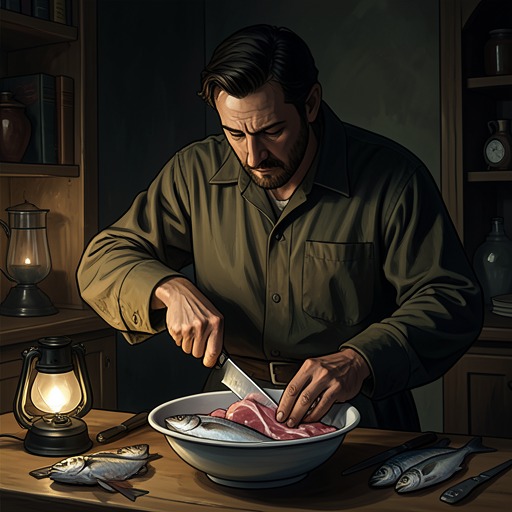
Afterward, Pi finds it easier to handle the fish as food. He chops it with the hatchet, puts the pieces in a bucket, and tries fishing again in the evening. At first he has no success. The small fish nibbling at his hook are too small for it, so he casts farther out and lets the line sink below the fish concentrated near the raft and Lifeboat. He then uses the flying fish’s head as bait, with one sinker, and skims it quickly across the surface. A dorado lunges for it, and Pi lets out a little line so the bait can be swallowed before he pulls.
The dorado’s strength makes the catch precarious. It jumps and dives, the taut line cuts into Pi’s hands, and its struggle repeatedly forces him to give line back. Pi wraps his hands in the blanket and braces himself rather than let the fish pull him from the raft. The other fish disappear from the area, and Pi hurries because the struggle could attract sharks. After a sustained effort, he hauls aboard a dorado more than three feet long. Too large for the bucket, it must be held down on the raft. Pi feels triumph: in taking this fish, he sees himself answering the sea, wind, shipwreck, and other circumstances working against him. He gives thanks to Lord Vishnu.
Food, Adaptation, and Richard Parker
Pi kills the dorado with the blunt end of the hatchet, still unwilling to use its sharp edge. As the fish dies, its surface flashes through several colors; Pi later learns that this change is characteristic of the dorado. He retrieves the embedded hook and part of the bait. The contrast with his earlier grief over the flying fish is striking, but Pi does not present it as a simple triumph over squeamishness. He recognizes a harsher explanation: people can become accustomed to killing. The change is already visible in the movement from hesitant sorrow to the pride of a successful hunter.
Pi takes the dorado to the Lifeboat, keeping low beside it, and drops the fish inside for Richard Parker. The tiger investigates it and begins eating. The catch thus serves more than Pi’s immediate need: it becomes food for the animal whose presence makes control of the boat an ongoing concern. The episode joins practical skill to uneasy accommodation. Pi’s first killing does not erase his reverence for life, but survival requires him to act again; the captured dorado shows how quickly necessity can make killing part of a routine, and how that routine can sustain the fragile arrangement between Pi Patel and Richard Parker.