Pi discovers the lifeboat’s emergency supplies
Life of PiPi Patel’s discovery of the lifeboat’s emergency supplies is the first sharp reversal in his prospects after the sinking of the Tsimtsum: a boat that seemed to offer no provisions contains enough water and food to make survival imaginable, though not assured. The discovery depends on close observation as much as necessity. A hidden lid, its position, and the risks of opening it become practical facts on which Pi’s immediate survival depends.
From Shipwreck to Search
The Tsimtsum sinks in the Pacific Ocean on the fourth day after leaving Manila, midway to Midway. Pi wakes before dawn, finds water flooding the lower levels, and realizes that his family is below him. Crew members give him a life jacket with an orange whistle and throw him overboard; he reaches the lifeboat after landing on its partly unrolled tarpaulin. The ship’s cause of sinking remains unknown: Pi recalls a possible explosion, but cannot be certain, and the later investigation likewise concludes that the available evidence cannot establish the cause.
The lifeboat initially appears to offer little help beyond flotation. As Pi takes stock of it, he notices its sturdy benches and sides, but sees no locker, box, or container. The flat floor seems to leave no space beneath it, and the continuous orange surfaces make the boat look entirely bare. This first inspection brings no relief. Pi is thirsty, his hopes of finding supplies diminish, and the most promising possibility seems to be at the bow, beneath the tarpaulin. That area, however, is also close to Richard Parker’s shelter.
Opening the Hidden Locker
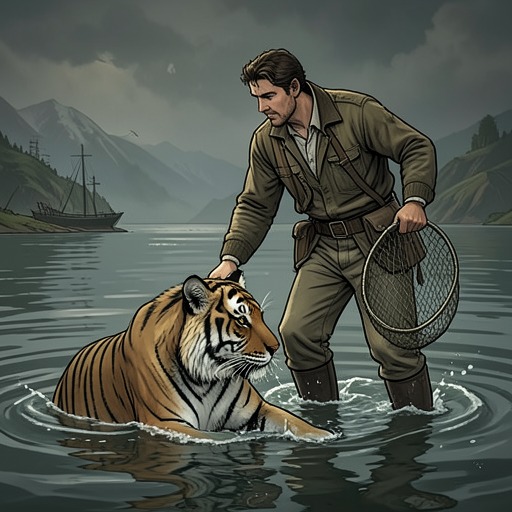
Pi decides that the need for water outweighs the danger of investigating. He removes an oar from beneath the tarpaulin, puts a lifebuoy around his waist, and lays the oar across the bow. Working at the ropes that hold the covering down, he loosens the hooks on both sides and unrolls the tarpaulin only gradually. The careful approach matters: the bow is not merely a possible storage place but the edge of Richard Parker’s den.
As the covering slackens, Pi finds an end bench and, near the bow, a hasp and the outline of a lid. An orange shape below first alarms him, but proves to be a life jacket. Through the life jackets he gets a clear glimpse of Richard Parker, lying still about two feet beneath the tarpaulin. Pi remains motionless while he opens the hasp. The lid’s hinge turns out to be crucial: as it opens, it blocks the narrow space between the tarpaulin and the bench through which Richard Parker might otherwise reach him. Pi positions himself with a foot at the locker’s edge and another against the lid, so that a movement from below would give warning and could send him backward into the water with the lifebuoy. The lid is therefore both the entrance to the supplies and a makeshift barrier between Pi and immediate danger.
Water and Food
Inside, Pi finds packaged provisions, including cans of drinking water. The cans hold 500 millilitres apiece and carry a label identifying the water and its producer, HP Foods Ltd. Unable to find a can opener, Pi makes holes by striking a can against one of the tarpaulin hooks. He drinks four cans, or two litres, before stopping. The water relieves his immediate thirst and restores his strength and clarity, making the locker’s contents more than a cache: they give him the capacity to plan beyond the next few moments.
He also finds Seven Oceans emergency rations. The half-kilogram cartons contain eighteen fortified wheat biscuits, with instructions to eat no more than six in twenty-four hours. Each carton is divided into nine wax-paper-wrapped bars; Pi eats the contents of one carton, then chooses not to open another. The restraint marks an early change in his response to scarcity. Hunger is immediate, but the supplies are finite, and consuming them without regard to their intended use would shorten the time they could sustain him.
Counting the Reserve
After eating and drinking, Pi examines the locker more systematically. Its interior extends farther than its opening suggests, down toward the hull and into the side benches. He counts thirty-one cartons of emergency ration remaining after the one he has eaten. At the stated rate of one carton every three days, he calculates that these provide ninety-three days of food. He also counts 124 remaining cans of water. At the instructions’ recommended half-litre per day, that supply represents 124 days of water.
The arithmetic gives Pi a provisional horizon, not a guarantee. The food estimate and water estimate rest on following the stated ration limits, while his initial two litres of water and full carton of food have already shown how strong immediate need can be. The calculation nonetheless replaces an undifferentiated fear of running out with quantities that can be managed. Pi repeatedly examines the manufactured supplies, finding reassurance in their presence and in the care implied by their preparation, but their finite number makes clear that he must ration them.
A Temporary Foundation for Survival
The locker’s discovery changes Pi’s relationship to the lifeboat. What first appeared to be an empty orange shell becomes a store of usable resources; its lid, hooks, oars, and tarpaulin also acquire practical significance through the way he uses them. This is a survival built from small material details: the hasp reveals the compartment, the hinged lid helps shield him from Richard Parker, and a tarpaulin hook becomes a tool for opening a water can.
The provisions establish a temporary foundation, not a complete solution. Later, as the cartons diminish, Pi limits himself to two biscuits every eight hours and remains hungry. His food practices also change: the bookish, religious boy who had been a peaceful vegetarian struggles with the necessity of killing a fish, and later becomes more accustomed to eating what he catches. The discovery thus begins a longer passage from dependence on packaged stores toward active subsistence. Its decisive gift is time enough to make that transition—and a countable measure of how little time the stores can provide.