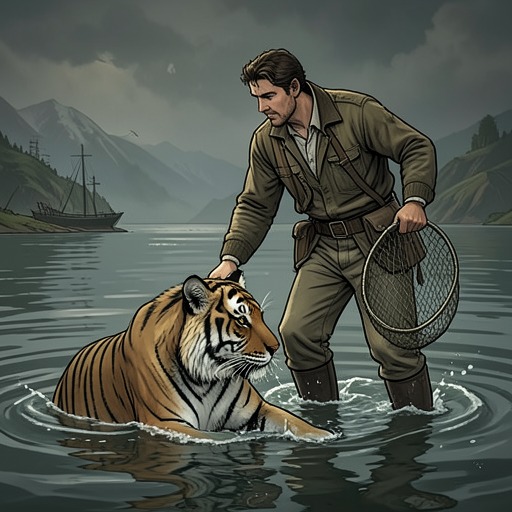
Pi trains Richard Parker to submit
Life of PiPi trains Richard Parker to submit not by overpowering him but by turning their cramped shared world into a lesson in territory, signals, and learned association. What begins as an emergency response becomes a sustained apprenticeship: Pi must make the Bengal tiger’s behavior more predictable while preserving the fragile relationship on which both their survival depends.
The Need to Establish an Order
The first decisive change comes when Richard Parker makes a quiet, friendly-sounding call known as prusten. Pi recognizes the sound from what his father had read and from his account of hearing it once at Mysore Zoo. Richard Parker repeats it with a rolling movement of his head. The absence of an immediate threat gives Pi time to recover his composure, but it does not remove the danger. He understands that waiting for the tiger to die would be a poor plan: Richard Parker’s physical endurance could outlast his own, and they are trapped together in the same boat.
Pi’s reasoning is also emotional. He admits that part of him is glad Richard Parker is alive. The tiger occupies his attention, keeping him from dwelling entirely on his lost family and circumstances; Pi credits that demand with helping him continue to live. The practical objective of training therefore has two sides: control the animal enough to survive, and preserve the presence that gives Pi a reason to persist. He does not treat the tiger simply as an obstacle to remove.
His childhood knowledge of animal behavior provides a framework. In a zoo, the keeper seeks to reduce an animal’s flight distance through knowledge, food, shelter, and protection, helping it feel secure rather than continually threatened. Pi’s father had an intuitive eye for animals despite lacking formal training. Pi also knows that animal rank governs access to food, rest, and association, and that uncertainty about rank can make an animal nervous and dangerous. He applies these lessons to the Lifeboat: the problem is not merely to frighten Richard Parker, but to make the limits of their respective territories legible.
The First Session and the Whistle
Pi sees the sea as both a source of rewards and a force that Richard Parker fears. The horizon supplies a natural arena, while a whistle hanging from a life jacket can provide a consistent signal. Pi’s first effort is theatrical in conception: he imagines the circular sea as a circus ring and himself as its trainer. Beneath that performance is a practical calculation. He needs Richard Parker to associate the whistle with a boundary he should not cross, and he needs to keep trying for as long as rescue may take.
At the first blast, Richard Parker cringes and snarls. He roars and strikes at the air but does not leap overboard. Pi recognizes that fear of the sea is not a permanent safeguard, especially when hunger and thirst become powerful, yet it gives him something on which to build. When the tiger backs away and settles at the bottom of the boat, Pi ends the session, exhausted. He calls the next stage Plan Number Seven: keep Richard Parker alive. The phrase marks a shift in emphasis: training is not a scheme to eliminate the tiger, but an attempt to make their enforced coexistence sustainable.
Training Through Territory and Repetition
Pi later describes a method built around controlled provocation. He recommends choosing a sea with regular, manageable waves, deploying the sea anchor for stability, and preparing a refuge and some bodily protection. The trainer should remain at the edge of his own territory, make a consistent noise, and retreat slowly enough to encourage an intrusion without provoking an outright attack. When the animal crosses the boundary, the whistle and the movement of the Lifeboat must be used promptly. The intended lesson is an association between the whistle and the discomfort of seasickness; once that association is established, the whistle alone can warn the animal away. Recovery, water, shade, and rest matter too: Pi’s account treats repeated practice, not unbroken punishment, as the means of making the signal reliable.
The method is dangerous, and Pi’s own training does not proceed smoothly. He makes a shield from a turtle shell, notches its sides, and ties it with rope. During the first attempt, Richard Parker charges and strikes the shield, sending Pi into the water; the shield is lost. Pi reaches Pi’s raft and spends the rest of the day and the night there without eating or drinking. On a later attempt he uses a smaller, lighter shell. These failures are not presented as proof that he can dominate the tiger by force. Rather, they teach him the cost of approaching too far and the need to read Richard Parker’s warnings.
Richard Parker strikes at him four times, and Pi loses a shield each time. Gradually, Pi learns to interpret the tiger’s ears, eyes, whiskers, teeth, tail, and throat as signals of what may come next. He backs down before a paw is raised, then resumes his own boundary-setting routine: feet braced on the gunwales, the boat made to roll, and the whistle sounded. Richard Parker’s distress at the resulting motion becomes part of the lesson. Pi’s fifth shield lasts for the remainder of the training, a concrete sign that observation and adjustment have made the encounters more manageable.
Retraining on the Floating Island
The work must begin again when Pi and Richard Parker reach the floating island. Richard Parker roams farther than Pi during the day and marks trees with deep gouges. His calls suggest that he is searching for a female, and Pi worries that comfort in this new environment may make the tiger less tolerant of another male in his territory. When they unexpectedly meet in the forest, Richard Parker rears and threatens him repeatedly before moving away. Pi remains frozen until the tiger has gone; then he follows, blows the whistle, and tries to reassert the training relationship.
Pi understands that a new setting can unsettle an animal even when it offers food, water, and space. He describes animal learning as dependent on instinct or rote, with new associations requiring exhausting repetition, especially in an adult animal. He blows the whistle until his lungs hurt, pounds his chest, repeats the command Hep thousands of times, and offers hundreds of Meerkat morsels, food he himself would gladly have eaten. He is careful not to claim the result as his achievement alone: Richard Parker is a young adult and, in Pi’s assessment, a pliable omega animal. The tension of the unfamiliar island may also leave him more ready to respond.
Pi teaches Richard Parker to jump through a hoop made from thin branches. Each of four jumps earns part of a Meerkat. Pi first holds the hoop about three feet above the ground, then changes its position and asks Richard Parker to return through it; for another jump, Pi kneels and raises the hoop over his head. The procedure places Pi in danger each time the tiger runs toward him, but Richard Parker jumps rather than attacking. Pi then rolls the hoop like a wheel for the next exercise. The scene shows training as a repeated negotiation between reward, command, fear, and trust—not a transformation that erases the danger between them.
Significance
The training turns animal-behavior knowledge into a survival practice. Flight distance, territorial boundaries, rank, warning signals, repetition, and reward are not abstract principles for Pi: they shape where he stands, when he retreats, and how he risks approaching Richard Parker. The resulting order remains provisional. The whistle can influence the tiger, but it cannot make him harmless, and Pi must keep observing and adapting rather than rely on a single demonstration of authority.
The episode also joins discipline to dependence. Pi seeks to establish himself as the higher-ranking presence in their shared space, yet his own account insists that Richard Parker’s continued life sustains his will to live. The aim is therefore not victory in a contest but an arrangement in which neither has to destroy the other. The circus-ring imagery gives that precarious arrangement a structure: repeated signals and learned boundaries make a life together possible, while the sea remains the dangerous arena in which the lesson must hold.