Pi’s 227-day ordeal
Life of PiPi’s 227-day ordeal lasts from the sinking of the Tsimtsum on July 2, 1977, to February 14, 1978. The number gives the ordeal a precise outer boundary, but Pi’s account resists the idea that he experienced it as a measured stretch of time: at sea, he survives partly by forgetting the calendar and remembering instead the routines and encounters that punctuate an otherwise vast, repetitive expanse.
Duration and its boundaries
The ordeal begins after the Tsimtsum leaves Manila and enters the Pacific Ocean. On the fourth day out, the ship sinks. Pi wakes shortly after four-thirty in the morning, discovers water surging through the lower levels, and realizes that the ship is listing and going down. When he reaches crew members, they put a life jacket in his arms and carry him away from the sinking ship; they throw him overboard onto a lifeboat below. His account presents the disaster’s cause as unknown: he thinks he heard an explosion but cannot be certain, and the explanation, as he puts it, lies beneath thousands of feet of water.
The dates that frame the ordeal are exact even though the days between them are not. Pi identifies July 2, 1977, as its beginning and February 14, 1978, as its end, and gives the duration as 227 days—more than seven months. He sets that figure beside other recorded sea-survival spans, from thirty-eight days to 173, making the length of his own ordeal legible as an extraordinary measure of endurance. Yet this numerical comparison is retrospective: while he is adrift, he does not keep a running count.
Time without a calendar
After the first five or six weeks, Pi says, he almost entirely stops looking out for a ship. He survives by making a point of forgetting—not only the count of days, weeks, and months, but the very notion of time as a continuous calendar. The distinction matters: he can later supply the endpoints and total duration, but his memories from inside the ordeal are not arranged as a dated log. He remembers events, encounters, and routines that emerged from the ocean of time and left an impression, while admitting that these recollections come in a jumble and may not be easy to put in order.
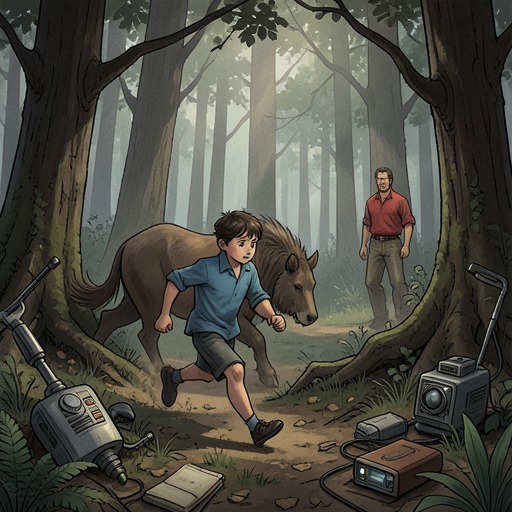
Routine helps give the unmeasured days a practical shape. Pi keeps busy because there is always something to do aboard a lifeboat or raft. Prayer belongs to the daily pattern; rain interrupts other work as he holds up rain catchers to collect water; turtles and Richard Parker disrupt the routine and demand attention. He also spends hours observing Richard Parker, both because the tiger fascinates him and because watching his sole companion distracts him. These repeated tasks do not restore a calendar. They make continued life possible without one.
The sea as changing environment and fixed geometry
For Pi, the apparent variety of the ocean coexists with a sameness that can make a castaway feel trapped. The sky shifts among clear blue, heavy cloud, haze, and rain; the sea can roar, whisper, hiss, or fall silent. Weather and water alter the immediate conditions of survival, but the castaway’s position remains the same: a point at the centre of a vast circle, with the horizon always beyond reach. The sea is therefore both a changing physical environment and the unchanging geometry of isolation.
Its cycles sharpen rather than resolve the ordeal’s oppositions. Day brings exposure, heat, and thirst; night brings cold and solitude. Calm can make Pi long for movement, while high water can make open space feel suffocating. Rain offers water but threatens to overwhelm him. These reversals help explain why elapsed time is less important in his recollection than the particular conditions and encounters that interrupt it: the same expanse can alternately supply what he needs and intensify what he lacks.
Memory, scale, and the ordeal’s meaning
One night, beneath a sharply defined crescent moon and brilliant stars, Pi sees his suffering against the immense scale of the universe. For a time it seems finite and insignificant, and he accepts that perception; when daylight comes, he protests that his suffering matters because he wants to live. He mumbles Muslim prayers and returns to sleep. The episode gives the ordeal a scale larger than survival alone: the ocean can make an individual’s pain appear small, but it cannot make that pain unreal to the person enduring it.
The ordeal’s endpoint is thus held in two kinds of memory: an exact span of 227 days and a disordered succession of remembered markers. Pi names dawn prayers, the killing of turtles, the biology of algae, and the smell of spent hand-flare shells among the impressions that remain, rather than offering a day-by-day chronology. The later investigation likewise cannot turn the duration into certainty about the catastrophe that began it. Its report says the sinking’s precise cause is impossible to determine from available evidence; a hull breach, engine trouble, structural fatigue, weather, and collision remain possibilities or conjectures, not established explanations. Pi’s extraordinary duration at sea is documented, while the ship’s final cause remains unresolved.