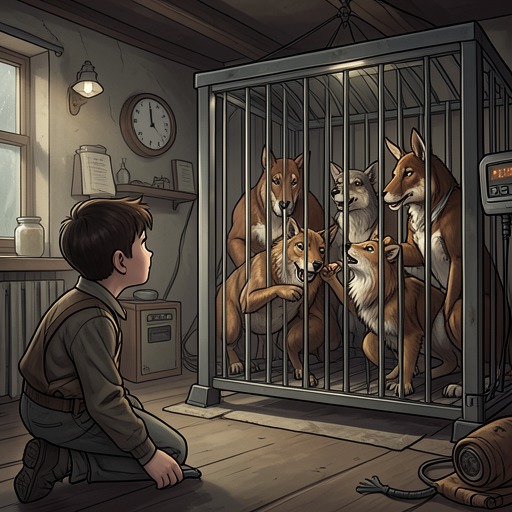
Pi’s Father Demonstrates a Tiger’s Danger with a Goat
Life of PiSantosh Patel’s demonstration at the Pondicherry Zoo turns a warning about tigers into a lesson Pi Patel carries into his later struggle to survive beside Richard Parker. By arranging for the boys to witness a tiger kill a goat, their father makes animal danger concrete; the episode also reveals the protective concern behind his severity and supplies a practical model of how human beings establish authority around powerful animals.
Background and Purpose
The episode takes place during Pi and Ravi’s childhood, when their father decides that his youngest son needs a lesson in the danger of large carnivores. He brings the boys to the zoo before it opens to the public. As they cross the grounds, they pass animal exhibits and familiar keepers, including Sitaram, who oversees the orangutans. At the big-cat house, Babu is waiting to admit them. The setting is not an accidental encounter with a wild animal but a carefully arranged visit inside the family’s zoo, with its keepers, cages, and barriers in place.
The boys enter a large, enclosed cat house where the cages are mostly empty. One Bengal tiger, the patriarch of the zoo’s tigers and weighing about 550 pounds, has been kept inside. The father asks his sons to identify the animal and then asks whether tigers are dangerous. Their answers make the point seem obvious, but he intends them to understand the danger as more than a fact they can recite. He tells them that he wants them to remember the lesson for the rest of their lives.
Pi later clarifies that his imaginative play with animals did not mean he mistook them for harmless companions. He had knowingly imagined animals speaking and behaving like people, but did not believe that a real tiger could safely be approached. The demonstration therefore answers a fear held by his father more than a delusion held by Pi: Santosh worries that his son might someday reach through bars to touch a tiger’s fur. His concern is protective, although the means he chooses will distress the children.
The Demonstration
At Santosh’s direction, Babu brings a goat with its legs tied and places it in a cage beside the tiger’s. A barrier and trapdoor separate the two enclosures. Babu enters and exits the goat’s cage carefully, then frees the animal. It moves to a raised level at the back of the enclosure, while the tiger tracks its movements from the neighboring cage. The father’s lesson depends on the children watching the keepers manage access between the cages rather than coming close to the tiger themselves.
The tiger becomes agitated as Babu prepares to open the trapdoor. The goat jumps, but the smooth, high wall prevents it from escaping the enclosure. When the trapdoor opens, the tiger crosses into the adjoining cage and kills the goat. Pi remembers the decisive action, but is uncertain whether his recollection of seeing blood belongs to the moment or was added later in memory. The uncertainty marks the scene as a child’s recollection shaped by fear, rather than a detached record of every detail.
Afterward, the family learns that the tiger had been left unfed for three days at Santosh’s order. The zoo’s normal practice was to withhold food from big cats one day a week to simulate conditions in the wild; this demonstration involved a longer interval. That preparation clarifies that the encounter was deliberately staged to make the danger unmistakable. It also complicates the father’s lesson: the tiger’s behavior is presented not as a mysterious act of malice, but as the response of a predator given access to prey.
Family Response and Immediate Aftermath
The demonstration frightens both boys, and their mother, Gita Patel, hurries them out. She is angry with her husband and tells him that the children may be scarred by what they have witnessed. Her response makes the cost of the lesson part of the event itself: Santosh means to prevent a future accident, but Gita sees that his method has caused immediate distress. Pi feels reassured by her visible emotion, which confirms that the children’s reaction has been recognized rather than dismissed.
Santosh answers softly that the demonstration was for the boys’ protection. He imagines Pi reaching through the bars to touch the tiger and argues that the goat’s death is preferable to such a risk to his son. He then joins the family and continues the warning in a gentler form, telling the boys about a man who tried to prove himself against lions and was killed. The account extends the lesson from the tiger enclosure to a broader rule: human confidence does not cancel an animal’s capacity to kill.
The event also becomes material for Ravi’s later teasing. When Pi accuses him of an unspecified offense, Ravi threatens that Pi will be the next goat. The joke turns the frightening lesson into a private family reference, but preserves its power: the goat is not simply an exhibit in a demonstration; it becomes shorthand for what can happen to someone who misjudges a dangerous animal.
A Lesson Reused at Sea
The principles behind Santosh’s warning recur in Pi’s later understanding of animal behavior. His account of zookeeping describes flight distance, the space an animal wants between itself and a perceived threat, and the different senses animals use to detect an approaching person. He also explains that animal behavior is shaped by territory and social rank. In this framework, an encounter with a dangerous animal is not safely managed by assuming it is friendly; distance, boundaries, and an animal’s response to its surroundings matter.
At sea, Pi recognizes that he and Richard Parker are confined to the same boat and that he must learn to manage their proximity. When the tiger makes a friendly-sounding prusten, Pi does not treat that sound as proof that the danger has vanished. Instead, he concludes that he must tame the animal and starts thinking in terms of a circus ring, a source of rewards, and a whistle. Later, he uses controlled provocation at the edge of the tiger’s territory, a whistle to signal aggression, and a sea anchor to steady the lifeboat. The childhood demonstration does not give him a complete solution, but it belongs to the knowledge that makes him take animal boundaries seriously.
Pi’s training also depends on repetition rather than on an animal’s understanding a human purpose. He blows the whistle, gives a command, and rewards Richard Parker for completing a series of jumps through a hoop made of thin branches. In this later setting, the lesson about danger has become a discipline of attention: survival requires reading the animal, maintaining boundaries, and acting consistently. Santosh’s demonstration remains severe, but its lasting significance lies in the distinction it impresses upon Pi between imagining an animal and confronting one.