Religious Faith
Life of PiReligious faith in Life of Pi is neither a single doctrine nor an escape from practical life. It takes shape through ritual, bodily action, and repeated acts of interpretation: first in Pi Patel’s childhood Hinduism, then in his encounters with Muslim devotion, and finally in the improvised worship that helps him endure the Pacific. The novel presents faith as a way of remaining in relationship with God amid doubt and suffering, while also connecting belief to the stories people choose to accept.
Formation in embodied worship
Pi’s religious life begins before conscious memory. As a small baby in Madurai, he is taken to a temple by a maternal aunt, with his mother carrying him on the outing. He later understands the visit as the beginning of a religious attachment that has continued to grow. The significance is not that the infant comprehends a doctrine, but that religious belonging first reaches him through participation in a rite and the environment of the temple.
His account of Hinduism remains grounded in particular practices and objects. Temple worship involves offerings, bells, lamps, songs, images of deities, and the blessing of an elephant; Pi recalls these details as the experiences to which he became loyal before he understood their meaning. He describes feeling at home in a temple, responding to the murti in the inner sanctum, joining his hands in worship, receiving prasad, and bringing the blessing of a flame to his eyes and forehead. Faith here is not merely an abstract assent: it is learned through recurring gestures and the senses, and it makes a sacred place feel like a point of contact with a larger presence.
That devotion also has an intellectual dimension. Pi understands the universe through Hindu concepts of Brahman, distinguishing the ultimate reality beyond description from its forms with qualities that permit relationship. The movement between what cannot be grasped and what can be approached through named deities gives his belief room for both mystery and intimacy. His religious inheritance is therefore not a fixed list of propositions alone; it includes ritual attachments and a framework for making sense of existence.
Learning Islam through practice
Pi’s knowledge of Islam grows through encounters rather than formal instruction. While visiting a Muslim baker, he sees the man interrupt an explanation of breadmaking to pray on a carpet unfurled in the bakery. The prayer takes place in the ordinary workplace, amid flour and the work of the oven. Pi watches the sequence of standing, bowing, kneeling, and prostration, initially interpreting its repeated movements as a kind of exercise. The scene unsettles his assumption that prayer must resemble the Christian worship with which he is familiar: the baker’s devotion makes the workplace itself a setting for communion with God.
On a later visit, Pi asks the baker what his religion is about. The answer, centered on the Beloved, leads Pi to recognize Islam as a religion of devotion and brotherhood. At the mosque, he listens to the imam with other worshippers; when prayer begins, people arrange themselves shoulder to shoulder in solid rows. Pi joins them in bringing his forehead to the ground and finds the contact deeply religious. His understanding changes through bodily participation, not just observation.
The baker is a Sufi who seeks fana, union with God, and describes his relationship with God as personal and loving. That example gives Pi a model of faith defined by nearness and affection. It also helps explain how his later religious practice can cross boundaries without reducing the traditions to interchangeable forms: he encounters distinctive ways of worship, yet recognizes in them a shared orientation toward God.
Ritual under survival pressure
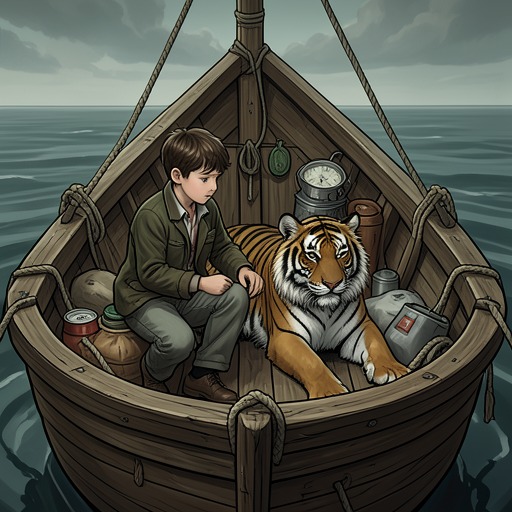
At sea, Pi adapts the practices he has learned to conditions in which their usual supports are absent. He performs solitary Masses without a priest or consecrated Communion hosts, darshans without murtis, and pujas in which turtle meat serves as prasad. He also directs acts of devotion to Allah despite not knowing where Mecca is and getting the Arabic wrong. These improvised rituals do not reproduce ordinary religious settings; they preserve acts of worship in isolation, with the materials and knowledge available to him.
Pi says that the rituals bring comfort, but he does not portray faith as effortless reassurance. Trust and love become difficult when anger, desolation, and exhaustion threaten to overwhelm him. To steady himself, he names the objects around him in relation to God: his turban, made from remnants of his shirt; his pants; Richard Parker; the lifeboat; the open sea; and the sky. The practice deliberately places his immediate world within a sacred frame, reminding him of creation and of his own place in it.
The objects resist that consoling interpretation. His makeshift clothing unravels, Richard Parker remains dangerous, the lifeboat confines him, the sea threatens him, and the sky appears unresponsive. Pi’s religious language therefore does not erase the material facts of survival. Despair returns, but it passes: a school of fish around the net, a knot that needs retying, or the thought that his family was spared the ordeal can draw him back from it. God remains, in his account, a point of light in his heart, and he continues to love. Faith is represented as recurring labor, not a permanent escape from fear or grief.
Wonder, endurance, and reason
A lightning strike becomes one of the rare moments when Pi experiences unqualified happiness during the ordeal. He praises Allah and tells Richard Parker that what they have witnessed is a miracle and an outbreak of divinity, though he cannot find words adequate to it. The response combines a specific act of Muslim praise with an expansive sense of wonder: the event leaves him nearly wordless, yet he understands it as an encounter with something larger than the immediate struggle to survive.
When a ship appears to be heading toward them, Pi’s hope likewise takes a religious form. He thanks Lord Ganesha and blesses God through the combined names Allah and Brahman. His appeal gathers elements of his religious life into one expression at the moment he believes rescue is near. The scene records his expectation in that instant; its force lies in the intensity with which hope and worship coincide.
Religious associations also shape how Pi sees the strange island. Its brilliant green recalls Islam, which he identifies with that color, and is his favorite color. The association does not resolve the island’s nature or make it a religious object; it shows how a religiously formed imagination accompanies him even as he tries to judge what is physically before him. After leaving the island, Pi describes his situation as continuing grief, ache, and endurance, and says that such suffering naturally turns his thoughts toward God. The movement back to faith follows renewed hardship rather than a simple progression toward safety.
Pi does not set faith against practical reasoning. In his later exchange with the Japanese investigators, he argues that reason is indispensable for obtaining food, clothing, and shelter and for keeping tigers at a distance. His objection is to reason made absolute: an excess of it can narrow understanding until the universe itself is excluded. The distinction matches the survival narrative, in which practical judgment governs immediate choices while religious belief helps Pi interpret experiences that practical calculation alone cannot settle.
Faith and the choice of a story
The final exchange makes the connection between religious faith and storytelling explicit. When the investigators prefer Pi’s account with animals as the better story, Pi applies that choice to God. The reply does not supply a factual proof of divine action; instead, it draws attention to how a story can shape what its hearers are willing to believe. Faith, like the animal story, offers a meaningful account of events whose full significance cannot be secured by reason alone.
This ending gathers the concept’s different strands without flattening them. Pi’s belief has been formed through temple rites, deepened by observing and joining Muslim prayer, and repeatedly renewed through improvised worship at sea. It has coexisted with doubt, exhaustion, danger, and careful practical reasoning. By linking the preference for a story with belief in God, the novel presents faith not simply as a claim about what happened but as a way of meeting the world: a chosen openness to meaning that survives even when certainty does not.