Santosh Patel
Life of PiSantosh Patel is the founder, owner, and director of the Pondicherry Zoo, a businessman whose attachment to animals is inseparable from the practical burdens of running a zoo. To his son Pi, the zoo is a childhood paradise; to Santosh, it is also a demanding institution and a precarious livelihood. His decision to leave it behind is shaped by financial realities and political anxiety, and turns the family’s familiar world into the starting point of emigration.
Identity and outlook
Before taking up zoo work, Santosh ran a large hotel in Madras. His enduring interest in animals led him into what might seem a natural transition from hospitality, though the novel emphasizes how different the work is: zoo animals do not leave their rooms, require constant feeding and cleaning, and draw visitors, including noisy ones. Each has its own dietary needs, while the practical work of cleaning depends on where the animals are. The comparison makes clear that Santosh has not simply exchanged one management job for another. He has taken on a business whose daily demands are unusually difficult to control.
At the zoo he is founder, owner, director, and head of a staff of fifty-three. That combination of responsibility makes his worries concrete: animal care, staffing, and money are all part of his working life. Pi remembers him as persistently anxious about the business, and describes the family as poor despite owning many animals. The zoo’s public and educational value does not guarantee that it will be profitable; the tension between service to the public and financial survival is central to Santosh’s position.
The zoo and his family
For Pi, growing up on the zoo grounds means living among animals as part of ordinary daily life. Lions’ morning roars serve as an alarm, while animal calls accompany breakfast and the walk to school passes enclosures and grounds. This affectionate account does not mean that Santosh treats the zoo as a child’s playground. Its animals are his responsibility, and he is alert to the difference between imaginative familiarity and actual danger.
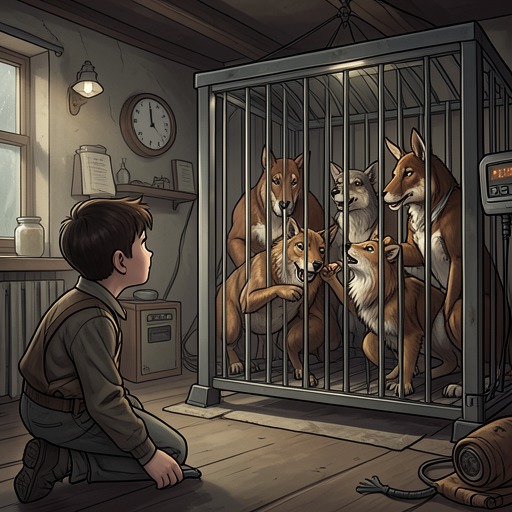
That difference becomes explicit when he takes Pi and Ravi through the zoo before it opens to the public. They pass the keepers at work and arrive at the big-cat house, where Babu is waiting. The Bengal tiger Mahisha is held in a cage, and Santosh asks his sons to identify the animal. He then explains that he intends to show them how dangerous tigers are and that he wants the lesson to stay with them. His instruction is not an abstract warning: Babu brings a goat into an adjoining cage, separated from the tiger by bars and a trapdoor. As the opening is prepared, Santosh watches grimly and repeats the importance of remembering. The evidence presents the demonstration in progress, emphasizing the controlled barrier and the boys’ proximity to the tiger, rather than detailing its outcome.
Religion and practical judgment
Santosh is presented as secular and business-minded, with little personal concern for spiritual questions. He has new animals blessed by a priest and maintains small shrines to Ganesha and Hanuman at the zoo, but Pi understands these gestures as good for business and public relations rather than expressions of his father’s private faith. The distinction fits Santosh’s broader habit of assessing matters through their practical consequences. His principal anxiety is financial: he worries that a disease outbreak among the animals could ruin the family.
The contrast with Pi is marked. While Santosh concentrates on the zoo’s finances and the health of its collection, Pi’s interest in religion develops beyond his father’s outlook. When religious leaders later discover that Pi practices Hinduism, Christianity, and Islam, their surprise throws the family’s differences into view. Santosh has not formed Pi’s religious commitments; his own approach remains that of a secular professional, attentive to the immediate problems of managing animals and sustaining a business.
Political anxiety and the decision to leave
During the troubled mid-1970s, Santosh follows political events with concern. Pi recalls seeing the furrows on his father’s forehead as he read the papers and hearing fragments of conversation at home. In the boy’s own world, the animals continue their routines and political news seems remote. For Santosh, however, the dismissal of the Government of Tamil Nadu in February 1976 is a decisive warning. He sees the takeover as part of Indira Gandhi’s dictatorial rule and imagines that the authorities might eventually take over the zoo or use its grounds for their own purposes. His fear is expressed through a joke about the government needing room for prisoners, but the humor does not disguise how seriously he takes the political threat.
The episode shows how differently father and son experience the same circumstances. Pi’s attention remains with the zoo and its animals; Santosh sees how political authority could reach into the family’s livelihood. His anxiety is not only personal unease: the zoo is a cultural and educational institution that, in Pi’s account, is not necessarily a profitable enterprise. For a family with little financial cushion, the combination of political uncertainty and a vulnerable business makes staying seem increasingly risky.
Selling the zoo and leaving
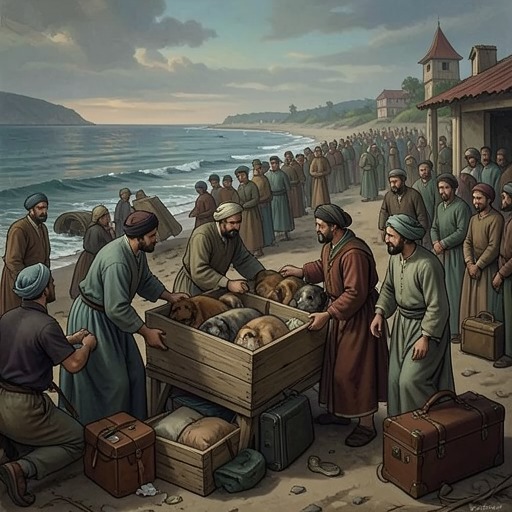
Santosh tells his family that they will sail like Columbus, a phrase Pi answers with the reminder that Columbus had hoped to find India. The exchange captures the gap between the father’s forward-moving plan and the son’s reluctance to leave. The family sells the zoo, its animals, and its equipment; the sale is intended both to secure the collection’s future and to fund immigration and a fresh start in Canada. Santosh could have sold the animals to zoos in India, but American zoos offered higher prices.
The timing is also significant. The Convention on International Trade in Endangered Species had just come into effect, and restrictions on trade in captured wild animals were changing the prospects for zoos. The Pondicherry Zoo closed as buyers competed for its collection. Most animals went to the Lincoln Park Zoo in Chicago and the soon-to-open Minnesota Zoo, while others were destined for zoos in Los Angeles, Louisville, Oklahoma City, and Cincinnati; two were to be shipped to a zoo in Canada. The transfer took well over a year to prepare, despite the fact that animals did not need the documents and household arrangements that make human migration complicated. Pi and Ravi do not want to go: Canada seems defined by severe winters and by the absence of cricket. Santosh’s choice therefore ends a substantial part of the family’s life even as it offers a route to a new one. The zoo that had embodied both his livelihood and Pi’s childhood becomes the property that makes their departure possible.