Starvation
Life of PiStarvation aboard the Lifeboat is not a steady absence of food but a fluctuating ordeal that governs Pi Patel’s imagination, habits, and sense of himself. Rationed biscuits and dreams of abundant meals give way to frantic feeding, bodily decline, and moments when even a tiny catch feels like fortune. Richard Parker’s competing need for food makes every catch urgent; the condition therefore tests not only endurance but also the cultural and moral boundaries Pi Patel had brought with him.
Rations, Memory, and Appetite
The Lifeboat initially contains food, including Seven Oceans emergency rations: half-kilogram blocks of vacuum-packed biscuits, with eighteen biscuits in each block and instructions allowing no more than six in a day. Pi Patel regards their animal fat as a problem for his vegetarian practice, but the circumstances lead him to set that objection aside. As the cartons diminish, he follows the stated limit, eating two biscuits every eight hours. The rule gives scarcity a measurable form, but it does not make hunger manageable: he remains hungry and thinks obsessively about food.
His dreams enlarge meals beyond anything available at sea. He imagines dhal soup like a Ganges, chapattis as large as Rajasthan, rice bowls on the scale of Uttar Pradesh, and enough sambar to flood Tamil Nadu, followed by ice cream piled as high as the Himalayas. The imagined food is not merely plentiful; its ingredients and preparation are perfect, while the meals remain just beyond reach. Familiar dishes and place names turn appetite into a mental return to the tastes and geography of home, even as the present is reduced to counting biscuits.
That distance between abundance and deprivation is sharpened by the conditions of the sea. Day brings heat and a longing for coolness; night brings cold and dreams of hot food. Rain can mean either relief or exposure, and periods of calm can feel as punishing in their monotony as rough seas are in their danger. Hunger belongs to this wider instability: sometimes there is food to feast on, and sometimes there is none. The body cannot settle into a dependable rhythm of comfort or replenishment.
Feeding Under Pressure
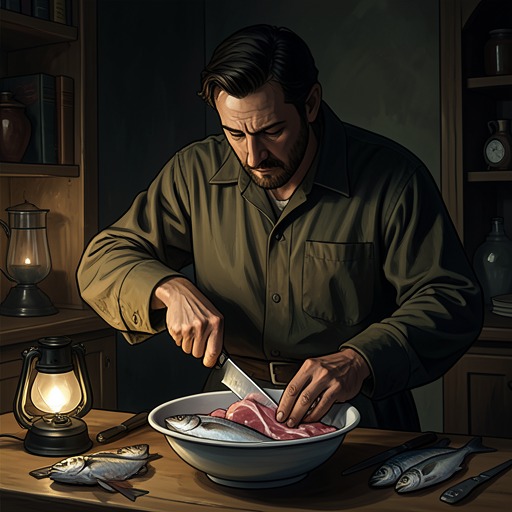
When Pi Patel catches a turtle, Dorado, or shark, Richard Parker is immediately alert to the catch. Pi Patel has little choice but to divide the food quickly and generously. The tiger waits at the edge of his territory, impatiently making his presence known; delay risks losing food. Pi Patel therefore handles fish in haste, sometimes preparing them before he has time to consider what he is eating. Hunger matters, but so does the pressure of the moment and the knowledge that Richard Parker may take the catch.
This urgency marks a change in Pi Patel’s relation to killing. A lifetime of peaceful vegetarianism makes it difficult for him even to kill a fish that is already caught. He tries to avoid seeing the act, hesitates, and changes his approach before he can complete it. Later, the emotional difference between grieving over a flying fish and taking pride in capturing a Dorado is difficult to miss. Pi Patel recognizes that repeated exposure can make killing familiar. Survival has not erased his former values in an instant; it has forced a gradual adjustment in which the next meal can outweigh the time once available for hesitation.
The adjustment also changes how he sees himself. Pi Patel comes to notice that he eats in a hurried, animal-like manner. That recognition brings a pinching sense of shame, but the behavior has a specific cause: food is scarce, Richard Parker is close, and a catch may be lost if it is not eaten or divided promptly. The Lifeboat’s food economy turns eating into a contest of timing and territory, making the distinction between human restraint and animal urgency harder for Pi Patel to maintain.
Hunger, Fear, and the Body’s Decline
The ordeal alternates between hunger and brief, disproportionate relief. Pi Patel describes a tiny dead fish as a reason to feel fortunate even at the lowest point of suffering. This reversal gives food its changed scale: a small catch can carry the emotional weight of a feast because it temporarily answers the immediate threat of having nothing. At the same time, the ease of such relief does not make the underlying hardship less severe. Life aboard the Lifeboat requires physical and moral adjustments, and what can be set aside expands as survival narrows the available choices.
By the later stages of the drift, Pi Patel and Richard Parker are both severely weakened. Richard Parker loses weight and the sheen of his fur; Pi Patel also becomes visibly wasted. He begins sleeping for long periods in a semi-conscious state where daydream and reality grow difficult to distinguish, and he makes use of his dream rag. The deterioration is shared, but their dependence is unequal: Pi Patel must endure his own weakness while remaining attentive to the tiger’s condition.
Pi Patel’s diary records how little strength remains. He sees a large shark circle without attacking and tries, unsuccessfully, to catch a dolphin with a gaff. He cannot stand, fears he lacks the strength to defend himself if Richard Parker attacks, and has so little water that he is down to five spoonfuls a day because the tiger is taking so much. On a hot day without food or rain, he believes both of them are near death. Heavy rain then lets him fill his mouth and the available containers, providing a reprieve from thirst. It does not restore the food supply or the strength already lost.
Pi Patel cannot identify the precise day when he goes blind; he places it somewhere between the hundredth and two-hundredth day, when time has ceased to matter to him. He describes this as the beginning of his extreme suffering. The blindness coincides with exhaustion, hunger, and the collapse of his expectation that he can continue caring for Richard Parker. When he resolves to die, he is more distressed by the tiger’s approaching death than by his own, and apologizes for having failed him. Starvation has thus become a crisis of responsibility as well as of bodily survival: Pi Patel fears that he can no longer sustain the creature whose continued life has shaped his own routines.
Hunger and the Limits of the Survival Story
The animal-free account adds a different perspective on hunger. It describes the Cook eating flies during the first day in the Lifeboat, despite the presence of food and water said to be sufficient for weeks and the expectation of rescue. Pi Patel recalls that the Cook also prepared a rat, and admits that he secretly ate a small piece. The episode does not describe the same prolonged scarcity as the later rationing; instead, it shows hunger and appetite appearing even when provisions remain, and Pi Patel’s own conduct departing from the disgust he feels toward the Cook.
In another part of that account, Pi Patel admits that, driven by extreme need after a castaway had died, he used the man’s body as bait and consumed a small amount of flesh. He says he stopped when he caught a fish and prays for the man’s soul. Placed beside his earlier difficulty killing fish, the admission makes the consequences of deprivation stark without making them simple. Starvation alters what Pi Patel can do and what he can bear to acknowledge, but the narrative retains his awareness of the moral cost. Across both tellings, food is at once ration, remembered meal, contested catch, and a measure of how survival changes the person who depends on it.