Survival Ethics and Moral Compromise
Life of PiSurvival Ethics and Moral Compromise is the struggle to preserve life when hunger and violence make familiar moral rules difficult to maintain. Through Pi Patel’s changing relationship with food, his refusal to eat a fellow human’s remains, and his eventual killing of the Cook, the narrative treats survival not as an escape from ethical judgment but as a condition that reshapes it. The crucial distinction is not simply between what a person will do to live and what that person will refuse to do: it is also between adaptation under pressure and the harm inflicted on others.
Moral Commitments Under Pressure
Before deprivation has fully remade his habits, Pi’s vegetarianism stands between him and the killing of an animal. When faced with a fish, he cannot readily bring himself to kill it. He covers its head with a blanket and tries to find a way to complete the act without looking directly at it. His hesitation is not abstract: the familiar rules of a lifetime meet the immediate need for food in the confined space of survival at sea. The effort required to cross that boundary makes the act morally legible even as necessity presses him toward it.
The contrast with Richard Parker’s killing of a rat sharpens Pi’s sense of responsibility. Pi distinguishes the animal’s predatory act from his own participation: he believes he contributed by throwing the rat, but does not regard himself as the one who killed it. That distinction matters because his later choices will be his own. The narrative follows a gradual movement from witnessing predation, to hesitating over killing, to taking an active part in securing food.
Rations, Hunger, and Adaptation
At first, food comes in packaged form. Pi finds Seven Oceans emergency rations made in Bergen, Norway: half-kilogram blocks of vacuum-packed biscuits, with instructions in twelve languages. The English directions specify eighteen fortified biscuits in a block and recommend eating no more than six in twenty-four hours. Pi’s vegetarian scruples remain present even as he accepts the ration, which contains animal fat; exceptional circumstances lead him to set that objection aside rather than refuse the food.
As the cartons diminish, he reduces his intake to two biscuits every eight hours and remains continuously hungry. Food occupies his imagination with increasing force. His dreamed meals expand into extravagant abundance: dhal, chapattis, rice, sambar, and ice cream, each imagined as perfectly prepared yet always beyond reach. The contrast between these plentiful meals and his restricted ration turns hunger into more than a physical condition. It reorganizes attention around what can be eaten, while memory and fantasy supply what the sea does not.
The change becomes more visible when Pi moves from reluctance to actively catching and killing fish. He later contrasts his sorrow at killing a flying fish with the confidence he feels after capturing a dorado. His own explanation is that a person can become accustomed even to killing. The transition does not erase his earlier resistance; it shows how repeated need can make a once-unthinkable act manageable, and how success at obtaining food can bring pride alongside moral unease.
The Human Story and Its Boundaries
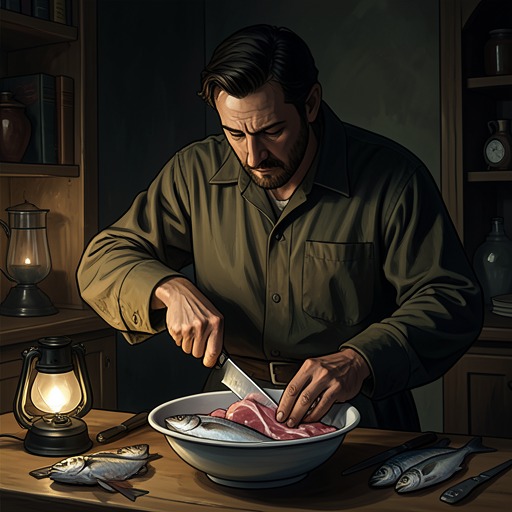
In the account without animals, the Cook’s conduct presents a harsher version of adaptation. Although the group has food and water expected to last for weeks, fishing equipment, and hope of rescue, the Cook immediately consumes flies and also prepares a rat for food. Pi recalls secretly accepting a small piece of the rat himself. The episode complicates any clean separation between Pi’s later survival habits and his earlier standards: even while he and Pi’s mother are offended by the Cook, Pi admits to yielding in a small way under hunger.
The Cook then uses the Taiwanese sailor’s body as bait after the sailor dies. Pi and Pi’s mother are horrified by the treatment, while the attempt also fails as a practical measure: the bait does not hold together on the hook. Two days later, Pi’s mother sees the Cook eating a portion he had claimed was intended for fishing. She confronts him, but he continues rather than showing remorse. His response makes the moral conflict plain: he treats consumption as a source of strength, while she insists on a boundary the conditions have not yet made her cross.
Pi and Pi’s mother refuse to eat the sailor’s remains, even at a cost to their strength. Their refusal is not a refusal of all animal food. Pi’s mother, a lifelong vegetarian, forces herself to eat raw fish and raw turtle caught from the sea, but never loses her revulsion; Pi finds the adjustment easier and says hunger improves the taste of everything. The difference between eating what the sea provides and consuming a human being remains central to their account of what survival has changed and what it has not.
Violence, Choice, and Responsibility
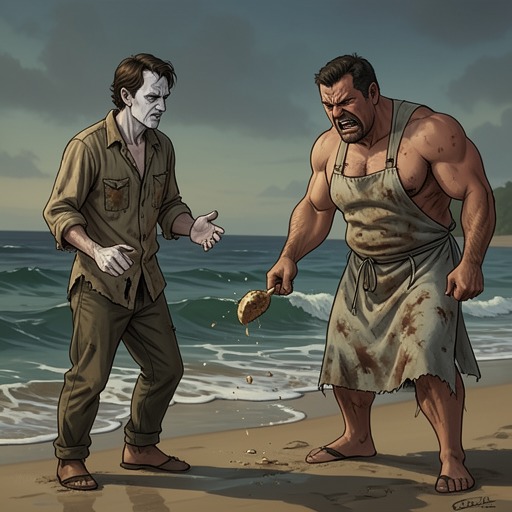
Conflict escalates after Pi and his mother lose a turtle they need to hold onto. The Cook strikes Pi, Pi’s mother strikes back, and the Cook kills her. She has pushed Pi toward the raft, and he jumps, believing she will follow. From the raft he witnesses the attack but cannot intervene. The event makes the Cook’s violence distinct from the compromises that hunger has already produced: the narrative does not present his killing of Pi’s mother as merely another way of obtaining food.
Pi later kills the Cook. He describes the knife as already in view and says that he takes it up and attacks until the Cook dies. His account gives the killing a particular moral weight: the Cook had gone too far, yet Pi does not portray himself as untouched by what he has done. He interprets the Cook as giving up during the struggle, but receives no apology or final words. The absence of an explanation leaves Pi with the action and its consequences rather than a reconciliation that might settle them.
The sea’s scarcity also leads Pi to use a dead fellow castaway as bait and to eat a small amount of the dead man’s flesh. He says that he stops once he catches a fish and prays for the man’s soul every day. These details place the act within extremity without making it morally weightless: the need is severe, the dead man is already beyond help, and Pi nonetheless continues to remember the act through prayer. Survival explains the pressure under which the boundary is crossed; it does not remove the memory of having crossed it.
Moral Aftermath and Narrative Significance
The account’s ethical force lies in its different forms of compromise. Pi accepts a ration containing animal fat, learns to kill fish, eats animal food despite earlier commitments, and finally acknowledges an act involving human remains. The Cook, meanwhile, exploits the vulnerable sailor and kills Pi’s mother. Pi’s own killing of the Cook follows that violence, but it also exposes capacities in himself that he would rather not claim. The narrative therefore resists equating every act done under scarcity: circumstances matter, as do the person harmed, the choices available, and the consequences that remain.
Pi’s final judgment is not self-exoneration. He says that the Cook was evil, but that the Cook met evil in him as well, naming selfishness, anger, and ruthlessness as qualities he must live with. That admission gives survival an aftermath beyond bodily endurance. The decisive question is not whether Pi remains exactly as he was before the ordeal, but whether he can recognize what necessity and violence have brought out in him. His daily prayer for the dead castaway and his acknowledgment of guilt keep remembrance alongside adaptation. In this way, moral compromise is presented as both a means of continuing to live and a burden carried after the immediate danger has passed.