Territorial hierarchy aboard the lifeboat
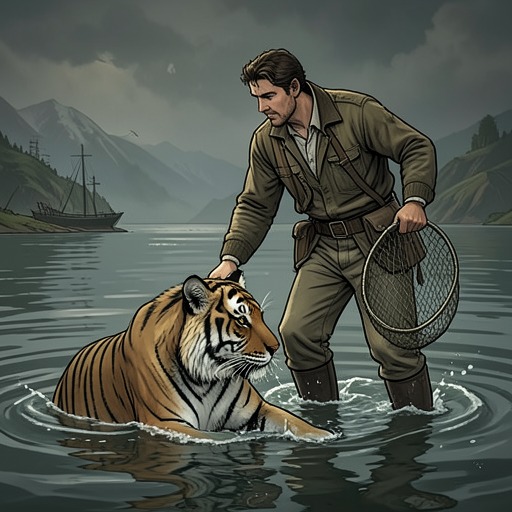
Life of PiThe territorial hierarchy aboard the lifeboat is Pi Patel’s practical answer to sharing a confined vessel with Richard Parker, a tiger capable of outlasting him. It divides the boat into spaces, assigns each animal a place, and uses repeated signals to make those boundaries legible. The arrangement is never simply a triumph of human authority: Pi’s safety depends on understanding Richard Parker’s warnings, managing the boat’s motion, and recognizing signs of deference as well as danger.
Boundaries and the Need for Order
Pi’s decision to tame Richard Parker takes shape when the tiger makes a quiet sound of friendliness, a prusten. The unexpected signal interrupts Pi’s immediate fear and brings a difficult recognition: they are dependent on the same lifeboat and will live or die together. Richard Parker is a threat, but his presence also keeps Pi from being alone with despair and gives him a reason to continue. Taming the tiger therefore means more than reducing danger. It is an effort to make their shared existence possible without wishing Richard Parker dead.
The survival manual offers practical advice about exposure, water, and food, but says nothing about establishing relationships of dominance with a dangerous animal aboard a lifeboat. Pi must devise that part himself. He determines that Richard Parker’s territory includes the floor, the stern bench, and the side benches up to the middle cross bench. Pi reserves the top of the tarpaulin and the bow for himself, with the middle bench functioning as neutral ground between them. This map turns a single cramped vessel into divided spaces, where crossing a boundary can carry a meaning beyond movement.
The boundaries are necessary amid other immediate demands. Pi expects the animal carcasses to run out and knows he must soon fish; he also recognizes that continual exposure to sun, wind, rain, and sea will exhaust him. He needs shelter, and he needs the raft’s rope secured with a second line in case the first fails. These practical concerns make the hierarchy part of a broader effort to keep the boat usable and his own survival manageable. Control is not an abstract claim to superiority: it is a condition Pi believes he must establish before hunger, exposure, or a future dispute over space overwhelms him.
The Whistle as a Learned Boundary
Pi’s method depends on provoking Richard Parker without provoking a full attack. He chooses a day with small, regular waves, extends the sea anchor to steady the lifeboat, and prepares a refuge and whatever protection he can make. Then he approaches the boundary, stamps on the middle bench, and blows the whistle mildly. The chosen place matters: Pi intrudes at the edge of the tiger’s territory rather than entering it, and the consistent sound gives his challenge a recognizable form.
The next step is to draw Richard Parker toward a boundary crossing and retreat as he advances, without breaking eye contact. Pi’s aim is to register an intrusion, then respond at once. He blows the whistle continuously and works to make the lifeboat turn broadside to the waves, using its motion as part of the conditioning. When Richard Parker is exhausted and unwell, Pi stops, steadies the boat, provides shade if needed, and leaves water available as the tiger recovers. The procedure is deliberately limited: discomfort is used to form an association, but recovery is part of the routine, and the process is not repeated until the animal has regained its strength.
With repetition, the desired connection is between the whistle and the consequence of crossing a boundary. Once Richard Parker has learned it, Pi expects a single shrill blast to send him back toward the safest, farthest part of his territory. The whistle’s role thus changes from a sound Pi uses during a risky confrontation to a compact signal that can maintain distance without repeating the whole exercise. Pi’s intended authority is produced through a pattern of intrusion, warning, consequence, and recovery—not by making the tiger cease to be dangerous.
Reading Danger and Establishing Rank
The arrangement requires Pi to learn Richard Parker’s signals as closely as he teaches the tiger to respond to his own. Pi understands that animals generally avoid the costs of a fight when warning and retreat can settle a contest. A tiger’s rush may include snarling and growling, yet it can stop before contact; the animal assesses the situation and may turn away once it considers its point made. This knowledge helps Pi distinguish a warning from an attack that cannot be safely challenged. The hierarchy is therefore reciprocal in its demands: Pi asserts boundaries, but he must also recognize when to back down.
The earliest attempts make that lesson consequential. Richard Parker strikes at Pi during the confrontations, and Pi is repeatedly forced to retreat. Over time, he learns to read the tiger’s ears, eyes, whiskers, teeth, tail, and throat as signs of what may come next. He begins to withdraw before Richard Parker raises a paw. Only after judging the animal’s warnings can Pi safely return to his own method: standing at the boat’s edge, setting the vessel in motion, and sounding the whistle. The resulting order rests partly on training and partly on Pi’s close attention to the tiger’s changing behavior.
A subtler sign emerges in Richard Parker’s treatment of his waste. When the tiger tries to conceal it, Pi reads that behavior as deference rather than a claim to dominance. Pi responds by handling the waste deliberately, staring and using the whistle in a low, menacing way. The act is not routine cleaning for the sake of zoo hygiene; Pi uses it to communicate that he can approach and inspect what Richard Parker has hidden. The tiger does not stare back, and Pi takes this avoidance as evidence that mastery is developing. The episode shows how the hierarchy is maintained not only through dramatic training, but also through Pi’s interpretation and staging of small, repeated signs.
A Precarious Coexistence
Pi’s system does not erase the imbalance between human and tiger. He cannot rely on Richard Parker’s natural death, and he cannot safely claim every part of the lifeboat. Instead, he marks a limited territory, learns to detect danger, and conditions the tiger to retreat from particular boundaries. Richard Parker’s warning signals limit the force Pi can use; Pi’s planning and the whistle give him a way to influence what happens next. The order aboard the boat is consequently neither effortless mastery nor undifferentiated panic, but a fragile arrangement built from restraint, repetition, and observation.
The hierarchy also clarifies why Pi needs Richard Parker alive. The tiger threatens his body, yet his presence keeps Pi’s attention fixed on the immediate work of surviving. The whistles, boundaries, and careful reading of behavior give that work a structure. A shared boat that might otherwise be only a trap becomes a place with rules—rules Pi devises, tests, and revises because both occupants remain dependent on it. Their coexistence is never made safe in an absolute sense; its achievement is that danger becomes sufficiently ordered for Pi to go on living.