Territory and Dominance
Life of PiTerritory and dominance are not merely abstract principles of animal behavior in Life of Pi: they become the working conditions of survival for Pi Patel and Richard Parker. The novel connects zoo practice, circus performance, and life aboard a lifeboat to show how boundaries and social rank can make dangerous encounters legible. Authority depends on the animal knowing where it stands, but also on the human repeatedly supplying signals and conditions that make that order hold.
Animal Territory and Social Rank
The account begins from the difference between an animal’s physical surroundings and the distance at which it feels safe from a perceived enemy. This flight distance varies by species and by sense: cats watch, deer listen, and bears smell. The examples make the principle measurable rather than metaphorical. A flamingo may tolerate a person at more than three hundred yards but react when that distance is crossed; giraffes respond differently to a person approaching on foot and to one inside a motor car. Fiddler crabs, howler monkeys, and African buffaloes each have their own thresholds. Keeping an animal calm therefore requires understanding the particular cues and distances that shape its response.
Zookeeping can reduce that distance through knowledge, food, shelter, and protection. The intended result is not simply an animal that stays in its enclosure, but one that remains healthy and relatively unstressed, feeds without fuss, behaves and socializes in natural ways, and may reproduce. Pi Patel describes his father’s success as grounded in attentiveness and intuitive observation: he could look at an animal and guess what was on its mind. The animals’ health and reproduction serve as evidence of care and competent management, not just control.
Territory also explains why an animal may attack without being hungry. In the account of a lion’s enclosure, an intruder has crossed into the animal’s space; the danger comes from the boundary violation, not from a need for food. Circus training reverses the apparent arrangement. The trainer enters first, in the lions’ sight, and establishes the ring as his territory through posture, movement, and conspicuous signals. The circular arena leaves the lions no corner in which to hide, reinforcing the trainer’s control of the space.
Rank matters because it organizes ordinary access as well as confrontation: whom an animal associates with, where and when it eats, and where it rests or drinks. Until its place is clear, social uncertainty can make it nervous and dangerous. The text stresses that rank does not always have to be settled by a fight. A confident posture, steady gaze, fearless approach, or striking noise can intimidate an animal into yielding. Dominance is thus psychological as well as physical: the human’s knowledge of animal behavior becomes a means of shaping what the animal expects and how it acts.
From the Lifeboat to a Shared Territory
At sea, these principles acquire immediate stakes. When Richard Parker makes the tiger’s quiet prusten—a nasal puff associated with friendliness and harmless intentions—Pi Patel’s panic briefly subsides. The sound does not make the tiger safe, but it changes how Pi understands their situation. They occupy the same confined boat and cannot simply separate; Pi recognizes that he must try to tame Richard Parker. He also admits that the tiger’s presence gives him a reason to keep living, distracting him from grief and despair. Their relationship therefore begins neither in trust nor in simple mastery, but in mutual dependence under threat.
Pi Patel sees the lifeboat as a space that can be organized like a circus ring. The sea supplies possible rewards, a whistle can act as a signal of authority, and the boat’s divisions can establish separate territories. His training depends on provoking Richard Parker carefully rather than making a direct attack unavoidable. Pi moves to the edge of his own area, makes a consistent noise, and retreats while maintaining eye contact, seeking to draw the tiger across a boundary without stepping into the tiger’s space himself. The method relies on a controlled trespass and an emphatic response: the tiger is to learn that the human is exacting about territory and that crossing into it brings consequences.
The arrangement also depends on resources. Richard Parker is accustomed to food and water arriving without his having to hunt or find them. On the lifeboat, Pi Patel supplies both, giving him a continuing practical role in the tiger’s survival. The evidence is behavioral: Pi remains alive day after day, and Richard Parker does not attack him even when Pi sleeps on the tarpaulin. Pi understands this provision as a source of authority. Dominance is not secured once and for all by a single display; it is reinforced by a relationship in which the tiger depends on what the human can provide.
Repetition, Signals, and Training
The training that follows is laborious because a tiger does not readily form new associations through reasoning. Pi Patel understands the process as repetition: an action must be linked to a reward again and again. On the floating island, the conditions that had sustained their uneasy order change. Richard Parker is restored by abundant food and water, grows healthier, and ranges more widely. He returns to the lifeboat at the end of the day, while Pi marks his own area with urine to maintain the distinction between their spaces.
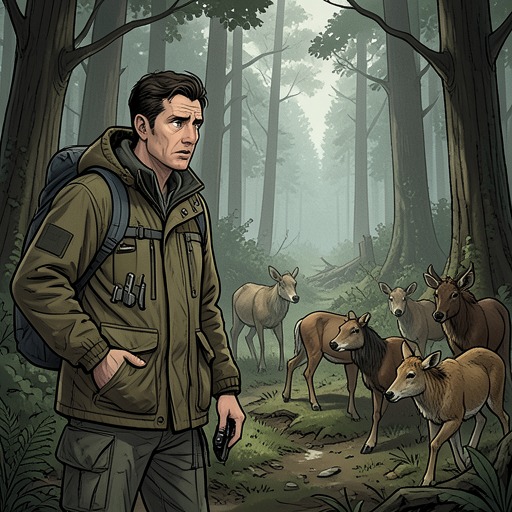
A close encounter in the forest shows how fragile that distinction can be. Richard Parker startles Pi Patel, rears, and threatens him repeatedly before moving away. Pi does not treat the retreat as proof that the danger has passed. He runs after the tiger, blows the whistle, and later concludes that he must resume training. The response is not a sudden exercise of force, but a return to the familiar pattern of signals and rewards. Pi blows the whistle until his lungs hurt, pounds his chest, and repeats his command thousands of times while offering pieces of meerkat as treats. Richard Parker’s tension in the changed surroundings helps keep him responsive, although Pi recognizes that his own success also depends on luck: the tiger is a young adult and relatively pliable.
The hoop routine turns the abstract rule of repetition into a precise sequence. Richard Parker must jump through a hoop held first at Pi Patel’s side, then again after Pi turns his back, and once more while Pi kneels and holds it overhead. Each jump earns part of a meerkat. The final task is to follow the hoop as it rolls and pass through it before it falls. Richard Parker performs that part clumsily, but follows the moving object; Pi gives him the last treat and moves away. The routine is both training and boundary management: it gives the tiger a structured task, rewards compliance, and creates distance between them.
An Uneasy, Maintained Order
The island makes the limits of any settled hierarchy more visible. Once Richard Parker is healthy, Pi Patel worries that plentiful food, fresh water, and open space may make the tiger more confident and less subject to his influence. The concern is not simply that the tiger is powerful; his needs and behavior are changing with the environment. Pi continues marking the lifeboat as his territory and relies on repeated training, because the order that kept them alive must be maintained as circumstances shift.
The contrast between the lifeboat and the island clarifies the novel’s treatment of dominance. On the boat, confinement makes territorial divisions unavoidable, and Pi’s control depends partly on providing necessities. On the island, Richard Parker can range farther and regain his strength, while Pi must reconsider where and how he can remain safe. Their coexistence never becomes equality or domestication. It is a temporary, vulnerable arrangement made possible by reading behavior, managing space, and repeating signals and rewards. Territory and dominance matter because they convert an otherwise uncontrollable proximity into a pattern the two can survive.