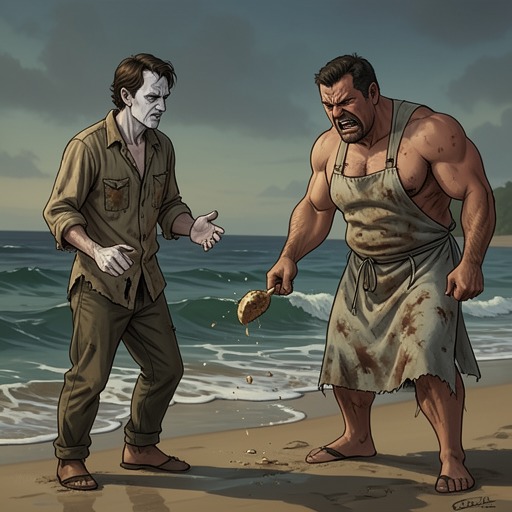
The Cook Kills Pi’s Mother
Life of PiThe Cook’s killing of Pi Patel’s mother is the decisive rupture in Pi’s human account of the castaways’ ordeal: a fragile arrangement sustained by hunger, dependence, and hope gives way to a death Pi witnesses but cannot prevent. The scene also turns survival into a moral debt, one that remains unresolved even after Pi later kills the Cook.
Circumstances and Escalation
The killing follows a period in which the castaways’ relations had, at times, seemed almost companionable. When the Cook caught a large fish or brought a turtle aboard, the food offered relief, and Pi recalled moments when the Cook and Pi’s mother could speak civilly and even joke. Their chief hope was to find an island. When none appeared, the Cook began stealing food and water, while hunger and Pi’s weakness made each failed attempt to secure food more consequential.
The immediate confrontation grows from a lost turtle. Pi could not hold on to it; the Cook struck him, and Pi’s mother struck the Cook in response. The Cook hit her back. Her intervention places her between the Cook and her son, turning a dispute amid deprivation into a direct conflict. She pushed Pi toward the raft and told him to go. Pi jumped, believing she would follow, and reached the raft while the two remained aboard the lifeboat.
The Killing and Pi’s Witness
From the raft, Pi watches the struggle without being able to intervene. The Cook overpowers his mother and kills her. The account gives the event through Pi’s restricted view: he sees the violence and the Cook looking toward him, but cannot make himself act. The Cook later throws her body overboard. Pi’s description focuses not only on the loss, but on the helplessness of being separated from the lifeboat and left to watch.
Pi spends the rest of the day and the night on the raft, looking toward the Cook. They do not speak. The Cook could have cut the raft loose but does not; Pi understands this continued connection as a way of keeping him nearby, like a bad conscience. The silence does not repair what has happened. It holds the two survivors in an uneasy proximity, with the murder occupying the space between them.
Aftermath and Significance
The next morning, Pi pulls himself back aboard the lifeboat in full view of the Cook. The Cook says nothing. He catches another turtle, gives Pi its blood, and sets aside its best parts for him to eat. This act of feeding follows the killing without apology or explanation; dependence on the Cook’s food persists even after Pi has witnessed what he did.
Later, Pi and the Cook fight, and Pi kills him. In Pi’s retrospective account, the Cook does not express despair, anger, fear, or pain, and does not apologize. Pi interprets his surrender as recognition that he had gone too far, even by his own brutal standards, and no longer wished to continue living. The sequence binds the mother’s death to Pi’s later act of violence without making them equivalent: first Pi is a powerless witness; later he kills the man who killed her. As an event in Pi’s embedded human account, the scene also presents the survival story without its animal figures, making the killing and its consequences central to how the reader understands that account.