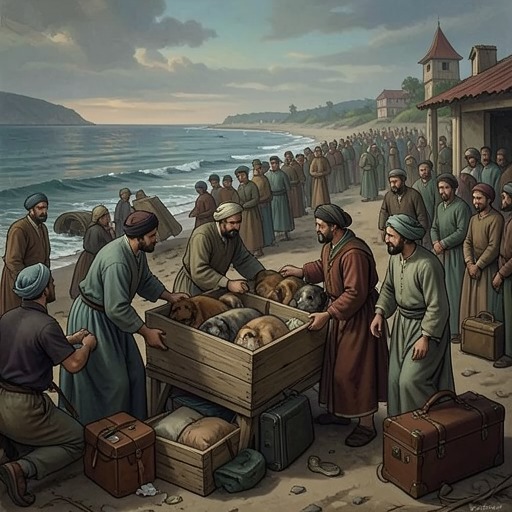
The Patel Family Decides to Emigrate to Canada
Life of PiThe Patel family’s decision to emigrate to Canada turns political unease and economic uncertainty into a concrete family rupture: a distant country becomes the answer to a future that Pi Patel’s father no longer trusts India to provide. The announcement, delivered over dinner, shocks Pi Patel and Ravi Patel, while the year-long preparations to sell and move the Pondicherry Zoo show that leaving meant uprooting an entire household and its livelihood, not simply changing countries.
Causes and Background
Pi Patel frames migration as a wager on the possibility of a better life, made when familiar surroundings begin to feel like a blocked future. In the mid-1970s, the political crisis in India becomes increasingly difficult for Pi Patel’s father to treat as distant news. Pi Patel notices the furrows on his father’s forehead as he reads the papers and catches fragments of conversations with Pi Patel’s mother and other adults. The animals, by contrast, continue their ordinary routines; their apparent indifference makes the widening gap between a child’s zoo-centred world and his father’s anxieties especially clear.
The decisive political shock comes in February 1976, when Delhi brings down the Government of Tamil Nadu, one of Indira Gandhi’s most vocal critics. Pi Patel recalls that India’s Constitution had already been suspended for eight months. The ministry’s quiet disappearance into resignation or house arrest matters to Pi Patel’s father not as an isolated change of government but as a new sign of dictatorial control. His fear takes the form of a bitter joke: he imagines Indira Gandhi arriving at the zoo because her jails are full and demanding space for political prisoners. The camel remains unfazed, but the political event breaks through his father’s efforts to endure the situation.
The family’s vulnerability is also financial. The zoo is a cultural institution devoted to public education and science, not a reliable source of profit; its aspirations toward public good conflict with the need to make money. The family is not wealthy, and owning many animals does not mean owning the roof over their heads. Pi Patel’s father understands the zoo as a precarious enterprise that cannot prosper without stable government, civil freedoms, and the rule of law. In his view, bad politics threatens both the institution and the family’s ability to build a secure future. Pi Patel’s mother agrees that they should leave.
The Decision at Dinner
The move becomes real when the parents announce it one evening during dinner. Pi Patel and Ravi Patel are thunderstruck. Canada is not merely far away: it is so unfamiliar that, to the boys, it signifies a place permanently beyond their ordinary map of understanding. Even Andhra Pradesh, just north of their home, seems alien to Pi Patel; Sri Lanka, across a narrow strait, seems almost impossibly remote. Canada is more abstract still. The contrast between the parents’ urgent calculation and the sons’ bewilderment makes the decision a generational turning point: the adults see a possible future, while the boys can scarcely picture the destination.
Neither boy wants to go. Pi Patel recalls their fear of a country imagined through extreme cold and gale-force winds, and their sense that Canada has no place on the cricket map. Their resistance does not alter the family decision, but it reveals its cost. Emigration promises security and a fresh beginning to the parents; to the children, it first means leaving familiar places, relationships, and routines for a country that means almost nothing to them.
From Intention to Departure
The sale of the zoo turns the decision into a practical plan. The family sells the collection as a whole, intending both to secure the animals’ future and to pay for immigration, with money left over to establish themselves in Canada. Pi Patel later judges that expected sum laughable, a retrospective reminder of how money can make a fresh start seem more certain than it is. The family could have sold the animals to Indian zoos, but American zoos offered higher prices.
The timing is shaped by the Convention on International Trade in Endangered Species (CITES), which had just come into effect and sharply restricted trade in captured wild animals. Pi Patel describes the window for that trade as having slammed shut; the future of zoos would increasingly depend on exchanges with other zoos. The Pondicherry Zoo closes at a moment when buyers are scrambling for its animals. The principal purchasers include Lincoln Park Zoo in Chicago and the soon-to-open Minnesota Zoo, with other animals going to Los Angeles, Louisville, Oklahoma City, and Cincinnati. Two animals are destined for the Canada Zoo. For Pi Patel and Ravi Patel, the irony is personal: they do not want to move to Canada, while two members of the zoo’s collection are being sent there.
Preparing the animals takes well over a year. Pi Patel compares the task to moving a city: animals may have no need for clothes, furniture, passports, or employment prospects, but moving them across borders demands immense coordination. The process involves offers, negotiations, approvals, agreed prices, contracts, certificates of origin and health, export and import permits, quarantine rules, and transport arrangements. This bureaucratic labour makes the family’s decision tangible long before the family itself boards a ship. Their departure is delayed not by a change of heart but by the scale of transferring the zoo’s living collection.
Departure and Significance
The family leaves Madras on June 21, 1977, aboard the Panamanian-registered Japanese cargo ship Tsimtsum. Its officers are Japanese and its crew Taiwanese. By then, Pi Patel and Ravi Patel have begun to imagine themselves as future Canadians, but Pi Patel’s mother lingers over the leave-taking. On the last day in Pondicherry, Pi Patel says goodbye to friends and acquaintances; his mother, dressed in her finest sari and wearing jasmine in her hair, faces the departure with sadness. Her attachment is to a specific India of monsoons, rice fields, the Cauvery River, coastlines, temples, familiar streets, and known shopkeepers—not simply to an abstract homeland.
The small exchange over cigarettes distils the family’s different relationships to leaving. The day before departure, Pi Patel’s mother earnestly asks whether they should buy a pack or two. Pi Patel’s father answers that tobacco is available in Canada and points out that the family does not smoke. The question is less a practical necessity than a sign of how difficult it is to stop thinking through the habits of the place being left. His brisk reply looks toward the destination; her hesitation remains with home.
The decision therefore joins public history to intimate departure. Political authoritarianism and the fragile economics of the zoo supply the pressure to move; the boys’ resistance and their mother’s farewell register what that move costs. Selling the animals provides a means of beginning again, but it cannot make Canada familiar in advance or erase attachment to India. The voyage aboard the Tsimtsum is the consequence of this choice and the threshold between the family’s life around the zoo and the uncertain journey that follows.