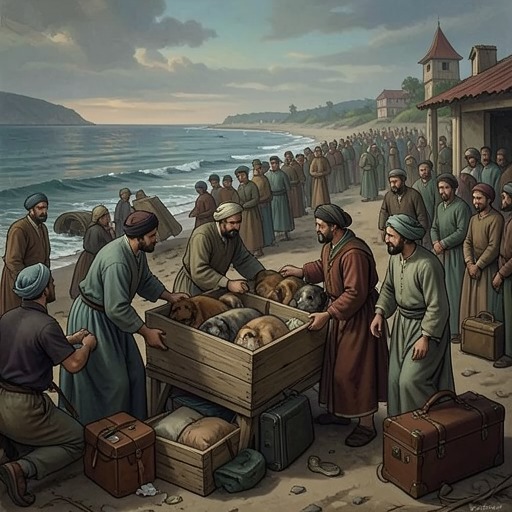
The Patel family emigrates to Canada
Life of PiThe Patel family’s emigration to Canada begins as a response to political insecurity and economic strain, but becomes a complicated transfer of an entire household and zoo. The move is at once an effort to make a future elsewhere and a farewell to a familiar India: the family’s departure is delayed by the work of relocating its animals, then made real when they sail from Madras aboard the Tsimtsum on June 21, 1977.
Causes and Decision
In Pi Patel’s recollection, migration is driven by the hope of a better life, but the family’s decision grows from specific pressures. The mid-1970s are troubled times in India. Pi notices the furrows on his father’s forehead as he reads the papers and hears fragments of adult conversation, though the political news initially matters less to him than the life of the zoo. In his childhood world, the animals continue their routines while the national crisis seems distant.
That distance narrows in February 1976, when the Government of Tamil Nadu is brought down by Delhi. The state government had been among Indira Gandhi’s vocal critics; its ministry disappears quietly into what is called resignation or house arrest. For Pi’s father, this is the decisive sign of a dictatorial takeover, coming after the Constitution has already been suspended for eight months. He fears that political power could reach even the zoo. Pi understands his father’s worry as more than political disagreement: it is anxiety about whether the family’s work and livelihood can survive an unstable system.
The zoo is a cultural institution devoted to education and science, not a reliably profitable business. The family is not rich, and the animals’ home is not even a property they own outright. Pi’s father sees the zoo’s prospects as tied to the protections of democratic government, including freedom of speech and association, a free press, elections, and the rule of law. Political instability therefore threatens both the institution and the family’s ability to build a secure future. Pi describes the decision as the result of accumulated strain: the sense that effort may be undone, that conditions will not change, and that children might have better prospects somewhere else. His mother agrees. The family will leave.
The announcement comes one evening at dinner, and Pi and his brother Ravi are thunderstruck. Canada is not merely far away; to the boys it is almost without meaning, as remote and unfamiliar as a place beyond their imaginative map. Their parents’ decision thus creates a sharp divide between the adults’ search for security and the children’s attachment to what they know.
Selling the Zoo and Moving Its Animals
The family sells the zoo as part of the plan to fund immigration and begin again in Canada. The sale is meant to give the animal collection a future as well as provide the family with money, although Pi later judges the sum they received as laughably small. American zoos offer higher prices than zoos in India, while the Convention on International Trade in Endangered Species (CITES) has just come into effect, restricting trade in captured wild animals. The market for the collection is therefore both an opportunity and a narrowing route: the future of zoos increasingly lies in transfers between zoos.
The buyers include the Lincoln Park Zoo in Chicago and the soon-to-open Minnesota Zoo, with other animals going to Los Angeles, Louisville, Oklahoma City, and Cincinnati. Two are destined for a Canadian zoo. Some animals are in demand, including many birds and reptiles, lemurs, rhinoceroses, orangutans, mandrills, macaques, giraffes, antelopes, big cats, hyenas, zebras, bears, elephants, and Nilgiri tahrs. Others are harder to place. One zoo will accept Elfie only if she receives cataract surgery; she eventually spends the rest of her life at the Trivandrum Zoo. Lions and baboons are considered too common, so Pi’s father trades them for an additional orangutan from Mysore Zoo and a chimpanzee from Manila Zoo.
The arrangements reveal how a family’s migration depends on the movement of lives beyond its own. A zoo must be moved almost like a city: offers, bargaining, approvals, prices, signatures, certificates of origin and health, export and import permits, quarantine rules, and transportation all have to be handled. The paperwork and telephone calls consume time and money, and the process repeatedly tests Pi’s father’s patience. The animals are examined by a delegation of three Americans, who check their health before approving them for transfer. Once accepted, the animals have, in Pi’s telling, their own working papers; the family and its collection alike are being assigned new national futures.
Departure from India
Preparing the animals takes well over a year, giving Ravi and Pi time to grow accustomed to the prospect of leaving even though neither wants to go. Their resistance is personal and immediate: Canada is not on their cricket map, and they imagine a country of severe winds and impossibly cold winters. The lengthy preparations do not erase that reluctance, but they turn the abstract decision into a sequence of practical steps, with the zoo’s future arranged before the family’s own departure.
The Patels leave Madras on June 21, 1977, aboard the Panamanian-registered Japanese cargo ship Tsimtsum. Its officers are Japanese and its crew Taiwanese. On their last day in Pondicherry, Pi says goodbye to Mamaji, friends, acquaintances, and even strangers. His mother’s farewell is slower than the men’s. She leaves behind the landscapes and ordinary landmarks of a familiar life: the monsoons, rice fields, river, coast, temples, roads, shops, and friends she has known. As the family prepares to depart, she wonders whether Canada will have familiar Indian goods, including Gold Flake cigarettes, Arun ice cream, Hero bicycles, Onida televisions, Ambassador cars, and Higginbothams’ bookshops. Her questions give the move a domestic scale: a new country is not only a destination but also the possible absence of everyday things that had made home recognizable.
The final preparations bring family and cargo together. Animals are sedated, cages loaded and secured, feed stored, and bunks assigned. When the lines are cast off and the ship is piloted out to sea, Pi waves goodbye to India, excited despite the family’s earlier fears and resistance. He later frames the departure through the recognition that events did not unfold as expected and that life must be met as it comes.
Significance
The emigration is not a clean break accomplished by a single decision. Political anxiety supplies the pressure to leave; the economics of the zoo shape the means; international rules, buyers, medical examinations, and transport determine what can travel and where. The family’s migration is therefore inseparable from the relocation of the animals on which its livelihood and daily life have been built.
The departure also establishes a contrast between movement as aspiration and movement as loss. Pi’s father imagines a fresh start, while Pi and Ravi initially experience Canada as an alien blank and their mother measures the distance through familiar places and products. The ship’s passage makes the choice irreversible in a way the dinner announcement was not. For Pi, the voyage is the beginning of a new life, but the confidence and excitement of departure stand beside the uncertainty that will shape what follows.