The Tsimtsum Shipwreck Interview
Life of PiThe Tsimtsum Shipwreck Interview brings the book’s survival narrative before an official inquiry but leaves its central uncertainty unresolved. In a recorded conversation with two Japanese transport officials, Pi Patel offers both an animal-filled account and a story without animals; both end with the ship sinking, his family dying, and his suffering. The officials cannot prove which account is true, yet they choose the animal story as the better one. Their answer shifts the encounter from fact-finding toward the question of how a story can make an otherwise unprovable experience meaningful.
Setting the Inquiry
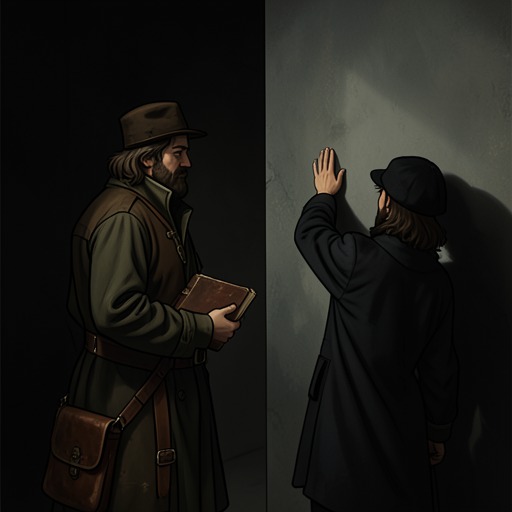
The interview takes place at the Benito Juárez Infirmary in Tomatlán, Mexico, after reports that the lone survivor of the Japanese ship Tsimtsum had come ashore. Tomohiro Okamoto and his junior colleague, Atsuro Chiba, were in Long Beach on unrelated business when their department instructed them to contact the survivor and investigate the ship’s fate. Their journey south becomes a small ordeal of its own: a fold in a map leads Okamoto to mistake Tomatan for Tomatlán, and the officials drive about eight hundred kilometres before realizing the error. They continue to Santa Rosalia, travel by ferry across the Gulf of California to Guaymas, and cover another thirteen hundred kilometres to their destination. Bad roads, a flat tire, a breakdown, and mechanics who replace parts improperly add further delays. By the time they reach the infirmary, they have travelled for forty-one hours.
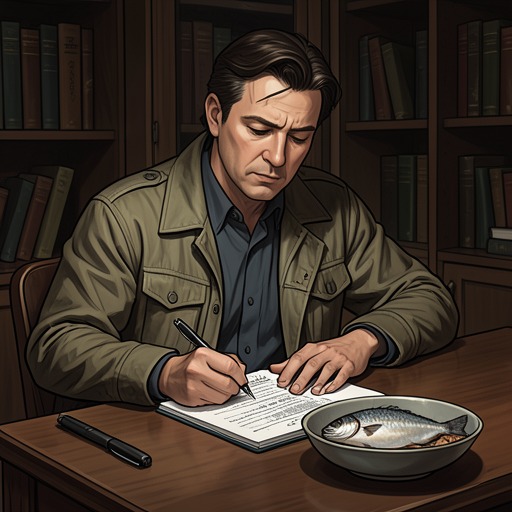
The weary officials speak with Pi Patel in English for close to three hours, recording the conversation. Okamoto later supplies the tape and his report; the printed interview presents excerpts from the verbatim transcript, identifying speakers where necessary and translating passages spoken in Japanese. The documentary apparatus promises a record: named participants, a tape recorder, an official purpose, and a transcript. Yet the inquiry’s most important question will not yield a verifiable answer.
From Shipwreck to Recorded Account
The interview concerns a sinking whose cause Pi Patel has already described as unknowable. The Tsimtsum had travelled from Manila into the Pacific Ocean; on its fourth day out, midway to Midway, it sank. Pi suspects an explosion, but he was asleep when the irregular noise woke him and cannot be certain. The ship’s possible mechanical failure, like the wreck itself, remains beyond direct confirmation: its answer lies thousands of feet underwater. That uncertainty gives the officials’ request for an explanation real stakes, while also setting a limit on what the survivor can establish.
When Okamoto asks Pi Patel to recount what happened in as much detail as possible, the answer is first the survival story the reader knows. Its setting is not a stable backdrop but an active measure of exposure and endurance. During one night, Pi sees a sharply defined crescent moon and stars above a sea of black and silver; for a moment, the vastness makes his suffering seem finite and insignificant. In daylight, however, he protests that his suffering matters because he wants to live. Elsewhere, his account gives the sea and sky many changing forms, while the castaway remains trapped at the centre of a circle: openness can blind and frighten him, darkness can feel claustrophobic, rain can drown, and calm water can become its own torment.
The narrative’s material details also resist any easy conversion into an orderly report. Pi and Richard Parker encounter floating refuse—oil, plastic, lumber, bottles, rope, and yellow foam. A refrigerator drifts past with rotten food and an unidentifiable animal carcass inside. Pi salvages an empty corked wine bottle and sends a message identifying the Tsimtsum, its July 2, 1977 sinking in the Pacific, his name, and the presence of a Bengal tiger in the lifeboat. Later, he sees a low-lying island and initially takes its forest for an illusion, registering the brilliant green as a striking contrast to the surrounding blue. Such episodes make the account vivid and particular, but vividness alone cannot serve as proof for the officials.
The Second Account and the Limits of Proof
After hearing the first story, the officials react with admiration and skepticism. Chiba calls it a story; in Japanese, he privately suggests that Pi Patel thinks they are fools. The interview resumes after a break, during which Pi says he is hungry and accepts a cookie. Okamoto then asks for an account without animals that will explain the sinking. After a pause, Pi agrees to tell another story.
The available passage begins that version with the ship sinking in a sound Pi compares to a monstrous metallic burp. Objects bubble at the surface and disappear. Pi finds himself in the Pacific Ocean, swimming toward the lifeboat, swallowing water, growing cold, and losing strength. He says he would not have made it if the cook had not thrown him a lifebuoy and pulled him aboard. The interview establishes the contrast in form—one account includes animals, the other does not—without turning the second telling into an independently verified correction. Pi explicitly tells the officials that they cannot prove which story is true and asks them to take his word for it.
He then identifies what the two accounts share: in both, the ship sinks, his entire family dies, and he suffers. This common ground does not settle the disputed particulars. Instead, Pi asks which account the officials prefer, pointing out that the factual difference cannot be proved to them. Chiba chooses the story with animals, and Okamoto agrees that it is the better story. Their preference is a judgment about the accounts, not a finding that one has been demonstrated as fact.
Preference, Faith, and the Ending
Pi answers Okamoto’s choice with the remark, “And so it goes with God.” The line connects the interview’s forced choice to the book’s wider treatment of belief: when proof cannot decide between accounts, preference still expresses a way of understanding what exceeds proof. The conversation does not demonstrate that the animal story is literally true, nor does it expose the animal-free account as the definitive hidden version. It leaves both possibilities in view while showing that the officials, having heard both, find the story with animals more compelling.
The exchange ends not with an official resolution but with silence. Chiba asks what Pi Patel has just said; Okamoto admits that he does not know. Then Chiba notices that Pi is crying, and another long silence follows. The recorded interview has begun as an attempt to shed light on the fate of the Tsimtsum, but its conclusion does not illuminate the wreck’s cause or authenticate one account. It records instead a decision made in the presence of uncertainty, followed by an emotional response that neither official can fully interpret. In this way, the inquiry’s documentary frame holds two impulses together: the demand for factual explanation and the human willingness to choose a story that gives suffering a shape.