The Will to Survive
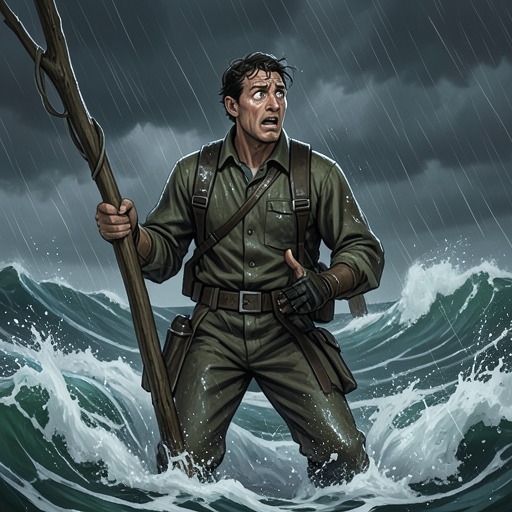
Life of PiThe Will to Survive is the resolve Pi Patel discovers when the prospect of death at sea becomes impossible to ignore. It is not presented as fearlessness or confidence in rescue. Rather, despair gives way to a stubborn commitment to continue, grounded in faith and made practical through work. Richard Parker complicates that resolve: he is a threat Pi must manage, but also a companion whose presence helps keep despair at bay.
The turn from despair
After food, water, and rest restore some of Pi Patel’s strength, he can no longer avoid facing the danger of Richard Parker aboard the Lifeboat. Escape into the sea offers no viable alternative: land is far away, and swimming would leave him exposed to hunger, thirst, cold, and sharks. Staying also carries mortal danger. The choice is not between safety and risk, but between different forms of peril, with no assurance that either can be mastered.
That recognition brings Pi Patel close to surrender. His thoughts gather around what he stands to lose: his family and the places associated with home. The awareness is not a distant abstraction; it makes the future he may not have feel sharply present. The passage marks a change in his outlook: he is no longer simply trying to recover from exhaustion, but confronting the possibility that his life is ending.
The reversal begins as an inward refusal. Pi Patel resolves that he will not die, that he will meet the ordeal with hard work, and that his survival so far can become a basis for continuing. His faith is part of this decision: he places his determination alongside the belief that God is with him. The resolve is neither a prediction of success nor a claim that danger has disappeared. It is a decision to keep acting despite uncertainty.
A will that must be exercised
Pi Patel understands the will to live as something he discovers in himself rather than an obvious, permanent quality. He distinguishes among people who relinquish hope, those who fight for a time and then stop, and those who continue fighting regardless of the cost or odds. He identifies himself with the last group, while resisting the idea that this necessarily makes him courageous. In his account, persistence may instead be a constitutional inability to let go, even a kind of life-hungry stubbornness.
That distinction keeps the resolve from becoming a simple story of heroic fearlessness. Pi Patel still feels fear, and Richard Parker’s growl makes the danger immediate. Yet fear no longer determines whether he acts. The change is visible in his attention turning toward the practical problem of survival: he needs shelter and begins to organize what is available. The will to survive is thus not merely an emotion or declaration. It becomes the capacity to convert a desperate situation into tasks.
Richard Parker as danger and motive
The relationship with Richard Parker gives Pi Patel’s resolve a troubling double edge. He recognizes that the tiger may outlast his human frailty, making taming him necessary. But he also admits that part of him does not want Richard Parker to die. If the tiger were gone, Pi Patel would be alone with despair. The animal that threatens his life also occupies his attention and helps him continue living.
This dependence changes the meaning of survival. It is not simply Pi Patel against Richard Parker, with the tiger’s death as the only desirable outcome. Pi Patel comes to see their fates as linked: they may live or die together. He is at once afraid of the animal, resentful of the pressure it imposes, and grateful for the purpose its presence gives him. In retrospect, he credits Richard Parker with helping keep him alive. The resolve that first takes shape as a refusal to surrender is therefore sustained in part by a relationship Pi cannot reduce to either enmity or comfort.
From resolve to action
Once panic loosens its hold, Pi Patel begins to assess the means at hand. He imagines the open horizon as a circus ring, the sea as a source of rewards, and a whistle as an instrument for keeping Richard Parker in line. He also draws on his knowledge as a zookeeper’s son, and on the time and necessity imposed by the situation. These are not guarantees of control; they are materials from which he can form a plan.
The change soon takes physical form. Pi Patel assembles a raft from buoyant oars, a lifebuoy, and life jackets, working carefully while Richard Parker remains nearby. The construction is a precarious beginning, not proof that the danger is over. Its significance lies in the movement from recognizing that the existing situation cannot simply be escaped to making a measure of shelter for himself. The sequence gives the will to survive a concrete grammar: notice, choose, and do the next necessary thing.
The episode holds faith and effort together without suggesting that one cancels the need for the other. Pi Patel’s appeal to God accompanies his determination to work; the resolve does not remove fear, distance, or dependence on Richard Parker. Instead, it makes action possible within those limits. Survival begins not as certainty about the ending, but as a refusal to let the prospect of death become a reason to stop.