The tarpaulin
Life of PiThe tarpaulin is a rough canvas covering aboard the Lifeboat, but its importance exceeds its use as shelter: it separates Pi Patel from Richard Parker, conceals supplies, and helps define the precarious territories in which both must survive. At once a physical obstacle and a potential safeguard, it turns small acts of adjustment into matters of life and death.
Material and Position
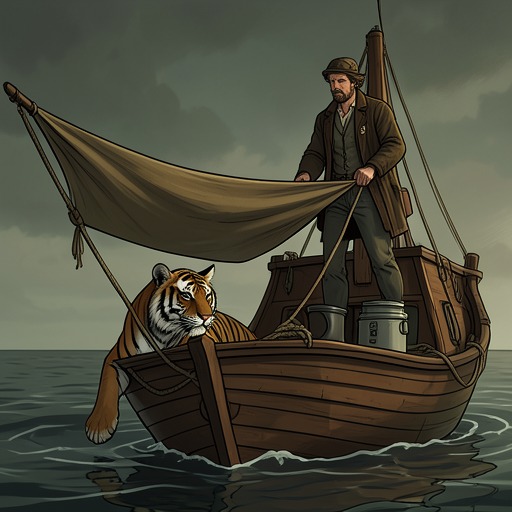
Made of tough, treated canvas, the tarpaulin grows rough against the skin after prolonged contact. It has been unrolled only a little beyond the middle cross bench. This placement leaves one cross bench beneath it, within Richard Parker’s den; the middle bench lies just beyond its edge, while a third, broken bench sits beneath the dead zebra. The canvas therefore does not cover the boat evenly. Its edge marks a specific divide between the tiger’s covered space and the more exposed area where Pi Patel must work.
The covering is orange, like the Lifeboat’s interior, life jackets, lifebuoy, oars, and other significant equipment. Its practical texture and color make it part of the boat’s crowded material environment rather than a detached symbol. It can shelter, conceal, and obstruct, but it offers no secure enclosure: Richard Parker is close beneath it, and the canvas itself can be approached from either side.
A Boundary Under Pressure
When Pi Patel first looks for provisions, thirst drives him to consider unrolling the covering further, although doing so would open access to Richard Parker’s den. The immediate conflict is not simply between shelter and exposure: the canvas conceals what Pi needs while lying between him and the tiger. To reach the bow, he must handle the covering without losing track of the danger below it.
As he loosens the ropes holding it down, Pi Patel lies flat across the canvas with his legs toward the stern. Looking beneath it, he mistakes an orange mass for the tiger before recognizing a life jacket. He then sees Richard Parker’s haunches and part of his back, only two feet below. The tiger is still, his sides moving with each breath; between the two of them lies only the thin tarpaulin. The scene makes the covering’s limits plain: it divides their bodies, but it is not a dependable wall, and Richard Parker could get around it.
The Locker and Its Accidental Protection
The tarpaulin’s position also controls access to the supply locker. After finding a hasp on the bow bench, Pi Patel opens the lid while remaining acutely aware of the tiger under the covering. The lid’s hinge, set close to the edge of the bench, gives the opening an unexpected use: as it rises, the lid closes the twelve-inch gap between the tarpaulin and the bench through which Richard Parker might otherwise reach him after pushing aside the life jackets.
Pi Patel props the lid against a crosswise oar and the edge of the tarpaulin, then stands with one foot on the locker’s edge and the other braced against the lid. If Richard Parker pushes from below, the movement should warn him and could send him backward into the water with the lifebuoy. If the tiger comes over the canvas from astern, the position gives Pi Patel an early view and another chance to escape. The tarpaulin does not become safe; instead, its edge, the lid, and the oar briefly form a defensive arrangement around it. The covering’s relation to the other objects matters as much as its material: a vulnerable sheet of canvas becomes part of a working barrier through Pi Patel’s positioning of the locker lid.
Territory and Survival
Later, the tarpaulin’s edge becomes part of Pi Patel’s planned territorial order. He intends the tiger’s range to include the boat’s floor, the stern bench, and the side benches as far as the middle cross bench. The top of the tarpaulin and the bow, with the middle bench as neutral territory, are to belong to Pi Patel and remain forbidden to Richard Parker. This division is a plan he must establish, not a boundary already enforced by the canvas.
The evidence beneath the covering gives the plan a basis. When Pi Patel cautiously opens the locker lid, he smells the sharp odor of tiger urine, which Richard Parker has used to mark territory. The odor comes exclusively from beneath the tarpaulin, suggesting that the tiger’s claims are confined to the boat’s floor. Below it, four inches of rainwater have collected; Richard Parker lies against the floor to cool himself in the shade. Pi Patel sees a possibility in these details: if he can make the tarpaulin his, the two might coexist. The canvas thus marks both the tiger’s existing refuge and the upper boundary Pi Patel hopes to claim. Its significance lies in that unstable overlap: it cannot keep the tiger out, but reading its position, the signs of his territory, and the space above it gives Pi Patel a way to begin organizing survival.