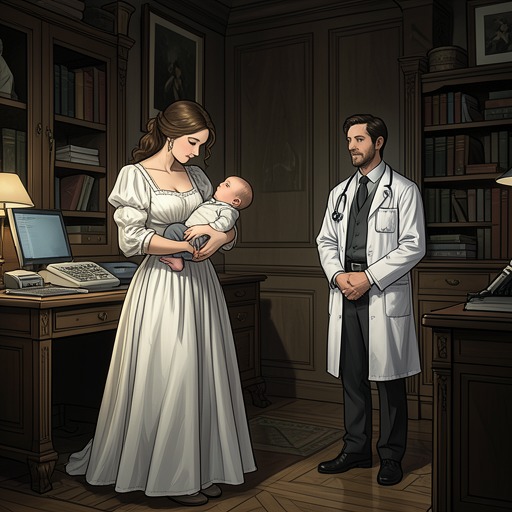
John Brown’s House
Like Water for ChocolateJohn Brown’s House is both a refuge for Tita after her breakdown and a place where the novel brings domestic memory into contact with scientific inquiry. Its rooms and patio do more than shelter her: they give her space to remain silent, to encounter a presence that recalls Nacha, and, eventually, to begin returning to life.
A refuge after the ranch
John brings Tita to his house in defiance of Mama Elena’s order. Rather than place her in a madhouse, where Tita fears she might truly have gone insane, he takes her into his care. The house is therefore defined from her arrival by a contrast: the coercion she has left behind against the warmth John offers in his words and manner. She is badly shaken, and the memory of her arrival remains blurred by the pain of having her broken nose set.
John’s care is practical as well as affectionate. He bathes Tita, removes the pigeon droppings from her body, brushes her hair, and puts her into a bed with starched sheets. She remembers his hands as having rescued her from horror. Yet the house does not instantly restore her. For her first days there, she stays in her room, accepts food brought by Katy, and feels no wish to meet Alex, John’s young son. Her silence is a condition of her recovery: she has feelings she cannot yet put into words and does not want her pain to escape as a shriek.
The little laboratory behind the patio becomes a particular refuge within the house. Tita sits by its window, where the light gives her only the faintest sensation of warmth; even under her heavy woolen bedspread, her chronic chill persists. She continues working on the bedspread at night with yarn John bought for her. The room’s quiet allows her to watch John at work without having to speak, while its window opens onto the patio and the everyday life she is not yet ready to join.
The patio, cooking, and recognition
The patio links Tita’s inward withdrawal to the life continuing around her. From the laboratory window she sees Alex chasing doves, but at first she has no desire to approach him. Later, when she watches him again, she longs to go down, kiss him as the son she does not have, and play with him. The sight marks a change in what the house makes imaginable: her attention begins to turn outward, even while she still cannot act on that desire.
A smell from a small room at the far end of the patio draws her across that threshold. Thinking the smoke might carry her away, Tita first raises her hands toward the sky; when she realizes the smoke is not hers, its familiar cooking aroma instead calls up memories of making tortillas beside Nacha and of a casserole and beans cooking nearby. She goes to find the cook, certain from the smell that this is someone who knows how to cook. In the room she meets an elderly woman who resembles Nacha, wears her thick braid wound around her head, and is making tea in an earthenware pan.
The woman offers Tita a cup. The herbs taste familiar and mysterious, and their warmth and flavor are welcome to someone who has remained cold beneath her bedspread. Neither woman speaks, but they establish a connection that does not depend on words. Tita begins visiting every day. In a house where she has withdrawn from speech and from other people, this quiet recognition makes room for companionship without demanding an explanation of her pain.
An inherited room and two kinds of knowledge
The room’s history gives it a significance beyond Tita’s first encounter there. The elderly woman is Morning Light, John’s Kikapu grandmother, who was captured by John’s grandfather and brought to live far from her tribe. Although he married her, his proud Yankee family did not accept her as his legal wife. John’s grandfather built the room at the back of the house so she could spend her days studying the curative properties of plants; it also served as shelter from the family’s attacks.
Those attacks included calling her the Kikapu instead of using her real name, intending the name as an insult. Morning Light took pride in it, while the Browns associated it with what they considered disagreeable. The room thus holds a history of cultural estrangement as well as medicinal knowledge. The family had little desire to learn Morning Light’s customs and traditions; the house’s hidden room preserves an interest that its dominant household culture had marginalized.
John inherits his grandmother’s fondness for experimentation. As Tita keeps visiting, he begins to appear in the room in place of the woman, and scientific equipment—test tubes, lamps, and thermometers—takes over much of the space. The little stove is pushed into a corner. Tita feels that moving it is wrong, but keeps her objection and her questions about the woman to herself. She enjoys John’s company, though the activity has changed: where the woman cooked, John tests theories scientifically. The altered furnishings make visible a tension between the room’s older domestic and healing uses and its new laboratory work, without erasing the continuity John carries from his grandmother.
From the house toward life
In the laboratory, John demonstrates how phosphorus can ignite in oxygen and uses the experiment to explain his grandmother’s theory of the inner box of matches. In that account, the breath of a loved person supplies oxygen, while food, music, a caress, a word, or a sound can serve as the candle that lights a match. The resulting warmth fades until another explosion renews it; if the matches remain damp, the soul goes unfed. The house’s care for Tita is echoed in this explanation: affection and sensory experience are not ornaments to survival but sources of warmth and nourishment.
About three months before the later scene, a spoonful of soup Chencha brings to John’s house has already helped Tita return to her senses. Now, still at her customary window post, she watches Alex chase doves and waits eagerly for John’s visit, since his words are her only link with the world. She longs to speak to him, approach Alex, cook, and enjoy food again. When John enters carrying a tray with ox-tail soup and Chencha follows in tears, the familiar dish gives the house another kind of welcome.
With the first sip, Tita remembers Nacha beside her, stroking her hair as she eats. The taste and smell bring back kitchen games, market trips, warm tortillas, Christmas rolls, and the ingredients of earlier cooking. Onion makes her cry, and she and Chencha laugh and weep over the remembered steps of the recipe. Tita can finally remember how to cook once she recalls that the first step is chopping the onion. The house has not simply kept her safe: its patio, rooms, and meals make a passage back from silence, reconnecting care in the present with the knowledge and affection she carries from the past.