Mexican Revolutionary Army
Like Water for ChocolateThe Mexican Revolutionary Army is the rebel force that repeatedly crosses the De la Garza family’s private world, bringing the Mexican revolutionary period into the kitchen, the fields, and the ranch’s stores. It is shown as a practical military presence—with troops, a captain, a sergeant, and a battalion—but also as the setting for Gertrudis’s rise to command. Its appearances expose the gap between the violence Mama Elena expects and the conduct she witnesses, while its campaigns give Gertrudis a life and authority beyond the family home.
Organization and Setting
The army appears as a force moving through active conflict rather than as an institution described through formal policies or a full chain of command. Its soldiers travel in troops, take orders from a captain, and are organized in numbers large enough to require provisions for a battalion. The narrative places them in battles with government troops, on horseback, and on campaigns that take them away from the ranch and toward places such as Zacatecas. The evidence does not set out a program or explain the army’s political structure; it presents the force through the people it moves, the resources it needs, and the consequences of its presence.
At the ranch, the army’s arrival is preceded by scarcity. An earlier visit by revolutionary soldiers has helped leave the household with few surviving animals, and the shortage has required the family to kill livestock and try to replace it. When another troop approaches, Nicholas is away buying cattle, while Tita, Chencha, Mama Elena, and two farmhands remain at the ranch. This domestic setting gives military movement immediate material consequences: food and animals are not abstractions but the household’s means of survival.
The Ranch Visit
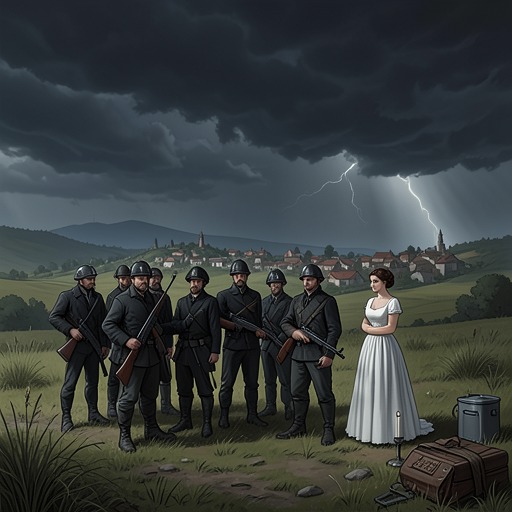
Warned that soldiers are approaching, Mama Elena takes up a shotgun and orders Tita, Chencha, and a pig into the cellar. Her response is shaped by alarming reports she has heard about rebel conduct, and she prepares to protect both the household and its possessions. She then meets the troop at the entrance with the weapon concealed in her clothing and two farmhands beside her. The captain recognizes that she will not be easily intimidated.
The captain asks for a contribution to the cause. Mama Elena permits the soldiers to take what they need from the corn crib and stable, but draws a firm boundary around the house and its contents. The captain answers her with a joke that treats her as a general; the soldiers laugh, but he understands that her limit is serious. When a sergeant suspects that valuable supplies are hidden indoors and asks to search the house, the captain refuses. Instead, he directs the men to look elsewhere on the property. The encounter therefore ends without the soldiers entering the home, despite Mama Elena’s expectation that their arrival would bring a more destructive intrusion.
The search does, however, uncover the enormous dovecote beneath the roof. Reached by a twenty-foot ladder, it holds a large flock of doves and pigeons. The soldiers trap enough birds to feed the battalion for a week. Their visit is neither harmless nor an all-out seizure: the army takes substantial food, but Mama Elena’s house remains untouched. As they leave peacefully, she is unsettled by their restraint and stops voicing opinions about the revolutionaries. She never learns that the captain is Juan Alejandrez, the same soldier who had carried Gertrudis away months earlier. Juan, for his part, does not discover the chickens Mama Elena has concealed behind the house; the family had already killed twenty and preserved them in a covered earthenware pot.
Juan Alejandrez and Gertrudis
The army’s reach into the family story is not limited to requisitioning food. In an earlier episode, Juan is fighting in a battle between rebel forces and government troops when Gertrudis’s rose-like scent reaches him. He leaves the battlefield and rides toward the ranch, abandoning an enemy soldier who is not quite dead. The narrative presents his departure as an irresistible summons rather than as a planned military decision. Juan finds Gertrudis in the field, and she leaves with him. Tita later decides to tell Mama Elena that government troops have set fire to the shower and taken Gertrudis, concealing the actual connection between her sister and a rebel soldier.
Juan’s personal history thus intersects with the army’s movements in two different ways: first as a fighter drawn away from battle, and later as the captain who visits the ranch. The recognition is available to the reader but not to Mama Elena, making the peaceful visit carry an unspoken family history. The army’s presence can therefore serve as cover for Gertrudis’s departure as well as a source of danger and material loss.
Gertrudis’s Military Career
Gertrudis eventually returns as a general in the revolutionary army, accompanied by Juan, now her husband. She tells Tita that she earned her commission through hard work and fighting in the field, and that she advanced through positions of authority after joining the army. Her account gives the organization a longer arc than the ranch visit alone: its ranks provide her with a path to leadership, travel, and public recognition. She comes back intending to show Mama Elena how far she has risen, but learns from Tita that their mother has died before she could see her success.
Her military life also keeps her in motion. During a later visit, Pedro is seriously burned, and Gertrudis regrets that her orders prevent her from staying to help: her troop must attack Zacatecas. She says farewell to Tita and rides away with Juan and the soldiers. The departure makes the cost of command concrete. Gertrudis’s attachment to her sister remains, but military orders take precedence over remaining at the ranch.
Narrative Significance
The army’s episodes contrast household authority with mobility and military command. Mama Elena can control the ranch’s daily routines and defend the threshold of her house, but she cannot prevent Gertrudis from entering a wider world once her sister joins the army. In Gertrudis’s case, military service is not merely background to her escape: it becomes a sustained vocation that brings her to the rank of general. The contrast is especially sharp beside the family’s expectation that daughters remain at home to serve their mothers.
At the same time, the novel does not present the army only as liberation. Its visits reduce the ranch’s already limited livestock, its soldiers take a week’s supply of birds, and its campaigns separate Gertrudis from Tita when the family faces a crisis. The same force that offers Gertrudis a public role also makes her subject to orders and the demands of battle. By placing that military history beside food preservation, family secrecy, and the guarded house, the narrative makes the revolution an influence on ordinary survival as well as an upheaval beyond the household.