Morning Light
Like Water for ChocolateMorning Light is John Brown’s grandmother, a Kikapu healer whose knowledge of medicinal plants becomes both a family resource and the foundation of John’s return to medical research. Though the Browns initially marginalize her and treat her practices as inferior, she earns recognition by healing Peter when their own treatment fails. After her death, she remains present in Tita’s experience through the room she once used, the methods John inherited, and the lessons he learned from her.
Identity and Background
Morning Light is described as a Kikapu woman who became the wife of John Brown’s grandfather after he captured her and brought her away from her tribe. The marriage did not secure her acceptance as a legal wife by his proud Yankee family. The family instead gave her the nickname Kikapu, intending it as an insult. Morning Light regarded the word as a source of pride, making the same name that expressed the family’s disdain a sign of identity from her perspective.
Her position in the household was shaped by that cultural divide. John’s grandfather built her a room at the back of the house where she could study the curative properties of plants. It was both a place for her work and a refuge from the family’s attacks. The Browns’ failure to learn about her customs and traditions meant that her expertise was initially dismissed rather than understood on its own terms.
Healing and Recognition
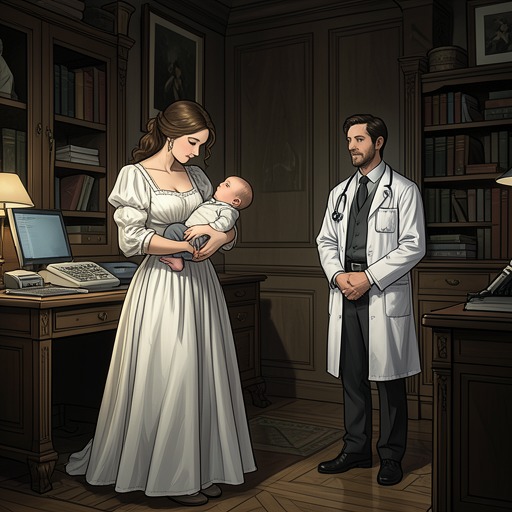
The family’s attitude changed when Peter became gravely ill with a lung disease. Mary, who knew medicine through her doctor father, prepared leeches for bloodletting, believing she was using an advanced and appropriate treatment. When the bleeding could not be stopped, Morning Light came to Peter and placed a hand on his wounds; the hemorrhage ceased. She then asked to be left alone with him. No one challenged her after what they had witnessed.
Morning Light spent the afternoon at Peter’s bedside singing, applying medicinal herbs, and burning copal and incense. She emerged later with Peter restored. The narrative sets Mary’s confidence in a modern treatment against the failure of that treatment, then gives Morning Light’s practice a visible result. It does not present her knowledge as a theory already translated into the Browns’ medical framework: its efficacy is witnessed first, while its explanation remains open.
Afterward, Morning Light became the family doctor and was widely regarded in the North American community as a miracle healer. John’s grandfather offered to build her a larger room for her investigations, but she preferred her small laboratory. Its value lay not in its size or status but in the work she could do there, on her own terms.
The Laboratory and John Brown
John spent much of his childhood and adolescence in Morning Light’s laboratory. When he entered university, he stopped visiting because the modern medical theories he was studying conflicted with what she had taught him. Later, after years of work and study, he returned to the room and sought to test her cures scientifically. His renewed attention does not erase the earlier opposition: it makes the inherited knowledge the subject of investigation rather than something he can simply accept or dismiss.
The room also connects Morning Light to Tita. During Tita’s silence, she follows the familiar aroma of cooking to a small room and meets an elderly woman whose heavy braid and appearance remind her of Nacha. The woman offers Tita tea, and Tita visits her there every day. Gradually, John appears in place of the woman, while scientific equipment displaces the stove from the room’s central position. Tita enjoys John’s company, but she registers the change: the place where the woman cooked and received her has become a laboratory for experiments.
John explains that Morning Light taught him through games as well as through the time they spent together. One game involved writing an invisible sentence on a wall and reading it later. As he tells Tita this, she understands that the woman she had been visiting was John’s dead grandmother. The recognition gives the earlier encounters a new meaning: Morning Light’s presence in the room is not explained away, but incorporated into Tita’s experience of its continuing connection to care and memory.
Inherited Knowledge and Narrative Significance
Morning Light’s influence persists in both John’s research and Tita’s practical care. While treating Pedro’s burns, Tita uses tepezcohuite bark to prevent scarring. John approves her treatment, and the bark is also connected to experiments Morning Light had begun and John continued. The episode joins household remedies, Indigenous plant knowledge, and scientific investigation without treating them as wholly separate worlds: Tita applies the remedy, John endorses it, and the family’s recovery gives the inherited practice immediate importance.
Morning Light is therefore more than the source of a healer’s reputation. Her laboratory preserves knowledge that the family once disparaged, while John’s return makes that knowledge consequential within his own medical work. Her story also locates expertise within a history of unequal recognition: she is denied full acceptance in the household, yet becomes indispensable when conventional treatment fails. Through her, the novel presents care as something learned through observation, practice, and transmission across generations, even when the people receiving that knowledge have not yet found a way to reconcile it with their formal theories.