Recipes as inherited memory
Like Water for ChocolateRecipes as inherited memory is the novel’s way of making family history tangible: Tita’s cooking transmits knowledge and feeling, while her cookbook carries that inheritance beyond her lifetime. Recipes begin as instructions for domestic work, but they also preserve private experience, connect generations, and keep the story of the family available to descendants.
A cookbook made from lived experience
Tita begins writing her cookbook on the night her sister Gertrudis leaves the ranch. As she records the rose-sauce quail recipe, she specifies how to arrange the dish: either place the quail on one platter with a perfect rose at the center and petals around the edge, or serve each portion separately. She prefers separate plates because the garnish is less likely to shift when served. This exacting practical detail makes the cookbook a record of Tita’s decisions and habits, not merely a collection of ingredients.
The act of writing accompanies another recurring practice: Tita crochets a large section of her bedspread each night. As she works, she thinks about Gertrudis and wonders what happened after her sister disappeared from view. The recipe therefore begins in the company of memory. Its instructions preserve the care Tita takes in preparing food, while the scene around them shows that the cookbook is formed alongside her continuing attention to family events.
The dish also retains an emotional history that its instructions cannot fully contain. Tita’s preparation of the rose-petal sauce conveys a message to Pedro through Gertrudis, who experiences the meal’s effects. Later, Tita prepares the quail annually in tribute to Gertrudis’s liberation, taking special care with the garnish. The repeated dish thus becomes both a record of a particular episode and a recurring act of remembrance.
Knowledge passed through the kitchen
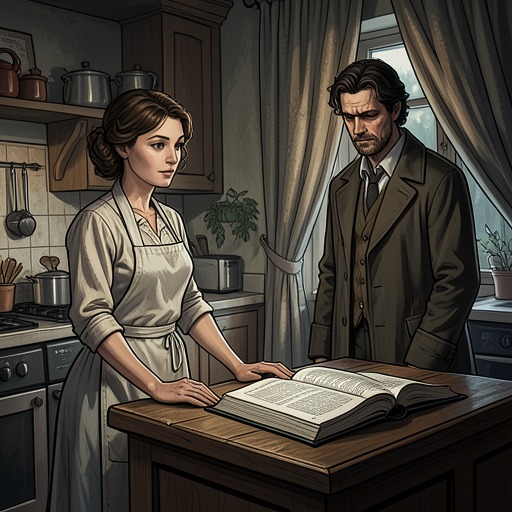
Recipes preserve skills that the family does not share equally. At a family supper, Gertrudis silently hopes Tita will live for many more years to prepare the family recipes; neither Gertrudis nor Rosaura knows how to make them. Gertrudis fears that when Tita dies, the family’s past will die with her. The scene presents culinary knowledge as an inheritance that can be lost if it remains with a single person.
Tita passes this knowledge directly to Esperanza. Although Rosaura initially regards her daughter’s future as service to her mother and favors lessons in piano, singing, and dancing over school, Tita and Pedro argue for Esperanza’s education. Once Esperanza attends the best school in Piedras Negras, Tita gives her a different education in their time together: the knowledge of love and life as revealed through the kitchen. Cooking is therefore not only a household duty; in Tita’s hands, it becomes a means of teaching the next generation beyond the narrow future Rosaura intends for her daughter.
That teaching carries particular weight because Tita herself has been denied choice within the family. Mama Elena invokes the rule that the youngest daughter must care for her mother until her death, and Tita privately questions the tradition’s logic and its disregard for the daughter expected to obey it. Her life has been organized around repetitive domestic labor, from preparing meals to washing dishes and tending the household. The recipes preserve the expertise acquired through that labor, but Tita’s transmission of them to Esperanza also turns kitchen knowledge into something she can choose to share.
The family history within the recipes
The cookbook’s inheritance is emotional as well as practical. The novel repeatedly makes food a medium through which feelings pass between people: in the rose-sauce episode, Tita’s experience reaches Pedro through Gertrudis. The recipes can consequently recall relationships and changes in the family even when their written directions concern preparation and serving. In this sense, the cookbook’s history is carried not only by what it says but by the occasions on which its dishes are made and remembered.
The family’s past also includes secrets that complicate inherited ideas about marriage and descent. After Mama Elena’s death, Tita discovers letters revealing that Mama Elena had loved Jose Trevino, had been prevented from marrying him because of his ancestry, and had continued corresponding with him after her arranged marriage. The letters further disclose that Gertrudis was Jose’s daughter. This history is not identified as a recipe in the cookbook, but it clarifies the generations of concealed experience surrounding the family whose culinary traditions Tita preserves.
Survival beyond the ranch
The cookbook outlasts the household that produced it. After Tita and Pedro die and the ranch is destroyed, Esperanza returns from her wedding trip to find the cookbook beneath the remains. She later bequeaths it to her child, the narrator. The book’s survival gives the family’s story a material form that can be inherited even after the home and its inhabitants are gone.
The recipes continue to operate in the narrator’s present. Preparing Christmas Rolls for a birthday gathering, the narrator remembers that her mother, Esperanza, made them every year, and associates their preparation with her mother’s kitchen and stories. She also finds that her own rolls do not taste like Esperanza’s and that she cries freely while making them, connecting this response to Tita’s sensitivity to onions. The opening onion recipe and this later scene create a frame in which inherited memory is not simply information handed down: it recurs through cooking, family resemblance, and the feelings that accompany a dish.
The narrator says Tita will continue to live as long as someone cooks her recipes. That claim is made concrete by the chain of inheritance: Tita writes, Esperanza receives the cookbook and passes it on, and the next generation prepares the family food. The recipes preserve neither an untouched past nor a simple set of instructions; they keep family knowledge active by giving each generation a way to remake and remember it.