Rosaura Gives Birth to Esperanza
Like Water for ChocolateRosaura Gives Birth to Esperanza is a turning point in which a difficult premature birth sets both a medical limit and a family obligation in motion. The loss of her mother deeply affected Rosaura and brought on the delivery three months early, just as Tita herself had been born prematurely. John Brown performed emergency surgery when the placenta could not be safely detached; the operation saved Rosaura’s life but ended her ability to become pregnant again. Esperanza would be Rosaura’s only child—and, as the youngest daughter, the one whom family custom designated to care for her mother for life.
The birth and its medical consequences
Rosaura’s grief after her mother’s death was followed by premature labor. The account links the two events without presenting the birth as a choice: Rosaura’s condition required urgent intervention, and John Brown had no other way to resolve the complication. He explained that an abnormal placenta can become firmly attached to the uterus. In Rosaura’s case, surgery was necessary, and its consequence was permanent infertility. The medical crisis therefore determined the shape of her family: Esperanza would have no younger sibling, and Rosaura could not have another child.
The operation had a parallel consequence for Tita’s response to the newborn. She had previously nursed her nephew Roberto, then experienced the devastation of having him taken away. This time she neither could nor would become Esperanza’s wet nurse, and she did not try to establish the same intense bond. Instead, she fed the baby gruels and teas, following the diet Nacha had used for Tita when she was an infant. Her care was real, but it took a different form from nursing.
A name chosen against inherited fate
Pedro wanted the child named Josefita, after Tita. Tita refused, fearing that her name might influence the girl’s destiny. She pressed for the name Esperanza, hoping to avoid giving the child another connection to the fate Tita herself had endured. That concern was specific: because Rosaura could have no more children, Esperanza was both the only child and the youngest daughter. Under the De la Garza tradition, those circumstances would make her responsible for caring for her mother until the end of her life.
The birth thus repeated the family rule at the very moment it made the rule newly consequential. When Mama Elena had told Tita that being the youngest meant caring for her mother until death, Tita had questioned who had established the custom, whether the daughter affected by it had ever been consulted, and what would happen to a daughter denied marriage and children. The tradition offered no answer to those questions; obedience was expected. Tita’s insistence on Esperanza’s name was a small but deliberate attempt to keep the same expectation from defining the next generation before the child could choose for herself.
The kitchen as nursery and contested home
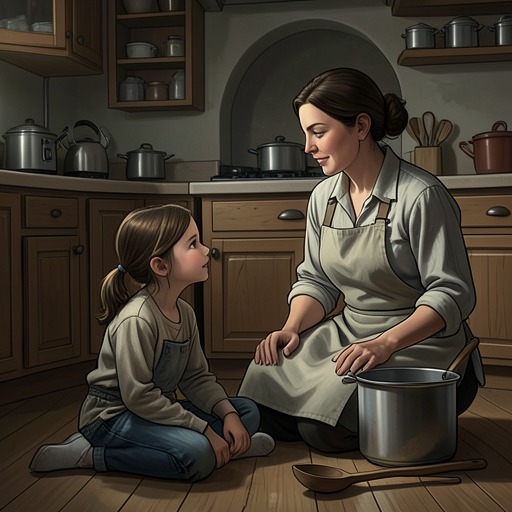
Because Rosaura could not care for the baby at first, Esperanza spent much of each day with Tita in the kitchen. The child grew healthier among the room’s food and warmth, and became accustomed to being there. When Rosaura recovered and asked for her daughter to be fed and put to sleep in her bedroom, the change came too late to be easy. Esperanza cried when taken away from the stove’s warmth. To soothe her, Tita carried the stew she was cooking upstairs so the child could settle near the warmth and smell of the pan, then brought the heavy pot back down and continued preparing the meal.
This care placed Esperanza within a domestic world that had shaped Tita’s own life. At Mama Elena’s ranch, Tita’s hands had been assigned an unending sequence of household tasks, from tending the stove and feeding the animals to cooking and washing dishes. In the kitchen with Esperanza, that inherited labor also became a means of nurturing and teaching. Yet the child’s closeness to Tita troubled Rosaura, who felt that her daughter was being kept from her. The nursery arrangement therefore held both affection and conflict: Tita helped the infant thrive, while Rosaura asserted her claim as mother and sought to bring the child back into her room.
The tradition’s later reach
The expectation attached to Esperanza’s birth shaped later disputes about her education and future. Rosaura initially argued that school was unnecessary for a girl destined to care for her mother; she preferred lessons in piano, singing, and dancing, which she believed would make her daughter an accomplished presence at social gatherings. After three long conversations, she agreed to send Esperanza to the best school in Piedras Negras. Tita, meanwhile, taught her what she understood as the secrets of love and life revealed through the kitchen. The girl’s upbringing thus became a continuing disagreement over whether her future would be confined to the role anticipated at her birth.
The birth also anticipates a later arrangement among Rosaura, Pedro, and Tita. They agreed to preserve the appearance of an ordinary family and to keep Pedro and Tita’s relationship secret; under their bargain, Tita would feed Esperanza while Rosaura directed her education. Even within that agreement, Tita used her time with the child to give her a different kind of knowledge from the one Rosaura intended. The division of care and authority made visible the unresolved question raised at Esperanza’s delivery: whether motherhood and family duty must determine a daughter’s whole life.
Family history and the meaning of inheritance
Esperanza’s birth occurs within a family history in which love, parentage, and social rules have repeatedly been shaped by inherited judgments. After Mama Elena’s death, Tita discovered letters revealing that Mama Elena had loved Jose Trevino, whose ancestry had prevented their marriage. The correspondence also showed that Gertrudis was Jose’s daughter, not the child of Mama Elena’s husband. Much later, when Gertrudis returned with Juan and their eldest son, the boy’s appearance made that family history visible. Tita eventually revealed the letters to protect Gertrudis’s marriage when the child’s parentage became a source of conflict.
Against this background, Tita’s choice of Esperanza’s name and her support for the girl’s schooling are not merely household preferences. They respond to a family order that has governed women through marriage, care, and assumptions about ancestry. The delivery establishes the circumstance that could repeat the youngest-daughter rule; the life that follows shows Tita trying to make that inheritance less certain.