The De la Garza Family Tradition Requiring the Youngest Daughter to Care for Her Mother
Like Water for ChocolateThe De la Garza family’s youngest-daughter tradition makes lifelong care of a mother the youngest daughter’s assigned duty, placing inherited obligation above her choice of marriage, work, and future. First imposed on Tita by Mama Elena, the rule governs more than one generation: it also threatens to bind Esperanza, whose life Tita tries to help shape differently. Its force lies not only in what it demands, but in how the family treats obedience as beyond discussion.
The Rule and Its Enforcement
Mama Elena states the custom when Tita tells her that Pedro may ask for her hand. She says he should not bother, because Tita, as the youngest daughter, must care for her mother until the day she dies. Mama Elena presents the arrangement as a settled family law: no one in the family has questioned it for generations, she insists, and Tita will not be the first. She ends the discussion and denies that Tita has an opinion to contribute.
Tita nevertheless tries to protest. She asks herself who began the tradition and what justification could make the youngest daughter more suitable than the eldest. Her doubts expose practical contradictions the rule leaves unanswered: if a daughter cannot marry or have children, who will care for her in old age, and what happens to a woman who marries but cannot have children? She also wonders whether a daughter expected to remain at home is allowed to experience love. The family supplies no answers. In its household, obedience is immediate, and Mama Elena responds to Tita’s resistance by refusing to speak to her for a week.
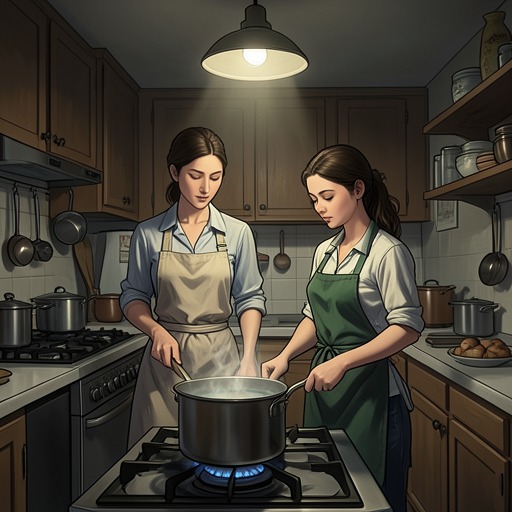
The rule governs ordinary life as well as marriage. At Mama Elena’s home, Tita’s hands are assigned a continuous sequence of domestic tasks: lighting the stove, preparing meals, feeding animals, washing dishes, making beds, and ironing clothes. Later, away from the ranch, she looks at her hands and recognizes how thoroughly their use had been decided for her. The tradition’s authority thus extends beyond a stated duty of care: it is reinforced through the repeated labor that keeps the household running.
A Family History of Restricted Choice
The family’s history gives the tradition a revealing context, though it does not establish when the custom began. After Mama Elena’s death, Tita finds letters and a diary in a locked box and learns that her mother had loved José Treviño. Mama Elena’s parents opposed their marriage because of his racial ancestry and forced her to marry Juan De la Garza instead. She continued her correspondence with José, and the letters indicate that he was Gertrudis’s father. This history shows another generation in which family authority and racial prejudice restricted a woman’s choice of partner; it does not, however, explain the origin of the youngest-daughter rule.
Tita’s own care for Mama Elena also complicates the distinction between duty and affection. When Tita returns to the ranch, her mother has disowned her, yet an injury has left Mama Elena dependent on care. Tita chooses to look after her carefully and prepares ox-tail soup in the hope that she will recover. The care takes place within the very relationship that has denied Tita a voice. Her actions show that caregiving can be offered with concern, even when the family custom that assigns it operates as a constraint.
The Rule Passed to Esperanza
The tradition threatens to continue through Esperanza, Rosaura’s only child. Complications during the birth require John Brown to operate on Rosaura, leaving her unable to have more children. Because Esperanza is both an only child and a girl, the family rule marks her as the one expected to care for her mother for life. Tita requests that the child be baptized Esperanza rather than Josefita, the name Pedro had proposed, because she does not want her own name to shape the child’s destiny. She gives Esperanza gruels and teas, but does not take on the role of wet nurse as she had with Roberto; she is wary of forming the same intense bond after the earlier separation from him.
Rosaura acts on the expectation by opposing her daughter’s education. She argues that Esperanza needs piano, singing, and dancing, not school, because her future is to remain with her mother and entertain her. Tita and Pedro eventually persuade Rosaura to send Esperanza to school, in part by arguing that education will help her converse and move in Piedras Negras society. Tita also teaches her the knowledge of love and life associated with the kitchen. The compromise does not erase Rosaura’s expectation, but it gives Esperanza an education beyond the narrow role the tradition prescribes.
Challenge and Consequence
The conflict returns when Alex, John Brown’s son, courts Esperanza. Rosaura opposes the relationship, while Tita and Pedro support the young couple. Rosaura sees their support as a breach of the agreement she had made with them: she was to raise Esperanza, while Tita would feed her, and Pedro and Tita were to preserve the appearance of a normal family and not have a child of their own. That arrangement had kept their private relationship concealed while also giving Tita a substantial part in Esperanza’s care.
The dispute over Alex therefore renews the original struggle over who controls a daughter’s future. Rosaura claims the lifelong caregiving expectation as her right; Tita and Pedro resist allowing it to prevent Esperanza from marrying. After three days of bitter argument, Rosaura dies, and the conflict ends without a further account of her decision about the proposed marriage. The tradition has shaped Tita’s denied prospects, entered the agreement governing Esperanza’s upbringing, and provoked a final confrontation when the next generation’s future comes into question. Tita’s efforts to protect Esperanza’s education and support her courtship offer a challenge to inherited obedience, even though the account does not establish that the rule has been formally abolished.