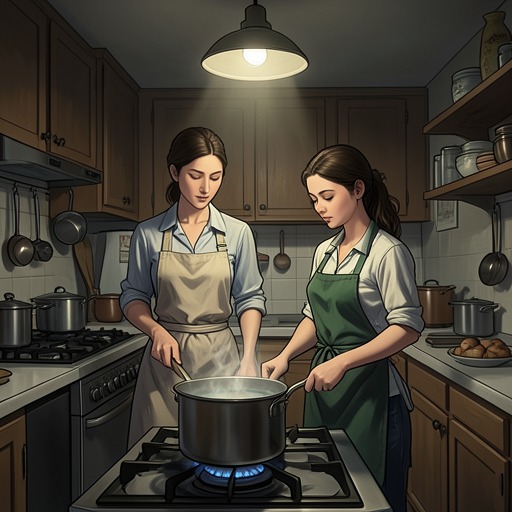
The Family Tradition of the Youngest Daughter Serving Her Mother for Life
Like Water for ChocolateThe Family Tradition of the Youngest Daughter Serving Her Mother for Life is a rule of the De la Garza household that makes the youngest daughter responsible for her mother until the mother’s death. Enforced by Mama Elena and later claimed by Rosaura for Esperanza, it determines who may marry and what future a daughter is permitted to imagine. Tita’s resistance challenges not the value of care itself but its assignment as an unquestionable, lifelong duty.
The Rule and Its Enforcement
When Tita learns that Pedro intends to ask for her hand, Mama Elena tells her that he should not bother: as the youngest daughter, Tita must remain at home to care for her mother. Mama Elena presents the custom as settled across generations and refuses to hear Tita’s attempt to express an opinion. Discussion is not permitted to alter the decision; obedience is expected immediately. The tradition therefore operates not merely as advice about family responsibility but as a household command that forecloses Tita’s choice of marriage.
Tita recognizes how little room the rule leaves for its subject to question it. She wonders who began the custom and what evidence could establish that a youngest daughter is better suited than an eldest to provide care. She also asks what becomes of a daughter who cannot marry or have children, and who will care for a woman who remains unmarried after her mother dies or for a married woman unable to bear children. These questions expose a practical gap in a rule presented as a complete plan for women’s old age: it assigns care to one daughter without accounting for her own future needs. Tita also asks whether the daughter affected by the arrangement has ever been consulted, or whether she is allowed to experience love at all.
Her questions remain unanswered. Mama Elena leaves the kitchen in anger and does not speak to Tita for a week. Tita understands that, in this family, the custom is protected by an expectation of immediate obedience rather than by an explanation that could withstand scrutiny. The rule reaches beyond the choice of a husband: it claims authority over Tita’s voice, her relationships, and the shape of her adult life.
Domestic Labor and the Cost of Duty
The obligation is made tangible by Tita’s daily work. After leaving the ranch, she looks at her hands and struggles to decide what they might do without her mother’s instructions. At home, their tasks had been prescribed from morning to night: lighting the stove, preparing meals, feeding animals, washing dishes, making beds, and ironing clothes. The repeated domestic routine had occupied her days without pausing for her to consider whether she wanted that life. Away from Mama Elena’s command, even choosing how to use her hands feels unfamiliar.
This experience clarifies the distinction between care as work and care as a freely chosen relationship. Tita’s ability to cook and provide for others is real, but the tradition treats that ability as grounds for claiming her future. Her objections focus on the lack of choice and on the custom’s failure to consider the caregiver’s own needs. The rule makes a daughter’s labor serve the household while leaving her personal hopes outside its calculation.
Esperanza and the Inheritance of the Custom
The same expectation threatens to pass from Tita’s generation to Rosaura’s daughter. After Esperanza’s birth, an emergency operation makes it impossible for Rosaura to become pregnant again. Esperanza is therefore her only child, the youngest, and a girl: exactly the position that, under the family custom, designates a daughter to care for her mother for life. Tita refuses Pedro’s suggestion that the child be named Josefita, after her. She asks that the baby be called Esperanza because she does not want Tita’s name to influence the child’s destiny, and she hopes Rosaura will not perpetuate the tradition.
Rosaura nevertheless states the expectation plainly when the young Alex says that he wants to marry Esperanza. She tells him that the girl is destined to stay and care for her mother until Rosaura dies. Tita is appalled that her sister would impose the same obligation on the next generation. The scene turns the custom from a private restriction on Tita into an explicitly inherited future for Esperanza: the girl’s marriage is treated as unavailable before she is old enough to choose it.
The disagreement also shapes Esperanza’s education. Rosaura initially argues that school is unnecessary for a girl whose lot is to care for her mother. In her view, Esperanza should learn piano, singing, and dancing so she can entertain Rosaura and impress guests at society balls. After three long conversations, Pedro and Tita persuade Rosaura to send her to school. Tita supplements that education with what she teaches Esperanza in the kitchen: knowledge of love and life. This compromise does not immediately abolish Rosaura’s claim, but it gives Esperanza learning and forms of knowledge beyond the domestic future prescribed for her.
Resistance and Change
Tita’s opposition becomes decisive when Alex courts Esperanza. Rosaura rejects the match and invokes her rights under the pact she had made with Pedro and Tita. The agreement had required Tita and Pedro to keep their relationship secret and give up having an illicit child, while Rosaura would share Esperanza with Tita: Tita would feed the girl and Rosaura would direct her education. Rosaura was also expected to live with them on friendly terms, without jealousy or complaints. The pact had preserved the appearance of a conventional family, but it had not resolved the conflict between Rosaura’s authority and Tita’s wish to give Esperanza a different life.
Tita and Pedro had already challenged Rosaura’s plans by securing Esperanza’s schooling. Supporting her marriage to Alex brings the conflict to a head. After three days of violent dispute, Rosaura dies amid her longstanding digestive problems. Tita then helps bring about the marriage, which she regards as her greatest triumph. Esperanza appears at her wedding to Alex confident, intelligent, prepared, and happy. The outcome reverses the future Rosaura had announced to the child: Esperanza marries rather than remaining assigned to lifelong service.
The tradition is thus shown across two generations as a mechanism for converting kinship into compulsory succession. Mama Elena invokes it to deny Tita marriage; Rosaura attempts to repeat that denial with Esperanza. Tita’s challenges—first in questioning the rule and later in defending Esperanza’s education and marriage—interrupt its transmission. The ending does not suggest that family care has no value. Instead, the contrast between imposed service and Esperanza’s achieved freedom makes the central issue the right of a daughter to have a future not decided for her by birth order.