The Revolutionaries’ Visit to the Ranch
Like Water for ChocolateThe Revolutionaries’ Visit to the Ranch tests Mama Elena’s command of her household against the armed authority of the Mexican Revolutionary Army. Expecting danger, she meets the soldiers with a shotgun and refuses them entry; they leave peacefully after taking food from the ranch. The encounter’s quiet reversals matter as much as its confrontation: Mama Elena misjudges the soldiers, the captain fails to recognize her connection to Gertrudis, and neither side discovers everything the other has kept hidden.
Background and Stakes
The visit takes place amid scarcity and recent upheaval. A few days earlier, the revolutionary army had come to the ranch, and only a small number of animals survived. The household is now making sausage from a pig, along with salt pork, ham, bacon, and lard, to preserve as much food as possible. The animals are not merely provisions: with food short, the ranch has had to kill livestock, and its manager, Nicholas, has gone to buy cattle to replace them.
The household is also waiting for news. Nicholas has taken trusted workers with him, while his son Felipe has been sent to San Antonio, Texas, to learn what has happened to Pedro and his family. At the ranch are Mama Elena, Tita, Chencha, and the farmhands Rosalio and Guadalupe. When Rosalio gallops up to report that soldiers are approaching, Mama Elena prepares for a threat she believes may include robbery and violence. Her information has come from Father Ignacio and the mayor of Piedras Negras, whose reports describe revolutionaries entering homes and harming the people inside. She orders Tita, Chencha, and the pig into the cellar, while she prepares to defend the house and conceal its valuables.
Mama Elena's Stand
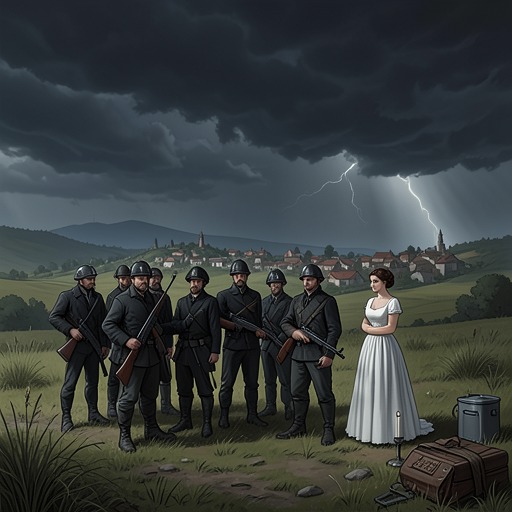
Mama Elena meets the troops at the house entrance with Rosalio and Guadalupe beside her and the shotgun hidden in her petticoats. The captain asks whether she owns the ranch and explains that the soldiers have come to ask her to support their cause. She offers them provisions from the corn crib and stable, but draws a firm boundary around the house and its contents. The captain jokes by addressing her as a general, and the soldiers laugh; his response, however, does not make her limit any less serious.
The search outside produces little: some corn and eight chickens. A sergeant, dissatisfied with the result, asks to enter the house, but Mama Elena refuses again. When he begins toward the door carrying the chickens, she raises the shotgun and shoots them. Rosalio and Guadalupe draw their pistols, while a soldier near the captain appears ready to shoot her. The captain stops him. Mama Elena then warns the captain that she can shoot him before his men kill her and insists that mutual respect is the best course. Her threat puts the immediate question of authority plainly before him: he can order force, but she has made the cost of entering the house unmistakable.
The captain answers by acknowledging her courage and ordering his soldiers not to enter. His men are affected by Mama Elena’s gaze, which the narration associates with the fear of maternal authority. The encounter therefore turns on more than the gun: the captain’s soldiers have arrived expecting to search a vulnerable household, but Mama Elena makes them confront the resolve of its owner. Her command protects the house, even as she allows the soldiers to take what they find elsewhere on the property.
The Search and Departure
The soldiers find another source of food in The dovecote, formed beneath the slopes of the roof of the enormous house. Reaching it requires a twenty-foot ladder. The men who climb up are struck by its scale and by the gathered doves; they close its door and windows so the birds cannot escape, then capture enough to feed the battalion for a week. The episode turns the household’s architecture into part of the encounter: the house itself remains off limits, but its roof shelters a resource the soldiers can claim.
Before leaving, the captain rides around the back patio and pauses at the scent of roses. He asks Mama Elena about her daughters. She tells him that the oldest and youngest live in the United States and that the other has died. The news moves him, and he expresses sorrow. He then bows and takes his leave. The troops depart peacefully, contrary to the picture of ruthless intruders that Mama Elena had expected; afterward, she no longer voices an opinion about the revolutionaries.
That apparent settlement is incomplete. The captain is Juan Alejandrez, the same man who carried off Gertrudis months earlier, but Mama Elena never learns his identity. He, for his part, remains unaware of the chickens hidden behind the house. Before the soldiers arrived, the household had killed twenty and preserved them buried in ashes. Stuffed with ground wheat or oats and kept in a tightly covered glazed earthenware pot, they could last more than a week. This established ranch practice completes the encounter’s double concealment: the soldiers leave with the pigeons they found, unaware that food remains hidden just beyond their search.
Consequences and Significance
The visit exposes the difference between Mama Elena’s expectations and what actually happens. She has prepared for intruders who will disregard her household’s boundaries; instead, the captain accepts the limit she sets and orders his men to stay out of the house. Her later silence about the revolutionaries registers the change in her judgment, though it does not undo the danger she anticipated or the force she used to protect her property.
The meeting also places domestic authority inside the revolution’s public conflict. Mama Elena does not hold military rank, but she confronts armed men, sets terms for what they may take, and persuades their commander to enforce her boundary. At the same time, the episode remains shaped by food and labor: scarcity has prompted the ranch to preserve meat, the soldiers requisition what they find, and the hidden stores survive because the household knows how to keep food for later.
The captain’s identity gives the peaceful exchange an irony that neither participant can see. He and Mama Elena speak face to face without her knowing his connection to Gertrudis, while his respectful departure leaves the family history between them undisclosed. Later, Gertrudis returns as a general and tells Tita of her marriage to Juan; after Gertrudis bears a child, Tita reveals the secret of her parentage to protect the marriage. The ranch visit does not itself disclose that secret, but its concealed connection between the captain and the family makes the revolution more than a distant military presence: it has already entered the household’s intimate history.